
Zet AI‑inzichten om in gerichte actie

Trending
Categories
Rolls-Royce Plans Return to Narrowbody Aircraft Engines
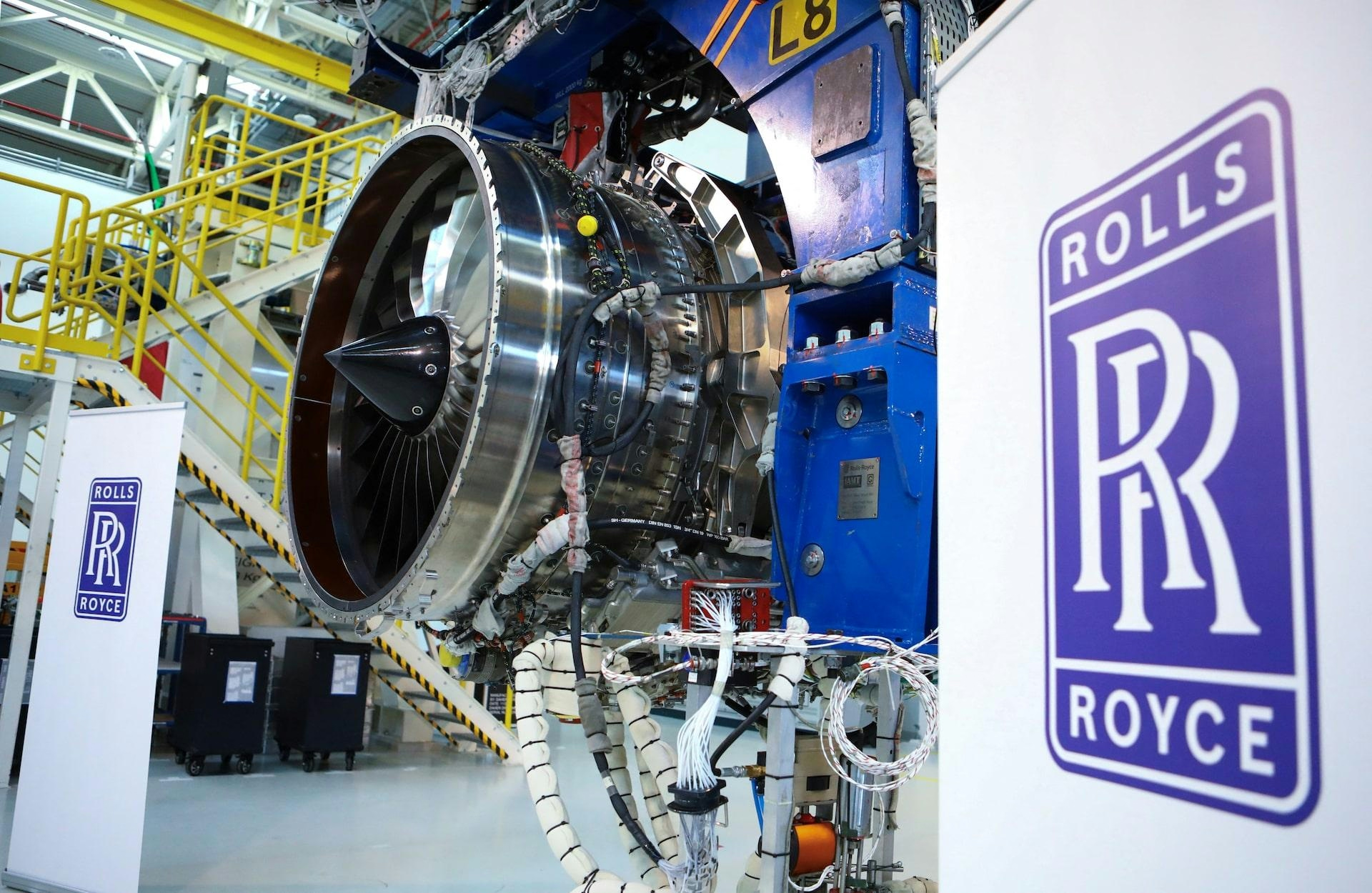
Rolls-Royce Plans Return to Narrowbody Aircraft Engine Market
Rolls-Royce’s 2025 full-year results brought encouraging news for investors, highlighted by a 40% surge in underlying operating profits, improved cash flow, and the announcement of a substantial share buyback program. Beyond these financial achievements and the company’s raised targets for 2028, the most consequential development for the aviation industry is Rolls-Royce’s strategic decision to re-enter the narrowbody aircraft engine market. Unlike previous efforts, the company intends to pursue this opportunity through partnerships rather than independently.
Strategic Significance of Narrowbody Market Re-entry
The narrowbody, or single-aisle, aircraft segment represents the largest volume market in commercial aviation. Industry forecasts from Boeing and Airbus anticipate the delivery of approximately 33,000 single-aisle aircraft globally over the next two decades. Rolls-Royce has remained absent from this market for over ten years, having exited its last major narrowbody program—the V2500 engine produced by the International Aero Engines consortium—during a prior strategic restructuring.
Currently, the narrowbody engine market is dominated by two major players: CFM International, a joint venture between GE and Safran, and Pratt & Whitney. CFM’s LEAP engines power the Boeing 737 MAX and serve as an option for the Airbus A320neo, while Pratt & Whitney’s geared turbofan (GTF) engines are available on the A320neo and are the exclusive choice for the Airbus A220 and Embraer E2 jets. This duopoly has effectively limited opportunities for new entrants, making Rolls-Royce’s renewed interest particularly noteworthy.
In its latest financial report, Rolls-Royce explicitly stated its intention to re-enter the narrowbody market leveraging its UltraFan technology, emphasizing a preference for partnership-based approaches. This declaration signals a firm strategic commitment to shareholders and sends a clear message to the industry about the company’s ambitions.
Challenges and Technological Ambitions
Rolls-Royce’s strong financial position, bolstered by robust profit growth and investor confidence, provides a solid foundation for this ambitious initiative. However, re-establishing a presence in the narrowbody segment will be challenging. The entrenched competitors are unlikely to relinquish market share without resistance, potentially responding with aggressive pricing strategies, accelerated technological innovation, or efforts to secure long-term commitments from airline customers. Such competitive dynamics could intensify market pressures, leading to price wars or accelerated technology development.
Central to Rolls-Royce’s strategy is its UltraFan technology, which promises substantial improvements in fuel efficiency and performance but has yet to reach commercial availability. The company is betting that by combining this technological advantage with strategic partnerships, it can present airlines with a compelling alternative as the next generation of narrowbody aircraft replaces current models such as the A320neo and 737 MAX.
For Rolls-Royce, this move represents more than a market re-entry; it is an attempt to compete for the most significant segment in commercial aerospace. The coming years will determine whether its technological innovation and collaborative approach can overcome established rivals and reshape the narrowbody engine market.

Etihad Airways Suspends Airbus A380 Flights on Key Route

Aditya Birla Group Seeks Approval for Aircraft Leasing in GIFT City

Qatar Airways Highlights Innovation and Connectivity at Arabian Travel Market 2026

Hong Kong's Five-Year Plan Includes Andrew Fan's Aircraft Parts Processing Hub Proposal

ACIA Aero Leasing Delivers ATR72-600 to Air Nostrum

RTX Appoints Jill Albertelli as Head of Pratt & Whitney

TAT Technologies Joins Beyond Aero Hydrogen Aircraft Program

AURAK Study Highlights Barriers to Air Taxi Adoption in Emerging Economies

Xiamen Air Selects Altitude for 787 Maintenance at Heathrow

Etihad and Swissport Extend Global Partnership
