
Zet AI‑inzichten om in gerichte actie

Trending
Categories
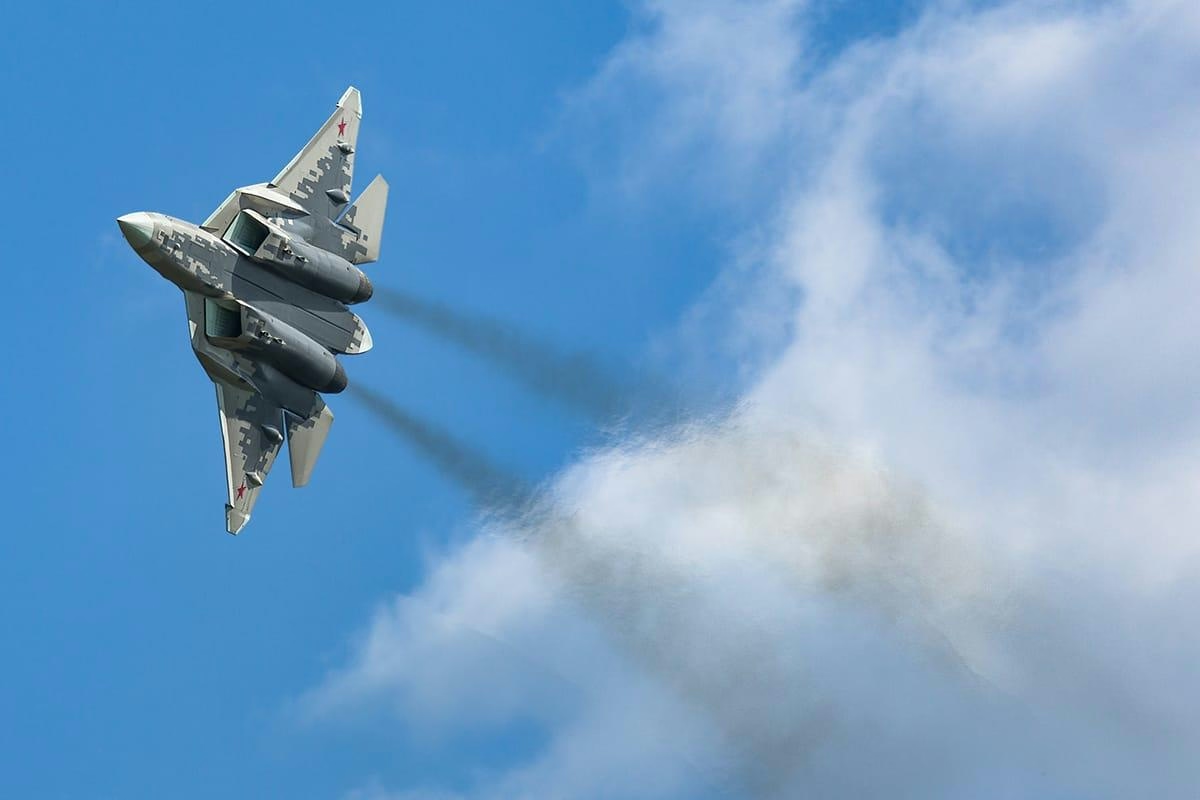
Russia Announces Combat AI Integration in Su-57D Fighter Jet
Russia Announces Combat AI Integration in Su-57D Fighter Jet
On August 14, 2026, the Russian state news agency TASS reported that the newly developed two-seat Su-57D stealth fighter will serve as a test platform for combat artificial intelligence (AI) currently under development at the Sukhoi Design Bureau. This announcement was made by Mikhail Strelets, director of Sukhoi, during an interview on the state-run Zvezda television program Military Acceptance. While the information originates from Russian state sources, independent verification remains limited. Nonetheless, it is confirmed that Russia has constructed and flown a two-seat Su-57D, with the second cockpit reportedly designed for drone command functions.
Development and Flight Details
The Su-57D is a two-seat variant of the Su-57 (NATO reporting name: Felon), with its maiden flight occurring on May 19, 2026, at the Komsomolsk-on-Amur Aircraft Production Association (KnAAZ). The flight lasted approximately 40 minutes and was piloted by Sergei Bogdan, Sukhoi’s chief test pilot. The aircraft is a modified early T-50 prototype featuring a tandem two-seat cockpit beneath an elongated canopy, with the rear seat elevated relative to the front. This configuration is intended to facilitate roles such as combat training, airborne strike coordination, and control of unmanned combat aerial vehicles (UCAVs).
In November 2023, United Aircraft Corporation filed a patent for this twin-seat Su-57 design, emphasizing its focus on UAV coordination. The rapid progression from patent filing to first flight—less than 30 months—demonstrates the program’s accelerated development pace. However, no independently verified photographs of the Su-57D have been publicly released to date.
Combat AI and Operational Intentions
According to Mikhail Strelets, the addition of a second operator’s cockpit enables the implementation of advanced sixth-generation technologies, specifically the control of unmanned aerial vehicles from an airborne command post. The Su-57D is intended to operate in conjunction with the S-70 Okhotnik-B heavy UCAV and potentially manage drone swarms or group systems. While TASS paraphrased these capabilities, no detailed information has been provided regarding the AI’s architecture, autonomy levels, operational timelines, or decision-making authority.
Independent defense analysts urge caution, interpreting these claims as developmental objectives rather than confirmed operational capabilities. It is also important to clarify personnel roles: Mikhail Strelets serves as Sukhoi’s bureau director, while Sergei Bogdan is the test pilot, a distinction sometimes confused in social media discussions.
Strategic Context and Global Implications
Russia’s announcement emerges amid intensifying global competition in military AI integration. The United States Air Force has already demonstrated AI-controlled fighter intercepts with the X-62A, while Western defense contractors such as Lockheed Martin Skunk Works continue to advance sensor-driven autonomous systems. These developments underscore a growing technological rivalry between Russia and Western nations, with significant implications for the global defense market.
Countries like India are actively seeking participation in advanced fighter programs, including France’s Future Combat Air System (FCAS), to maintain technological parity. Concurrently, Ukraine’s efforts to develop autonomous strike capabilities highlight a broader trend of nations investing heavily in AI-driven military technologies to counter Russian advances.
While the Su-57D program signals Russia’s ambition to integrate AI into air combat, its actual capabilities remain to be independently verified. The accelerating global race for combat AI integration is poised to reshape the future landscape of aerial warfare.

Etihad Airways Suspends Airbus A380 Flights on Key Route

Aditya Birla Group Seeks Approval for Aircraft Leasing in GIFT City

Qatar Airways Highlights Innovation and Connectivity at Arabian Travel Market 2026

Hong Kong's Five-Year Plan Includes Andrew Fan's Aircraft Parts Processing Hub Proposal

ACIA Aero Leasing Delivers ATR72-600 to Air Nostrum

RTX Appoints Jill Albertelli as Head of Pratt & Whitney

TAT Technologies Joins Beyond Aero Hydrogen Aircraft Program

AURAK Study Highlights Barriers to Air Taxi Adoption in Emerging Economies

Xiamen Air Selects Altitude for 787 Maintenance at Heathrow

Etihad and Swissport Extend Global Partnership
