
Zet AI‑inzichten om in gerichte actie

Trending
Categories
Schiphol Uses Technology and AI to Improve Airport Capacity and Flow
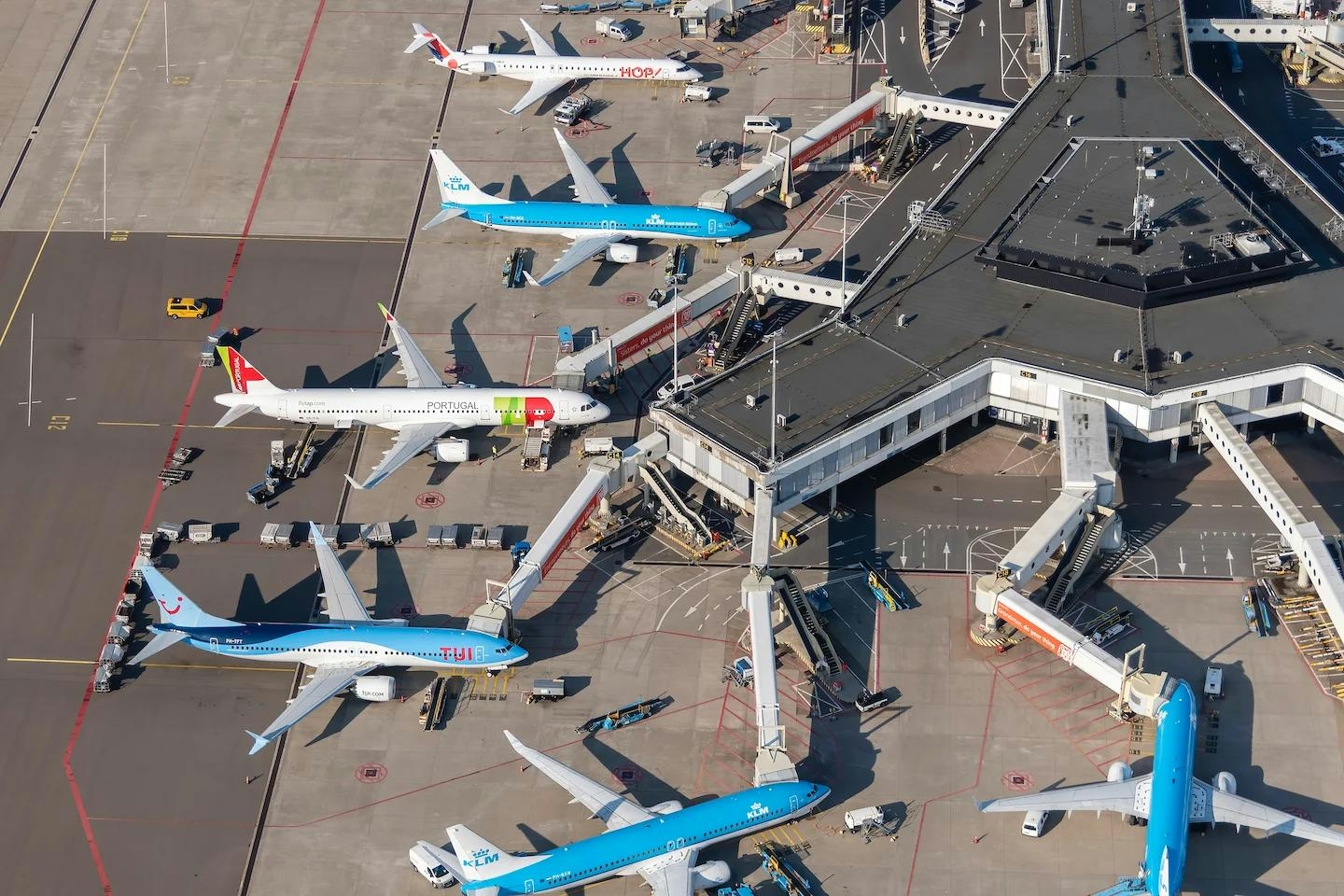
Schiphol Uses Technology and AI to Improve Airport Capacity and Flow
Royal Schiphol Group is pursuing an ambitious vision to transform the airport experience by 2030, aiming to deliver a seamless passenger journey with minimal waiting times. As a Corporate Partner of the FTE Digital, Innovation & Startup Hub, Schiphol is harnessing advanced technology, data analytics, and design principles to better align demand with capacity, reduce congestion, and enhance both customer satisfaction and operational efficiency.
Innovative AI-Driven Solutions
In preparation for his presentation at FTE Global—the aviation industry’s equivalent of CES—scheduled for September 2025 in Long Beach, California, Martijn van Boven, Product Manager at Royal Schiphol Group, outlined how the airport is deploying proprietary AI-powered tools to revolutionize its operations. Van Boven emphasized that a genuine passenger experience begins with operational excellence rather than superficial features. He highlighted key innovations such as Dynamic Time Slots, Real-time Passenger Flow Balancing, and Gate Planning Insights, which have collectively reduced peak loads and waiting times while improving safety and efficiency.
Dynamic Time Slots allow passengers to pre-book preferred security check times through Schiphol’s app or website. Using intelligent algorithms, the system dynamically allocates these slots based on flight schedules, planned capacity, and historical data. This approach has successfully shifted an average of 7.5% of passengers away from peak periods, increasing to 22% on critical days, resulting in 99.6% of travelers waiting less than ten minutes at security checkpoints.
On the day of travel, Flow Balancing leverages real-time sensor data, predictive modeling, and simulations to guide passenger groups by flight or time window. This digital twin methodology prevented over 4,000 minutes of crowding in 2024 alone, smoothing passenger movement throughout the terminal.
Gate Planning Insights employs machine learning to optimize gate assignments and turnaround operations, providing airport operators with enhanced control, predictability, and safety through data-driven decision-making.
Van Boven explained that the overarching goal is to create a passenger journey free of waiting times by perfectly synchronizing demand and capacity and dynamically managing passenger flows. This seamless experience often operates unnoticed by travelers, underscoring the subtle yet powerful role of technology.
Challenges and Industry Implications
Despite these technological advancements, Schiphol faces several challenges in integrating AI and digital solutions. Ensuring seamless compatibility with existing airport systems is critical to prevent operational disruptions. Additionally, the initial investment and ongoing costs associated with AI deployment require careful financial oversight. There are also concerns among staff regarding potential job displacement due to increased automation, which the airport must address sensitively.
Nevertheless, the market response has been positive, with growing investor confidence in Schiphol’s ability to enhance operational efficiency. Competitors are closely observing these developments and are expected to accelerate their own AI investments to remain competitive.
Schiphol’s ongoing innovation exemplifies how the strategic application of data, design, and artificial intelligence can quietly yet profoundly reshape the airport experience, setting a new benchmark for European aviation.

Etihad Airways Suspends Airbus A380 Flights on Key Route

Aditya Birla Group Seeks Approval for Aircraft Leasing in GIFT City

Qatar Airways Highlights Innovation and Connectivity at Arabian Travel Market 2026

Hong Kong's Five-Year Plan Includes Andrew Fan's Aircraft Parts Processing Hub Proposal

ACIA Aero Leasing Delivers ATR72-600 to Air Nostrum

RTX Appoints Jill Albertelli as Head of Pratt & Whitney

TAT Technologies Joins Beyond Aero Hydrogen Aircraft Program

AURAK Study Highlights Barriers to Air Taxi Adoption in Emerging Economies

Xiamen Air Selects Altitude for 787 Maintenance at Heathrow

Etihad and Swissport Extend Global Partnership
