
Zet AI‑inzichten om in gerichte actie

Trending
Categories
Seven Airlines Operating the Longest Boeing 737 MAX Flights in 2026
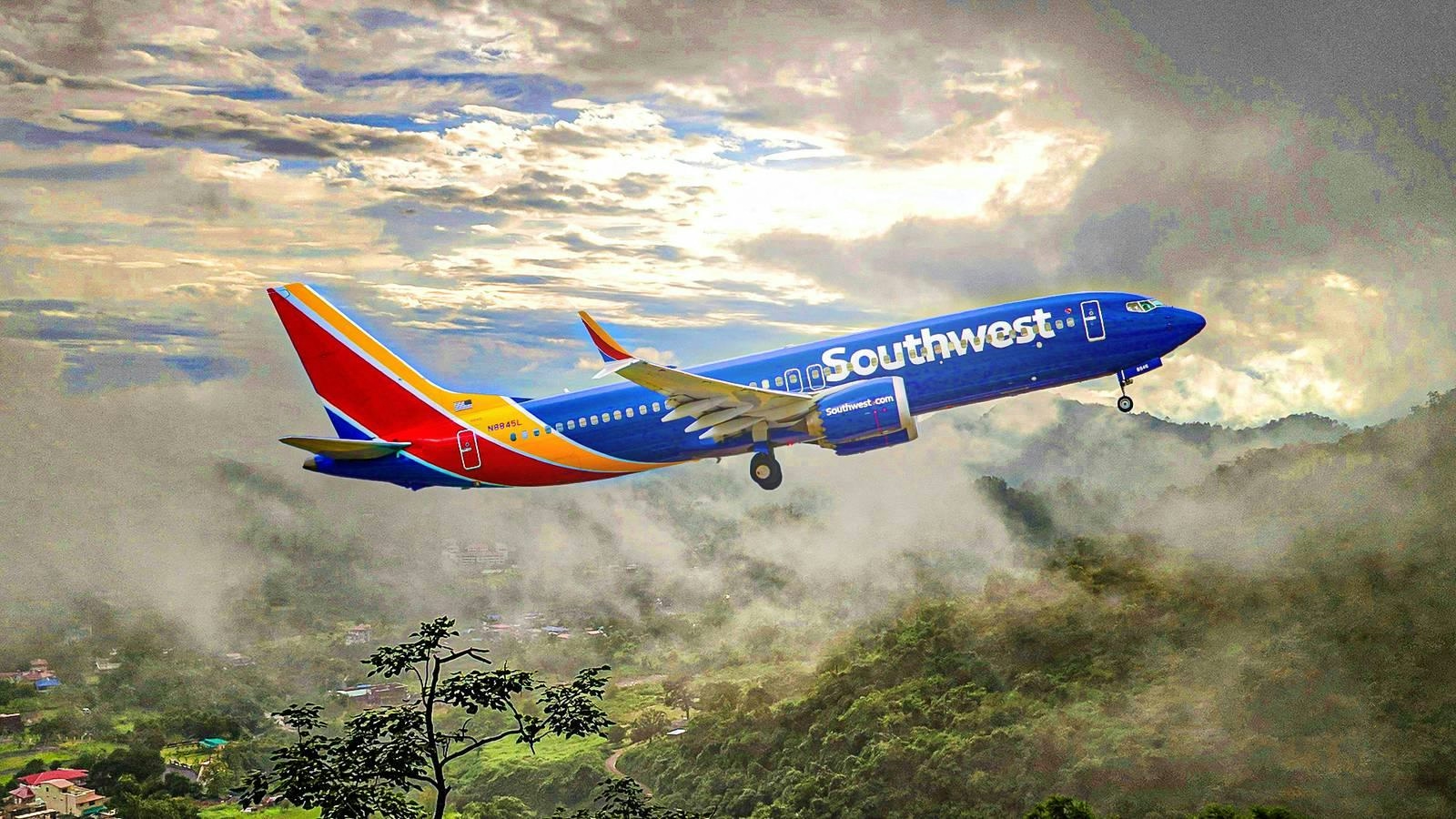
Seven Airlines Operating the Longest Boeing 737 MAX Flights in 2026
Boeing’s 737 MAX family, developed as the successor to the 737 Next Generation series, comprises four variants: the MAX 7, MAX 8, MAX 9, and MAX 10. Currently, only the MAX 8 and MAX 9 are in active service, while the MAX 7 and MAX 10 await FAA type certification. This delay is a direct consequence of the 2018 and 2019 MAX crashes, which prompted rigorous regulatory scrutiny of Boeing’s MCAS software and production processes. The resulting heightened oversight and quality control measures continue to influence the program’s development and delivery timelines.
The MAX 8 offers a maximum range of up to 3,500 nautical miles (4,027 miles/6,480 km), with the longer MAX 9 variant capable of flying up to 3,300 nautical miles (3,450 miles/6,110 km). These extended ranges represent an increase of approximately 700 nautical miles over previous models, enabling airlines to operate longer routes that were previously impractical for single-aisle aircraft.
Longest Scheduled Boeing 737 MAX Flights in 2026
According to aviation analytics firm Cirium, seven airlines will operate the longest scheduled Boeing 737 MAX flights in 2026. Each airline is represented by its single longest route to illustrate the diversity of operators utilizing the aircraft’s extended capabilities.
Mauritania Airlines, the national carrier of Mauritania, operates a modest fleet that includes one 737 MAX 8. Its longest route connects Nouakchott, the capital, to Medina in Saudi Arabia, covering 3,592 miles (5,780 km). This route primarily serves religious pilgrims traveling to Islamic holy sites, with a limited schedule of five flights in each direction and a total seating capacity of 800. The service highlights the MAX 8’s potential to open new long-haul markets for smaller carriers.
Alaska Airlines, the fifth-largest U.S. airline and a significant Boeing 737 operator, maintains a fleet of 252 Boeing 737 aircraft, including 18 MAX 8s and 80 MAX 9s. Its Seattle to Reykjavík route, spanning 3,622 miles, exemplifies how the MAX’s extended range allows U.S. carriers to connect secondary cities with international destinations, expanding their global reach beyond traditional hubs.
Industry Outlook and Competitive Landscape
Operating ultra-long flights on the 737 MAX presents several challenges for airlines. They must contend with ongoing supply chain disruptions, production quality concerns, and intensified regulatory oversight. In response, Boeing has announced plans, in consultation with the FAA, to increase 737 production rates from 42 to 47 jets per month to meet growing demand.
Market competition is expected to intensify as new variants enter service. Southwest Airlines is preparing to introduce the 737 MAX 7 in 2027, while Virgin Australia anticipates receiving its first MAX 10 aircraft in late 2027. Additionally, carriers such as Arajet are expanding their MAX fleets, with plans to operate 17 jets by the end of the year.
As airlines continue to push the operational limits of the 737 MAX, the industry remains focused on balancing ambitious route expansion with stringent safety, reliability, and regulatory compliance standards. The coming years will be critical in testing Boeing’s production capabilities and airlines’ ability to leverage the MAX’s extended range to capture new market opportunities.

Etihad and Swissport Extend Global Partnership

Sepehran Airlines B737 Returns to Mashhad After Tyre and Engine Issues

Etihad Deploys Widebody Fleet to Meet Strong Demand

Korean Air Finalizes $36.2 Billion Deal with Boeing

Australia’s RFDS Queensland Section Orders Six King Air 260Cs

Korean Air Finalizes Order for 103 Boeing Jets and Engines

Embraer E195-E2 Features Distinctive Engine Placement Among Regional Jets

What Passengers Can Expect on Boeing’s New 777X Jet

How Ethiopian Airlines Became Africa’s Leading Carrier Amid Gulf Competition

Joby Aviation Extends Autonomous Flight Capabilities with Cross-Country Tour
