
Zet AI‑inzichten om in gerichte actie

Trending
Categories
Singapore Airlines Vs. Cathay Pacific: Which Carrier Wins On Transpacific Routes?
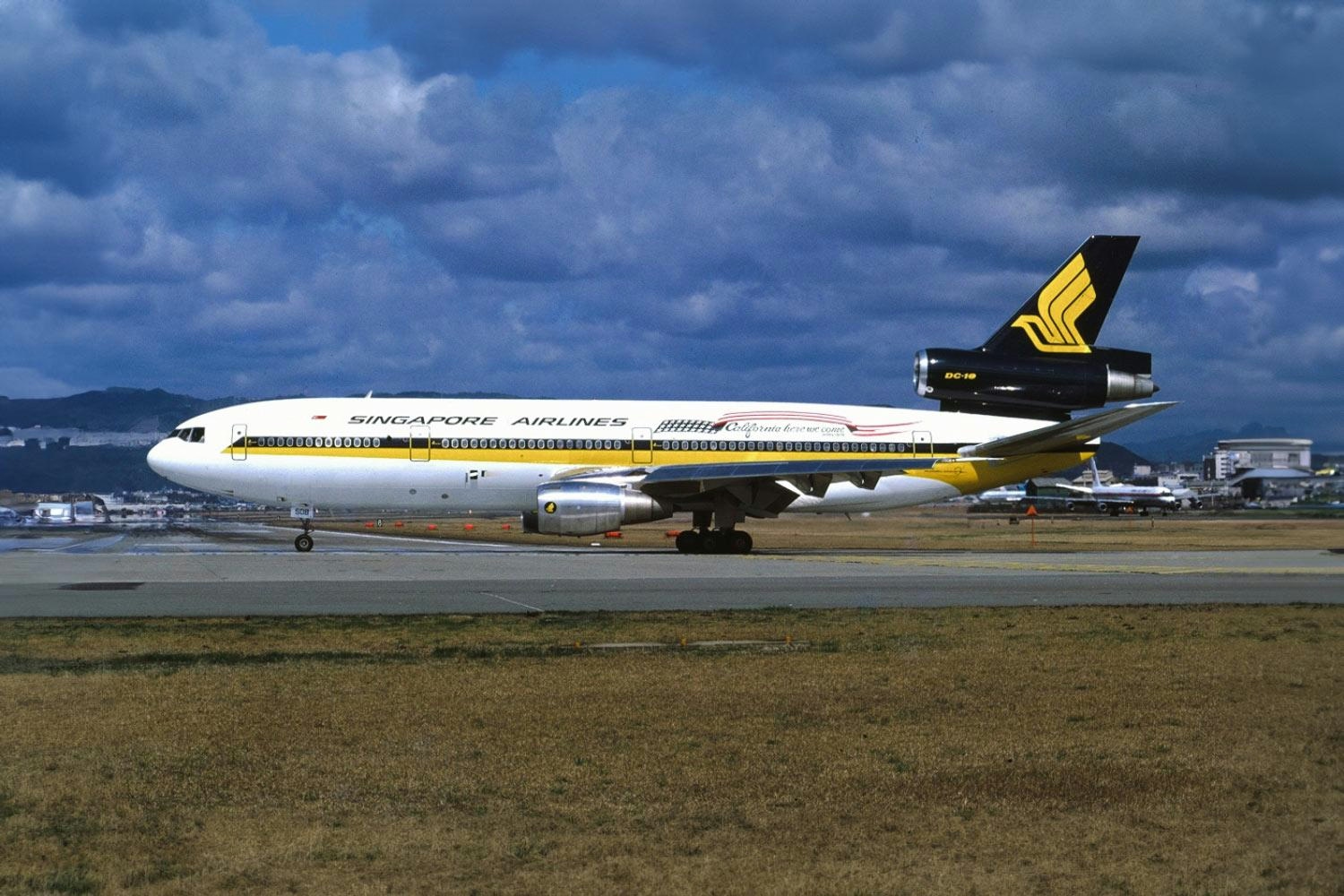
Singapore Airlines vs. Cathay Pacific: A Transpacific Comparison
When considering air travel between the Americas and East Asia, Singapore Airlines and Cathay Pacific consistently emerge as premier carriers renowned for their exceptional service. Both airlines have cultivated strong reputations for quality, yet their approaches to the transpacific market differ significantly. Drawing on Cirium data from November 2025 and recent industry developments, this analysis examines their route networks, fleet compositions, and strategic positioning.
Market Demand and Route Networks
The year 2025 has witnessed a robust resurgence in tourism and air travel to Asia, with passenger volumes reaching unprecedented levels as global travel rebounds post-pandemic. Demand for premium cabins has surged, intensifying competition among leading airlines. Singapore Airlines and Cathay Pacific remain at the forefront of this revival, each leveraging distinct strengths.
Cathay Pacific commands a substantial lead in terms of flight frequency and capacity. In November 2025, the airline is scheduled to operate 884 transpacific flights, more than twice the 370 flights offered by Singapore Airlines. Cathay’s widebody fleet will provide nearly 300,000 seats across the Pacific, compared to Singapore Airlines’ approximately 80,000. Key routes for Cathay include Los Angeles–Hong Kong, Hong Kong–Toronto, and Hong Kong–Vancouver, supplemented by important connections to San Francisco and New York JFK.
Conversely, Singapore Airlines focuses on ultra-long-haul operations, capitalizing on its exclusive use of the Airbus A350-900ULR. This aircraft, configured solely with business and premium economy cabins, is designed for maximum passenger comfort on extended journeys. Singapore Airlines deploys these aircraft on routes such as Singapore–Los Angeles, Singapore–San Francisco, and two of the world’s longest flights: Singapore–New York JFK and Singapore–Newark.
Fleet Composition and Service Excellence
Cathay Pacific’s fleet comprises 30 Airbus A350-900s, 18 A350-1000s, and 35 Boeing 777-300ERs, providing a versatile mix of capacity and range to support its extensive network. Singapore Airlines operates 22 Boeing 777-300ERs alongside a fleet of 65 A350-900s, including the specialized ULR variant. Both carriers have garnered industry accolades: Singapore Airlines is frequently lauded for its cabin crew and first-class offerings, while Cathay Pacific has received recognition for its economy class service and overall value proposition.
Strategic Developments and Sustainability Efforts
The competitive landscape is undergoing notable shifts. Qatar Airways’ recent divestment of its entire $897 million stake in Cathay Pacific signals a strategic realignment that may influence Cathay’s future alliances and market positioning. In response to growing environmental concerns, Cathay Pacific has partnered with Airbus to invest $70 million in sustainable aviation fuel (SAF) initiatives, underscoring its commitment to sustainability and competitive differentiation.
Broader market challenges, including Qantas’s cautious approach to fuel price volatility and geopolitical uncertainties, highlight the complex environment facing transpacific carriers. Both Singapore Airlines and Cathay Pacific are navigating these headwinds while pursuing strategic advantages amid evolving market conditions.
Conclusion
Cathay Pacific leads the transpacific market in terms of capacity and route diversity, whereas Singapore Airlines distinguishes itself through ultra-long-haul comfort and premium service offerings. As both airlines adapt to shifting alliances, sustainability imperatives, and market uncertainties, travelers can anticipate ongoing innovation and competition on these critical international routes.

Etihad Airways Suspends Airbus A380 Flights on Key Route

Aditya Birla Group Seeks Approval for Aircraft Leasing in GIFT City

Qatar Airways Highlights Innovation and Connectivity at Arabian Travel Market 2026

Hong Kong's Five-Year Plan Includes Andrew Fan's Aircraft Parts Processing Hub Proposal

ACIA Aero Leasing Delivers ATR72-600 to Air Nostrum

RTX Appoints Jill Albertelli as Head of Pratt & Whitney

TAT Technologies Joins Beyond Aero Hydrogen Aircraft Program

AURAK Study Highlights Barriers to Air Taxi Adoption in Emerging Economies

Xiamen Air Selects Altitude for 787 Maintenance at Heathrow

Etihad and Swissport Extend Global Partnership
