
Zet AI‑inzichten om in gerichte actie

Trending
Categories
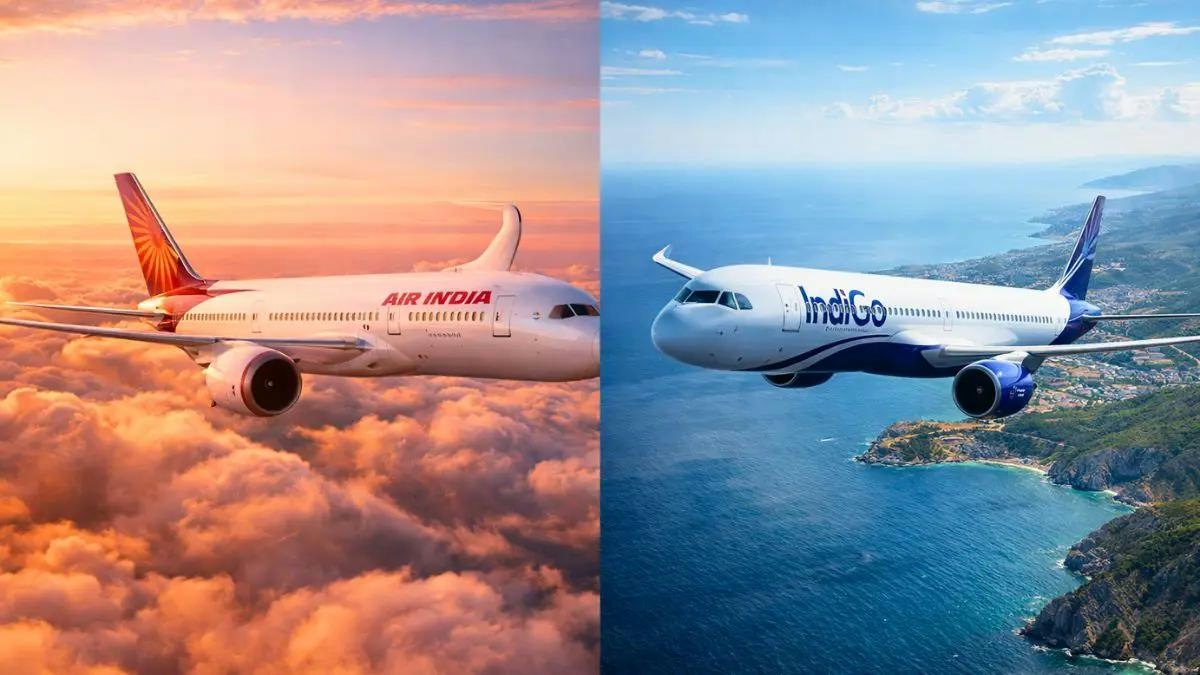
The Battle for the Skies: Air India’s Widebody Bet vs IndiGo’s XLR Gambit
The Battle for the Skies: Air India’s Widebody Bet vs IndiGo’s XLR Gambit
Shifting Dynamics in Indian Aviation
For much of the past decade, the Indian aviation sector has been characterized by a clear division of roles: IndiGo dominated the domestic market through relentless operational efficiency, while Air India, supported by state backing and legacy international routes, maintained its position as a key player on the global stage. As 2026 approaches, this familiar landscape is undergoing a profound transformation. Air India’s post-privatisation phase is evolving from internal restructuring to a visible overhaul of its fleet, while IndiGo is ambitiously extending its reach beyond short-haul dominance into the long-haul international market.
Divergent Fleet Strategies and Market Philosophies
At the core of this emerging rivalry lies a fundamental clash of business philosophies and fleet strategies. Tata Group-backed Air India is committing to a traditional hub-and-spoke model, investing heavily in widebody aircraft to attract premium travelers and provide non-stop intercontinental connectivity. The airline’s introduction of its first post-privatisation “line-fit” Boeing 787-9 Dreamliners marks a significant milestone, enabling Air India to offer a premium product aligned with global standards. This is a critical step in regaining the confidence of international business travelers.
Air India’s strategy focuses on yield management, targeting high-spending corporate and long-haul passengers who prioritize comfort, reliability, and the time savings afforded by direct routes. Equipped with true widebody aircraft featuring lie-flat business class seats, the airline aims to deliver a consistent and premium experience that narrowbody aircraft cannot easily replicate. An industry analyst encapsulated this approach by stating, “Air India isn’t just selling a seat; it’s selling time, comfort, and direct access.”
However, this widebody-centric approach carries inherent risks. The substantial costs associated with acquiring and maintaining larger aircraft, the potential for overcapacity, and the challenge of competing with IndiGo’s expanding long-haul network present significant hurdles. Market responses have been mixed, with some experts describing Air India’s strategy as ambitious yet fraught with risk, particularly given the pressure to maintain high load factors on ultra-long-haul routes.
In contrast, IndiGo is capitalizing on the Airbus A321XLR—a long-range, fuel-efficient narrowbody aircraft—as a disruptive force in the long-haul market. Rather than competing on luxury, IndiGo is reshaping the economics of long-haul flying by deploying aircraft that serve thinner international routes with fewer seats and lower operating costs. This approach mitigates the risk of underfilled widebodies and makes direct flights viable on routes where demand is still emerging.
IndiGo’s aggressive expansion is already visible. The airline recently received its first A321XLR and plans to deploy it on routes such as Athens, signaling a strategic push into new international markets. By leveraging its scale, pricing discipline, and operational efficiency on longer sectors, IndiGo is capturing market share and challenging traditional long-haul models. The carrier is also evolving its product offering, introducing a premium “IndiGoStretch” service designed to attract higher-yield passengers, particularly business travelers seeking enhanced comfort on extended flights.
A High-Stakes Contest for India’s Aviation Future
As Air India and IndiGo pursue markedly different strategies—one betting on the strength of premium widebody aircraft, the other on efficient, direct narrowbody connectivity—the competition for India’s skies transcends mere market share. It has become a high-stakes contest of business models, fleet composition, and the future trajectory of long-haul travel in one of the world’s fastest-growing aviation markets.

Etihad Airways Suspends Airbus A380 Flights on Key Route

Aditya Birla Group Seeks Approval for Aircraft Leasing in GIFT City

Qatar Airways Highlights Innovation and Connectivity at Arabian Travel Market 2026

Hong Kong's Five-Year Plan Includes Andrew Fan's Aircraft Parts Processing Hub Proposal

ACIA Aero Leasing Delivers ATR72-600 to Air Nostrum

RTX Appoints Jill Albertelli as Head of Pratt & Whitney

TAT Technologies Joins Beyond Aero Hydrogen Aircraft Program

AURAK Study Highlights Barriers to Air Taxi Adoption in Emerging Economies

Xiamen Air Selects Altitude for 787 Maintenance at Heathrow

Etihad and Swissport Extend Global Partnership
