
Zet AI‑inzichten om in gerichte actie

Trending
Categories
The Challenge of Developing Sustainable Aviation Fuel
The Challenge of Developing Sustainable Aviation Fuel
Aviation has long been a symbol of human innovation, yet it now represents one of the most pressing challenges in the fight against climate change. Commercial aviation accounts for approximately 2.5% of global annual CO₂ emissions, with its overall climate impact further amplified by contrails and nitrogen oxide emissions. Unlike ground transportation, which can transition to batteries or hydrogen, jet engines require energy-dense fuels such as kerosene, making the sector’s decarbonization particularly complex.
The Importance of Sustainable Aviation Fuel
As international climate targets become more stringent and the aviation industry commits to achieving carbon neutrality by 2050, the search for alternatives to fossil-based jet fuel has become increasingly urgent. Although electric and hydrogen-powered aircraft are under development, current battery technology remains too heavy for most commercial planes, and hydrogen propulsion would necessitate entirely new aircraft designs alongside a global refuelling infrastructure.
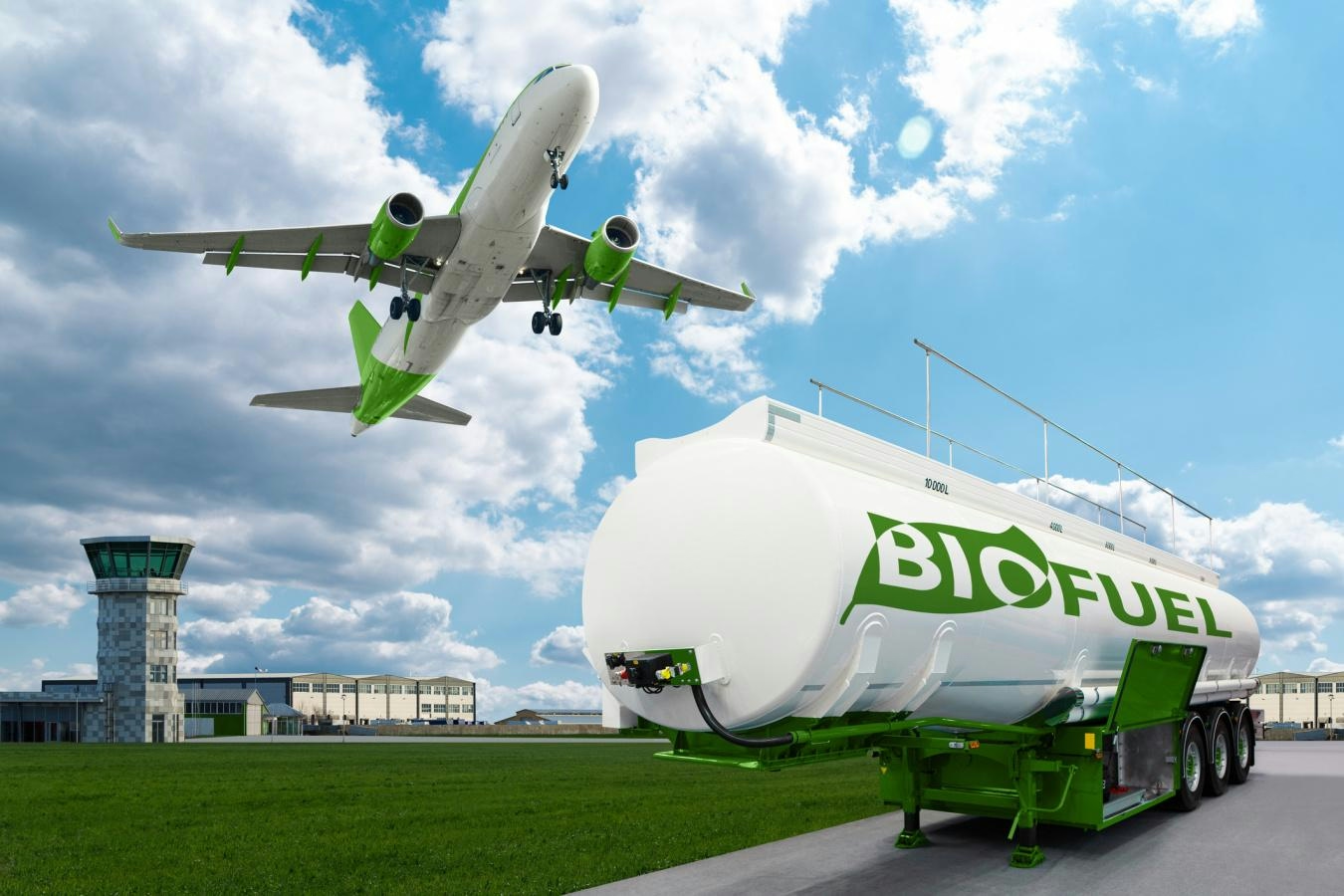
Sustainable Aviation Fuel (SAF) has thus emerged as the most viable near-term solution. Airlines have begun blending small quantities of bio-based SAF—produced from agricultural residues, used cooking oils, and municipal waste—with conventional jet fuel. These blends offer a reduction in emissions compared to fossil fuels. However, the current scale of production and availability of feedstocks are insufficient to meet the demands of the world’s 25,000 commercial aircraft.
Obstacles to Scaling Sustainable Aviation Fuel
The expansion of SAF production faces considerable challenges. The supply of bio-based feedstocks is limited and must be shared with other industries, creating competition for resources. More critically, the infrastructure required for commercial-scale SAF production is underdeveloped, and the costs remain significantly higher than those of conventional jet fuels. The European Union’s proposal to mandate 1.2% of aviation fuel to be electro-sustainable aviation fuel (eSAF) by 2030 is currently under debate, as the capacity for large-scale production has yet to be established. Although over 70 eSAF production facilities are in various stages of development, most depend heavily on private and national investments to proceed.
Despite these obstacles, progress is being made. Companies such as SkyNRG are constructing new SAF production plants, with the first expected to become operational by 2028. Major airlines and energy corporations, including Delta Air Lines and Shell, are forging partnerships to accelerate SAF adoption. Nonetheless, logistical challenges remain, particularly in emerging markets where infrastructure and supply chains are less developed.
The Potential of Electro-Synthetic Aviation Fuel
Electro-synthetic aviation fuel (eSAF) represents a promising innovation that could revolutionize the industry. Produced by combining captured carbon dioxide with green hydrogen generated from renewable electricity, eSAF creates a liquid hydrocarbon fuel that closely resembles conventional jet fuel. This technology has the potential to overcome the limitations associated with bio-based feedstocks and enable scalable, low-carbon aviation fuel production.
Future Outlook
The global market for sustainable aviation technologies is expected to expand rapidly, driven by advancements in electric propulsion, hydrogen engines, and sustainable fuels. However, for SAF and eSAF to realize their full potential, substantial investment and the development of supporting infrastructure are imperative. As the aviation sector strives to meet its climate commitments, the critical challenge remains the scaling of sustainable fuel production to power the future of flight.

Etihad Airways Suspends Airbus A380 Flights on Key Route

Aditya Birla Group Seeks Approval for Aircraft Leasing in GIFT City

Qatar Airways Highlights Innovation and Connectivity at Arabian Travel Market 2026

Hong Kong's Five-Year Plan Includes Andrew Fan's Aircraft Parts Processing Hub Proposal

ACIA Aero Leasing Delivers ATR72-600 to Air Nostrum

RTX Appoints Jill Albertelli as Head of Pratt & Whitney

TAT Technologies Joins Beyond Aero Hydrogen Aircraft Program

AURAK Study Highlights Barriers to Air Taxi Adoption in Emerging Economies

Xiamen Air Selects Altitude for 787 Maintenance at Heathrow

Etihad and Swissport Extend Global Partnership
