
Zet AI‑inzichten om in gerichte actie

Trending
Categories
The FACE Technical Standard for Modular and Open Avionics Systems
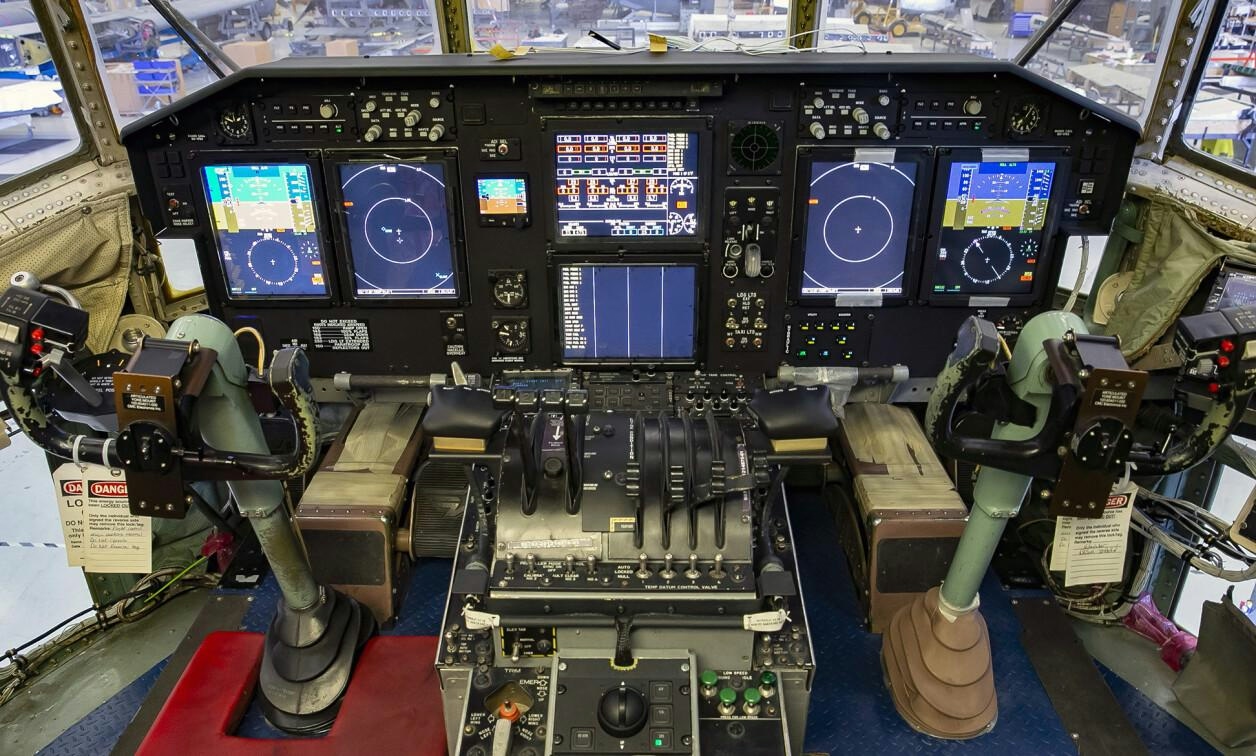
The FACE Technical Standard: Advancing Modular and Open Avionics Systems
The rapid advancement of technology in military and civilian aviation is reshaping the development and deployment of avionics systems. At the forefront of this transformation is the Future Airborne Capability Environment (FACE) Technical Standard. Alongside the Modular Open Systems Approach (MOSA), FACE is establishing a foundation for modern, open, and future-proof software architectures on airborne platforms.
Unlike traditional monolithic and proprietary systems, the FACE Technical Standard advocates for open, modular, and reusable software components. It was developed to address longstanding challenges associated with integrating vendor-specific avionics, which are often costly to maintain and difficult to interoperate. Since 2019, U.S. legislation has mandated that all major defense acquisition programs adhere to MOSA principles. Although Europe does not have a comparable legal requirement, procurement agencies in Germany, France, and Italy are increasingly incorporating modularity into their specifications. Additionally, many NATO countries are exploring ways to align national projects with the FACE standard.
MOSA provides the strategic framework for open, networked, and internationally compatible systems, while FACE delivers the concrete, verifiable software architecture necessary for airborne applications. Complementary standards such as Open Mission Systems (OMS) and the Universal Command and Control Interface (UCI) have also gained traction in both military and civilian aviation sectors. Importantly, these standards are designed to be non-overlapping, allowing platforms to integrate FACE, OMS, and UCI simultaneously, thereby enhancing flexibility and capability.
Technical Architecture of FACE
The FACE Technical Standard structures software into five principal segments: the Operating System Segment (OSS), Transport Services Segment (TSS), I/O Services Segment (IOS), Portable Components Segment (PCS), and Platform-Specific Services Segment (PSS). These segments are interconnected through well-defined interfaces that enable interoperability and modularity.
For instance, the OSS can be implemented by solutions such as Sysgo PikeOS, with guest operating systems like ELinOS operating within a FACE-compliant environment. The standard further delineates three OSS profiles—Security, Safety, and General Purpose—each tailored to meet varying requirements for assurance, certification, and performance by specifying appropriate operating system APIs and features.
Industry Challenges and Market Dynamics
Despite its potential, the adoption of the FACE Technical Standard faces several challenges. Broad industry participation in MOSA consortia is essential to develop genuinely non-proprietary architectures. Fragmented accountability and misaligned incentives within acquisition processes can impede progress. Moreover, the rapid pace of technological change, exemplified by disruptions in inflight connectivity, demands swift adaptation. The emergence of new technologies, such as the Telesat Lightspeed low Earth orbit (LEO) constellation, highlights the necessity for agility, while concerns about declining industrial capacity persist if trends like the artificial intelligence bubble falter.
In response, industry competitors are innovating aggressively. Viasat is developing new antenna systems to compete with SpaceX Starlink and Gogo, while Textron Systems has introduced advanced warhead technology built on a modular open systems approach. These developments underscore the critical role of open standards like FACE in maintaining technological superiority and operational flexibility.
As the aviation sector continues to evolve, the FACE Technical Standard remains a cornerstone for constructing interoperable, modular, and future-ready avionics systems, ensuring that both military and civilian platforms can meet the demands of tomorrow’s skies.

Etihad Airways Suspends Airbus A380 Flights on Key Route

Aditya Birla Group Seeks Approval for Aircraft Leasing in GIFT City

Qatar Airways Highlights Innovation and Connectivity at Arabian Travel Market 2026

Hong Kong's Five-Year Plan Includes Andrew Fan's Aircraft Parts Processing Hub Proposal

ACIA Aero Leasing Delivers ATR72-600 to Air Nostrum

RTX Appoints Jill Albertelli as Head of Pratt & Whitney

TAT Technologies Joins Beyond Aero Hydrogen Aircraft Program

AURAK Study Highlights Barriers to Air Taxi Adoption in Emerging Economies

Xiamen Air Selects Altitude for 787 Maintenance at Heathrow

Etihad and Swissport Extend Global Partnership
