
Zet AI‑inzichten om in gerichte actie

Trending
Categories
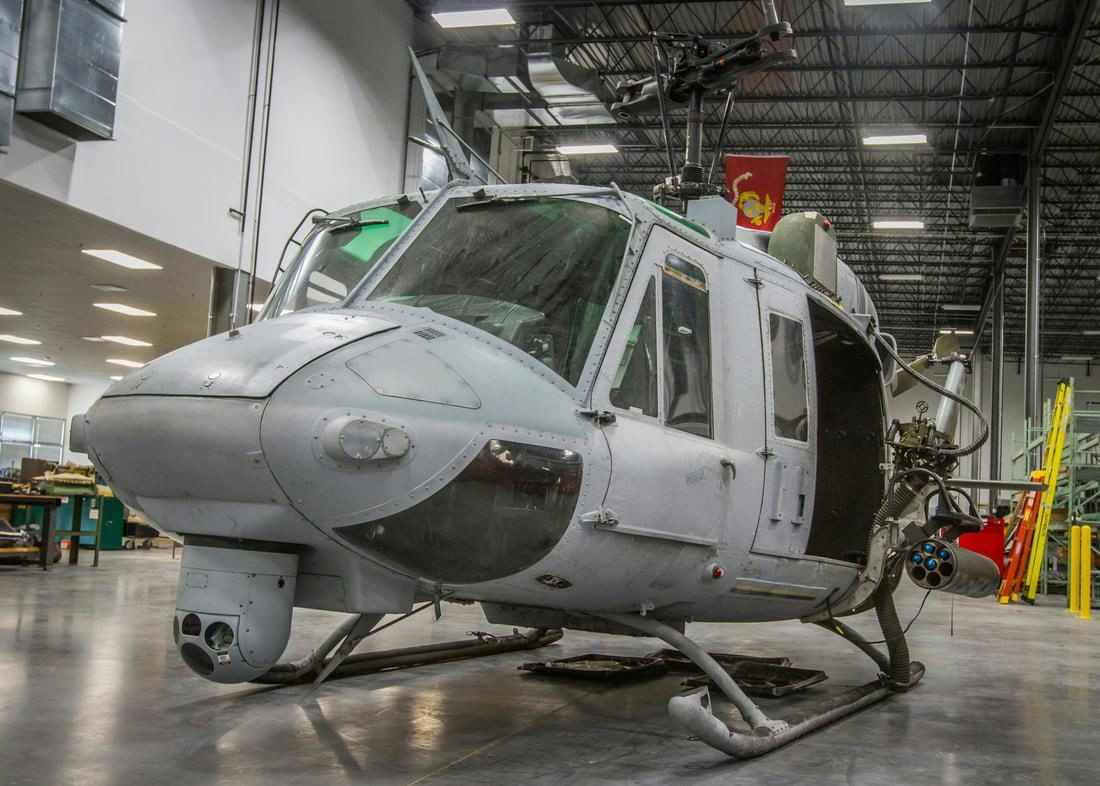
The Small Cold War Helicopter Considered by the Marines for Combat
The Small Cold War Helicopter Considered by the Marines for Combat
The 1950s were a transformative era in aviation, characterized by rapid technological advancements as the world adjusted to the post-World War II landscape. Amid the escalating tensions of the Cold War, the United States military pursued innovative solutions to gain strategic advantages. Among these efforts were pioneering experiments in personal rotorcraft, notably the Hiller YROE-1 Rotorcycle and the Hiller Flying Platform. These early single-person aircraft concepts aimed to revolutionize reconnaissance, personal mobility, and combat tactics.
The Drive for Personal Helicopters
In the aftermath of World War II, the U.S. military identified a critical need for enhanced battlefield mobility. While traditional helicopters had already demonstrated their value, their size and logistical demands limited their deployment in certain combat scenarios. This spurred interest in developing compact, collapsible helicopters capable of rapid, tactical movement, particularly in environments where larger aircraft faced operational constraints.
Hiller Aircraft Corporation, a prominent innovator in rotorcraft technology, undertook two ambitious projects sponsored by the U.S. Navy and the Office of Naval Research: the Hiller YROE-1 Rotorcycle and the Hiller Flying Platform. These designs sought to expand the possibilities of vertical takeoff and landing (VTOL) technology by creating lightweight, portable aircraft for individual use.
The Hiller YROE-1 Rotorcycle
The Rotorcycle was conceived as a small, single-seat helicopter emphasizing portability and ease of operation. Its primary role was envisioned as reconnaissance and liaison for the U.S. Marine Corps rather than direct combat or heavy transport. A distinctive feature of the Rotorcycle was its collapsible frame, which allowed it to be packed for transport or even delivered by parachute to isolated personnel such as downed pilots or small units in the field. This capability promised to provide dispersed forces with unprecedented rapid mobility.
Designed for simplicity, the Rotorcycle could reportedly be piloted by individuals with minimal training—Hiller claimed that a nonpilot could master solo flight after approximately eight hours of instruction. The aircraft cruised at around 52 miles per hour and had an operational range near 40 miles, marking a significant step toward practical personal vertical flight.
Modern Parallels and Continuing Challenges
Although the Rotorcycle never entered active service, its conceptual legacy persists in contemporary efforts to develop agile, deployable aerial platforms. The U.S. Marine Corps continues to investigate advanced technologies such as the Neros Archer unmanned aerial vehicles (UAVs) to enhance battlefield reconnaissance and mobility. However, these modern systems face challenges reminiscent of those encountered in earlier experimental programs. Regulatory constraints imposed by the Federal Aviation Administration complicate scheduling for UAV training ranges, while technical difficulties including communication link losses and mechanical failures remain ongoing concerns.
Simultaneously, the broader aerospace and defense sectors are advancing with programs like the U.S. Army’s Future Long-Range Assault Aircraft and the U.S. Air Force’s Collaborative Combat Aircraft initiative. These developments unfold amid economic uncertainties shaped by internal Federal Reserve divisions and volatile market conditions, factors expected to influence defense procurement and innovation through 2026.
A Legacy of Innovation
While the Hiller Rotorcycle and Flying Platform never saw combat deployment, their development represents a pivotal chapter in the evolution of vertical flight and personal aviation. The enduring pursuit of enhanced battlefield mobility and adaptability continues to drive military innovation, underscoring the relevance of these early Cold War experiments in today’s defense landscape.

Etihad Airways Suspends Airbus A380 Flights on Key Route

Aditya Birla Group Seeks Approval for Aircraft Leasing in GIFT City

Qatar Airways Highlights Innovation and Connectivity at Arabian Travel Market 2026

Hong Kong's Five-Year Plan Includes Andrew Fan's Aircraft Parts Processing Hub Proposal

ACIA Aero Leasing Delivers ATR72-600 to Air Nostrum

RTX Appoints Jill Albertelli as Head of Pratt & Whitney

TAT Technologies Joins Beyond Aero Hydrogen Aircraft Program

AURAK Study Highlights Barriers to Air Taxi Adoption in Emerging Economies

Xiamen Air Selects Altitude for 787 Maintenance at Heathrow

Etihad and Swissport Extend Global Partnership
