
Zet AI‑inzichten om in gerichte actie

Trending
Categories
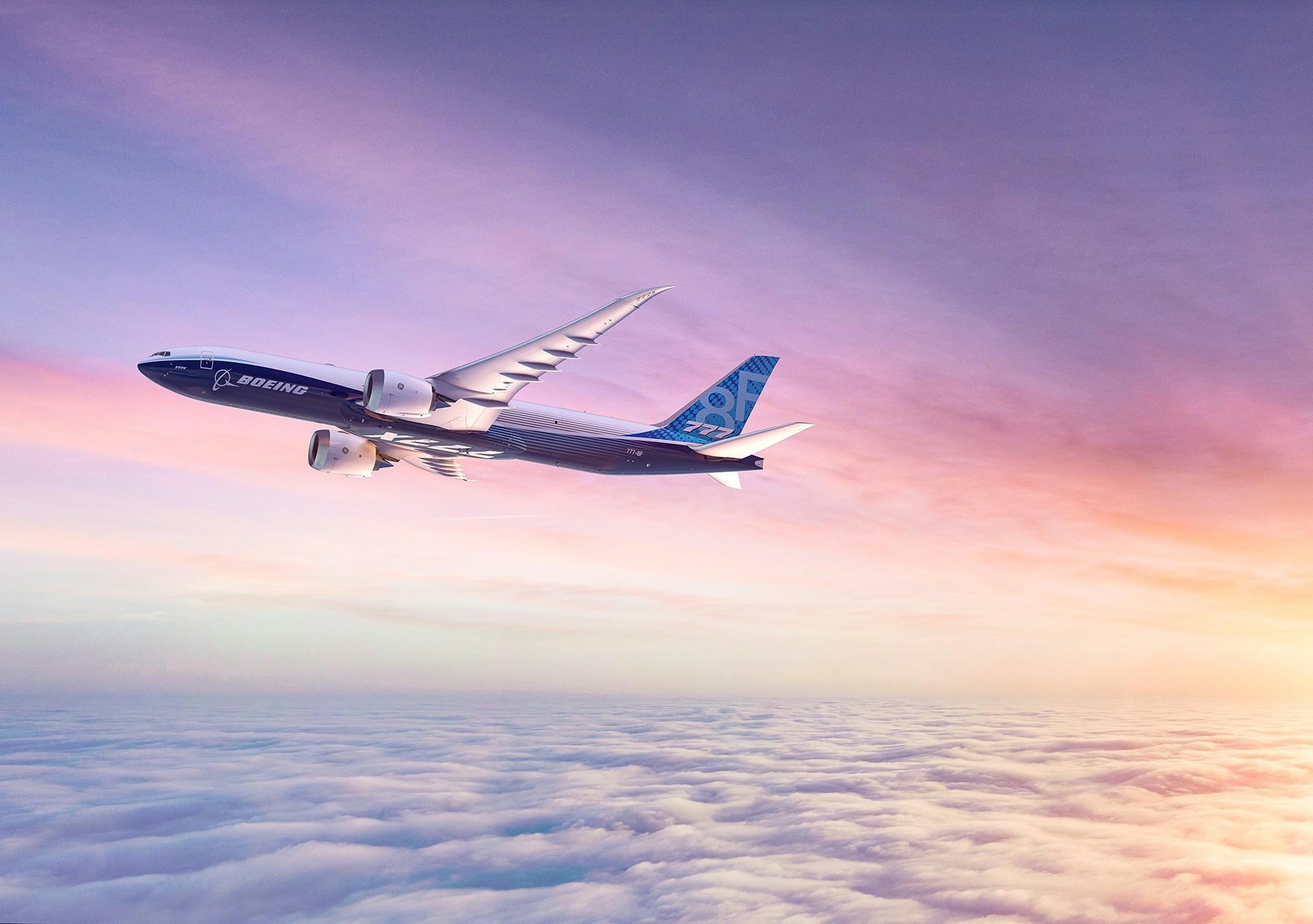
Thirty Years On, the Boeing 777 Remains the Best-Selling Long-Haul Widebody
Thirty Years On, the Boeing 777 Remains the Best-Selling Long-Haul Widebody
Thirty years after its introduction, the Boeing 777 continues to be a pivotal aircraft in the landscape of modern aviation. Since its first delivery in 1995, this twin-engine widebody has revolutionized long-haul travel by setting new benchmarks in airline efficiency and operational economics. Developed in response to the industry’s transition away from older three- and four-engine jets, the 777 combined range, capacity, and fuel efficiency in a way that enabled airlines to offer direct flights between distant cities while significantly reducing operating costs.
Innovation and Market Impact
Boeing’s development of the 777 was marked by close collaboration with airlines to ensure the aircraft met practical operational requirements. This partnership resulted in a design that balanced passenger comfort with cutting-edge technology. The aircraft featured a spacious cabin, advanced avionics, and was powered by the formidable General Electric GE90 engines, which contributed to its rapid acceptance. Major carriers placed substantial orders even before the aircraft’s maiden flight, and by the late 1990s, the 777 had become a staple in international fleets. It effectively replaced older widebody models and enabled airlines to open new routes that were previously uneconomical.
The launch of the 777-300ER variant in the mid-2000s marked a significant evolution for the program. Offering increased seating capacity and extended range, the 777-300ER allowed airlines to operate high-density, long-haul routes with unprecedented efficiency. This model gained particular favor among leading global carriers such as Emirates, Qatar Airways, and Singapore Airlines, whose large orders helped shape the competitive dynamics of the long-haul market. The 777-300ER emerged as a strong competitor to both the Boeing 747 and Airbus A340, delivering comparable capacity while offering substantially lower fuel consumption and maintenance costs.
Sustained Success Amid Emerging Challenges
Over the past three decades, the 777 family has amassed more than 2,400 orders, securing its position as the best-selling long-haul widebody aircraft in aviation history. Boeing’s ability to adapt the 777 program to shifting market demands has been instrumental in maintaining its relevance. However, the aircraft now faces new challenges. Geopolitical tensions, particularly between the United States and China, have begun to affect delivery schedules and order volumes in the critical Asia-Pacific market. The sensitivity of Boeing’s sales to China in the context of U.S. foreign policy introduces a degree of uncertainty into future prospects.
Domestically, competition among U.S. carriers is intensifying. American Airlines has lagged behind Delta and United in expanding its widebody fleet, potentially jeopardizing its share of profitable international routes. Despite these obstacles, Boeing is increasing production rates and is projected to return to net profitability by 2025. The company is preparing to deliver the next-generation 777-9 and new Max variants in 2026, with expectations of a strong first quarter that could mark its highest delivery numbers since 2019.
As the Boeing 777 enters its fourth decade, its legacy as a transformative force in long-haul aviation remains firmly established. The aircraft’s future, however, will depend on Boeing’s ability to navigate evolving geopolitical tensions and intensifying market competition.

Etihad Airways Suspends Airbus A380 Flights on Key Route

Aditya Birla Group Seeks Approval for Aircraft Leasing in GIFT City

Qatar Airways Highlights Innovation and Connectivity at Arabian Travel Market 2026

Hong Kong's Five-Year Plan Includes Andrew Fan's Aircraft Parts Processing Hub Proposal

ACIA Aero Leasing Delivers ATR72-600 to Air Nostrum

RTX Appoints Jill Albertelli as Head of Pratt & Whitney

TAT Technologies Joins Beyond Aero Hydrogen Aircraft Program

AURAK Study Highlights Barriers to Air Taxi Adoption in Emerging Economies

Xiamen Air Selects Altitude for 787 Maintenance at Heathrow

Etihad and Swissport Extend Global Partnership
