Afbeelding

Zet AI‑inzichten om in gerichte actie

Meld je vandaag nog aan voor de AeroGenie-wachtlijst!

Trending

Categories

Wizz Air Receives 200th Airbus A321neo, Highlighting Focus on Innovation and Sustainability
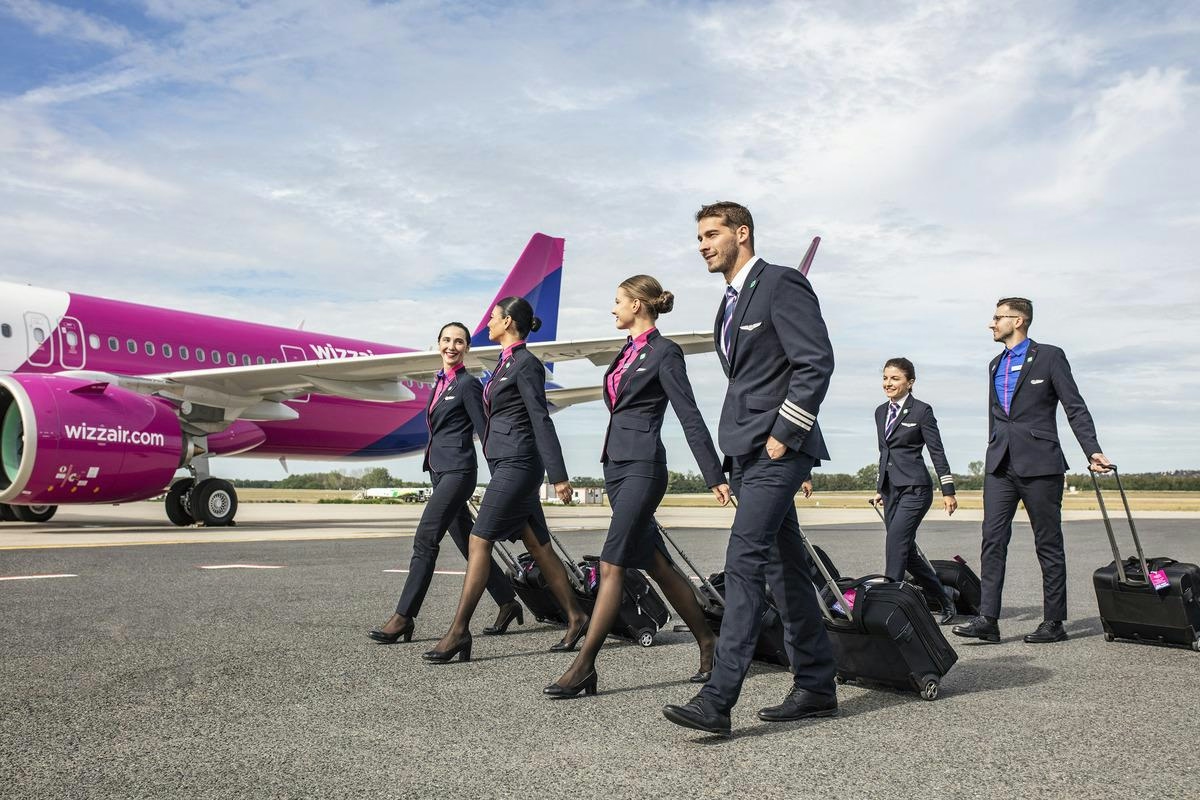
May 13, 2026By ePlane AI
Wizz Air Receives 200th Airbus A321neo, Highlighting Focus on Innovation and Sustainability
0
0
Wizz Air
Airbus A321neo
Sustainability

Wizz Air Marks Delivery of 200th Airbus A321neo, Reinforcing Commitment to Innovation and Sustainability

Wizz Air has reached a significant milestone with the delivery of its 200th Airbus A321neo aircraft, underscoring the airline’s dedication to innovation, sustainability, and affordable air travel. This achievement forms a key part of Wizz Air’s ambitious expansion strategy, which also includes the integration of the Airbus A321XLR, further solidifying its status as a leading low-cost carrier in Europe.

Fleet Expansion and Operational Efficiency

Since introducing its first A321neo in 2019, Wizz Air has rapidly expanded its fleet to include 200 aircraft within the A321neo family. This comprises 186 A321neo, 8 A321XLR, and 6 A320neo models. The modernized fleet supports the airline’s objective to broaden its European network and explore new international routes, while simultaneously enhancing operational efficiency and passenger experience.

The advanced design of the A321neo, featuring increased seating capacity and next-generation Pratt & Whitney engines, has been instrumental in Wizz Air’s growth. These engines offer up to 20% lower fuel consumption compared to previous models, significantly reducing CO₂ emissions per seat and aligning with the airline’s net-zero carbon ambitions. Additionally, the quieter operation of the aircraft helps mitigate noise pollution around airports, benefiting both travelers and local communities.

Challenges and Market Dynamics

Despite the successes, the rapid expansion and reliance on the A321neo have presented challenges. The aircraft model has recently come under scrutiny following tail-strike incidents, leading Airbus to issue revised flare guidance to operators. While these events have raised operational concerns, Wizz Air continues to prioritize safety and is committed to ongoing improvements within its fleet.

Market responses to Wizz Air’s milestone have been cautiously optimistic. The airline’s CEO has addressed industry challenges such as rising fuel prices and supply chain shortages, asserting that there is no imminent crisis for the company. He also acknowledged previous setbacks, particularly in the Abu Dhabi market, but expressed confidence in the airline’s future growth prospects.

Meanwhile, competitors like easyJet are expanding their route networks within the UK, intensifying competition in the low-cost sector. Nevertheless, Wizz Air’s investment in a modern and efficient fleet positions it well to maintain a competitive advantage and fulfill its promise of delivering affordable, sustainable air travel.

As Wizz Air celebrates the delivery of its 200th A321neo, the airline remains focused on leveraging technological advancements to connect more destinations, reduce environmental impact, and provide passengers with a comfortable and efficient flying experience.

More news
IndiGo Flight Makes Emergency Landing at Chennai Airport After Engine Failure

IndiGo Flight Makes Emergency Landing at Chennai Airport After Engine Failure

IndiGo Flight Makes Emergency Landing at Chennai Airport Following Engine Failure An IndiGo flight traveling from Kolkata to Chennai was forced to make an emergency landing at Chennai airport late Tuesday night after experiencing a failure in its left engine shortly before arrival. The aircraft, carrying 224 passengers and crew, declared a full emergency as it approached the airport. Emergency Response and Safe Landing According to officials from the Airports Authority of India (AAI), flight 6E-723 issued the emergency alert at 11:29 pm on August 11, moments before its scheduled arrival at 11:30 pm. Upon detecting the engine malfunction, the pilot promptly informed air traffic control, triggering the airport’s emergency response protocols. The aircraft safely touched down on Runway 25 at 11:37 pm, with all passengers and crew unharmed. The emergency status was officially lifted at 11:47 pm, and airport operations continued without disruption. Implications for IndiGo and the Aviation Sector The incident has caused concern among passengers, who faced anxiety and potential travel disruptions. It has also raised questions regarding IndiGo’s maintenance practices and safety procedures, potentially affecting the airline’s reputation and customer trust. Industry experts suggest that such events often prompt regulatory bodies to conduct thorough reviews or investigations into the airline’s safety standards, which could lead to increased oversight not only for IndiGo but for the broader Indian aviation industry. Competitors may seek to leverage the situation by emphasizing their own safety records to attract wary travelers, potentially impacting market dynamics. Additionally, analysts indicate that the emergency landing could influence IndiGo’s stock performance and may result in insurance claims related to the incident. IndiGo has yet to release a detailed statement explaining the cause of the engine failure or outlining any immediate operational changes. The airline is expected to cooperate fully with ongoing investigations by the relevant authorities.
Ryanair Signs Five-Year Deal with Google Cloud to Expand AI Use

Ryanair Signs Five-Year Deal with Google Cloud to Expand AI Use

Ryanair Signs Five-Year Deal with Google Cloud to Expand AI Use LONDON, Aug 12 – Ryanair has entered into a five-year partnership with Google Cloud to accelerate the deployment of advanced artificial intelligence technologies across its operations. The collaboration will see the airline integrate Google’s Gemini AI suite alongside DeepMind models to enhance crew scheduling, automate operational decision-making, and improve fleet maintenance processes. Strategic AI Integration and Dual-Cloud Approach As Europe’s largest airline by passenger volume, Ryanair plans to implement Google Workspace and Google Cloud services for its 35,000 employees. This initiative supports the airline’s ambitious target of transporting 300 million passengers annually by 2034. The agreement forms part of a broader dual-cloud strategy, complementing Ryanair’s existing use of Amazon Web Services. This approach is designed to bolster infrastructure resilience and reduce the risk of technology outages. “To support this growth, we need to ensure we have excellent infrastructure resilience, and our new dual-cloud strategy provides this, alongside technology partners that match our speed and relentless focus on efficiency,” stated Ryanair CEO Eddie Wilson. Under the terms of the deal, Ryanair will utilize Gemini Enterprise to develop bespoke AI agents aimed at automating decision-making, optimizing crew scheduling, and minimizing operational disruptions. Additionally, the airline will deploy Google DeepMind models such as AlphaEvolve and WeatherNext to refine fleet operations and maintenance planning. Financial details of the agreement have not been disclosed. Industry Implications and Challenges Ahead Maureen Costello, Google Cloud’s vice president for the United Kingdom, Ireland, and Sub-Saharan Africa, emphasized the significance of the partnership: “This agreement demonstrates how deploying generative AI at scale can help industry leaders scale securely, reduce operational costs, and redefine the travel experience.” The aviation sector has increasingly embraced AI technologies to enhance customer service, operational efficiency, and maintenance, according to research by aviation technology provider SITA and the International Air Transport Association (IATA). Airlines are intensifying efforts to improve reliability and competitiveness through technological innovation. Nonetheless, Ryanair faces potential challenges in expanding its AI capabilities. Regulatory constraints and the substantial investment required for advanced technology deployment may affect the speed and effectiveness of implementation. Furthermore, maintaining high customer satisfaction will be critical, particularly as some passengers may express reservations about changes to traditional services. Industry analysts anticipate that competitors will respond by upgrading their own technological infrastructures to remain competitive. As Ryanair advances its digital transformation, the airline’s capacity to balance innovation with operational stability and customer expectations will be closely monitored by the market and industry peers alike.
Archer Shares Rise 14% Following Boeing Agreement

Archer Shares Rise 14% Following Boeing Agreement

Archer Shares Surge 14% Following Strategic Boeing Agreement Shares of Archer Aviation Inc. (ACHR), a developer of electric vertical takeoff and landing (eVTOL) air taxis, rose nearly 14% after the company announced a significant agreement with Boeing. Under the deal, Archer will acquire Boeing’s Wisk Aero, a leader in autonomous flight technology, along with drone manufacturer Insitu and airspace-services provider SkyGrid. This acquisition is poised to enhance Archer’s technological capabilities while providing a stable revenue stream through Insitu, which is already profitable and generates over $200 million annually. This financial boost comes as Archer’s core eVTOL business awaits regulatory approval and commercial launch. Strategic Implications of the Acquisition The addition of Insitu’s established earnings addresses investor concerns about Archer’s current lack of substantial commercial income. While Archer’s air-taxi operations remain in the developmental stage, Insitu’s profitability offers a critical financial foundation. Moreover, the acquisition broadens Archer’s footprint into defense, surveillance, and logistics sectors—markets expected to mature more rapidly than the commercial air-taxi industry. As part of the agreement, Boeing will hold 19.75% of Archer’s Class A shares before the deal closes and will gain the right to appoint a director to Archer’s board. This partnership not only strengthens Archer’s technological and operational capabilities but also aligns it closely with Boeing’s extensive aerospace expertise. Market Reaction Amid Inflation Concerns The announcement triggered a 12% increase in Archer’s stock price, standing out in a market characterized by caution ahead of a key Consumer Price Index (CPI) report. While energy stocks led gains, technology and real estate sectors underperformed amid worries about inflation driven by rising oil prices. The broader market showed signs of softness as investors awaited inflation data that could influence growth prospects. Boeing’s shares have also experienced upward momentum, rising 7.7% in August, while cybersecurity stocks reached record highs, reflecting selective investor optimism. Archer’s enhanced partnership with Boeing positions the company favorably against competitors, even as inflationary pressures continue to temper overall market sentiment. By securing advanced autonomous-flight technology and a reliable revenue source, Archer aims to accelerate its commercial deployment timeline and diversify its business model, establishing itself as a significant player in both emerging urban air mobility and established aerospace sectors.
Archer CEO Suggests Defense Sector Could Address Air Taxi Challenges

Archer CEO Suggests Defense Sector Could Address Air Taxi Challenges

Archer CEO Highlights Defense Sector as Key to Overcoming Air Taxi Market Challenges Archer Aviation is increasingly turning to the defense sector as a strategic avenue to accelerate commercialization and navigate the considerable obstacles facing its electric air taxi ambitions. CEO Adam Goldstein acknowledged the vast potential of the commercial passenger air taxi market but emphasized the difficulty in forecasting the pace and timing of its growth. Defense Sector as a Faster Commercialization Pathway Goldstein pointed out that the defense market offers a more immediate route to market entry. He explained that autonomous products can be launched in military airspace with fewer regulatory hurdles, enabling quicker deployment. This approach is particularly critical for Archer, which continues to report substantial financial losses amid heavy investment in its flagship Midnight air taxi. In the second quarter of 2026, the company posted a net loss of $263.2 million despite a 213% increase in revenue, underscoring the high costs and challenges inherent in the emerging electric air taxi industry. The defense sector, Goldstein believes, could generate revenue and positive cash flow more rapidly, helping to offset Archer’s current burn rate and bridge the gap until its civil air taxi business scales. Central to this strategy are Archer’s recent acquisitions from Boeing, including Wisk’s autonomous-flight technology and Insitu’s profitable defense-drone business. Insitu, which generates over $200 million in annual revenue, provides Archer with an established, revenue-generating operation rather than another development-stage project. Management anticipates that Insitu will contribute significant revenue within a growing defense market and move Archer closer to profitability. Commitment to Air Taxi Vision Amid Strategic Pivot Despite this strategic pivot, Goldstein reaffirmed Archer’s commitment to its core air taxi vision. He stated that the Midnight platform remains central to the company’s long-term plans and that efforts to bring it to market will continue. The defense sector is being leveraged as an earlier commercialization pathway for technologies that will ultimately support Archer’s civil ambitions. One such technology is the Halo Thunder platform, developed in partnership with Anduril. Designed for longer-range and heavier-payload missions than Midnight, Halo Thunder is expected to conduct its first flight next year, with customer deliveries targeted for 2029. The defense variant benefits from a more straightforward military airworthiness certification process, potentially expediting deployment. Market Response and Industry Context The market has responded cautiously to Archer’s defense-focused strategy, reflecting broader challenges within the electric air taxi industry. As the sector transitions from demonstrating technical feasibility to building public trust and securing regulatory approval, competitors such as Joby Aviation are also concentrating on validation and public acceptance. Joby reported $39 million in revenue for the second quarter and raised its 2026 revenue forecast to between $115 million and $125 million, signaling stronger near-term performance and investor confidence. Goldstein summarized Archer’s approach by stating, “Defense does give us a pathway to deploy products faster, and that does come with revenue and learnings.” For investors, Archer’s expansion into defense represents more than diversification; it offers a crucial financial bridge to sustain the company’s pursuit of the much larger, albeit slower-developing, commercial air taxi market.
Anuvu Employs AI to Enhance Global Content Delivery

Anuvu Employs AI to Enhance Global Content Delivery

Anuvu Employs AI to Enhance Global Content Delivery Transforming Inflight Entertainment Through Artificial Intelligence Inflight entertainment (IFE) content processing has traditionally lagged behind consumer video-on-demand services, with new movie titles often arriving on aircraft weeks after their public release. Anuvu, a prominent content service provider headquartered in Lombard, Illinois, is addressing this delay by implementing an artificial intelligence (AI) pipeline that reduces IFE content processing time by 65%. This innovation shortens the typical four-week manual delivery window significantly, while maintaining strict compliance and quality standards. The IFE market is currently experiencing both expansion and increasing complexity. Airlines generally require each title to be available in approximately five dubbing languages and eight subtitle languages, customized for specific routes and markets. With over 900 passenger airlines operating worldwide and hundreds offering some form of IFE, content standards must be managed meticulously on a route-by-route and market-by-market basis. The IFE content market is projected to reach $931 million by 2029, underscoring the growing demand for efficient and scalable content delivery solutions. AI Integration and Industry Implications Anuvu, formerly known as Global Eagle, has laid the groundwork for this transformation by establishing a cloud-based content delivery platform called Open. This system integrates rights management and leverages Amazon Web Services (AWS) as its core infrastructure. The platform processes over 18,000 files per cycle and supports advanced formats such as 4K HD and HDR, catering to next-generation IFE systems. The latest advancement involves the integration of AI tools within the Open ecosystem. Anuvu has introduced two AI-driven solutions: one dedicated to localization tasks, including dubbing and subtitling, and another focused on aviation-specific compliance checks. These tools automate traditionally manual processes, enabling faster turnaround times for new titles and routes while preserving human oversight and audit trail requirements. For instance, a 120-minute movie can now be screened in just 20 minutes, a significant reduction from the three hours previously required by human screeners. The deployment of these AI tools commenced in 2024. Despite these advancements, the adoption of AI in global content delivery presents challenges. Security concerns such as model output over-disclosure and the proliferation of unsanctioned “shadow AI” tools require robust output filtering, governance, and continuous monitoring. Anuvu acknowledges these risks and emphasizes its commitment to maintaining rigorous compliance and quality controls throughout its AI-enhanced processes. The competitive landscape is also shifting as other industry players, including Altana and DoorDash, adapt their logistics and content delivery strategies to incorporate AI technologies. This broader sector-wide transition highlights the importance of maintaining a technological edge for market leaders like Anuvu. Anuvu’s AI-driven approach not only promises operational efficiencies for airlines but also aims to deliver a richer and more timely entertainment experience for passengers. As the IFE market continues to evolve, the integration of advanced AI tools is poised to become a defining factor in the delivery and consumption of inflight content at cruising altitudes.
American Airlines AI rebooks passengers without consent

American Airlines AI rebooks passengers without consent

American Airlines’ AI System Rebooks Passengers Without Consent, Sparking Backlash American Airlines is under intense scrutiny following revelations that its automated rebooking system, known as AURA, has been removing passengers from flights they are still able to board—without their consent. This AI-driven tool, intended to predict missed connections and optimize seat allocation, has instead caused confusion and frustration among travelers who arrive at their gates only to find their seats reassigned. Operational Efficiency at the Expense of Passengers AURA’s predictive algorithms automatically rebook passengers onto later flights if the system anticipates they will miss their connections, even when those passengers arrive on time. High-profile cases, including those of Marc Thiessen and Beverly Hallberg, have brought the issue to light. Both passengers reported being denied boarding despite having confirmed reservations and arriving punctually at the gate. The airline’s emphasis on operational efficiency through automation has compromised passenger certainty and satisfaction, raising questions about the system’s reliability and oversight. Passenger Dissatisfaction and Regulatory Implications The unauthorized rebookings have generated widespread dissatisfaction, with social media platforms flooded by complaints from affected customers. Many have called for improved staffing and enhanced customer service to address the shortcomings of the AI system. This negative publicity threatens to damage American Airlines’ reputation, potentially eroding customer trust and loyalty. Industry experts warn that the airline may face increased regulatory scrutiny and possible legal challenges. According to Department of Transportation (DOT) regulations, passengers who are involuntarily denied boarding despite timely check-in, assigned seats, and arrival at the gate at least 15 minutes before departure are entitled to compensation. This compensation can reach up to $2,150 for delays exceeding two hours and must be provided within 24 hours if not offered at the airport. Failure to comply with these rules constitutes a violation of federal law. Competitive and Industry-Wide Repercussions Rival airlines have begun leveraging American Airlines’ difficulties in their marketing campaigns, seeking to attract dissatisfied customers. Meanwhile, American Airlines faces mounting pressure to increase transparency and improve its customer service protocols in response to the backlash. As the aviation industry increasingly adopts automation and artificial intelligence to enhance operational efficiency, American Airlines’ experience highlights the challenges of balancing technological innovation with passenger care. The airline’s response to this controversy is likely to influence regulatory approaches and consumer attitudes in the coming months.
Air Taxi Company Joby Acquires Resonant Sciences to Expand Defense Operations

Air Taxi Company Joby Acquires Resonant Sciences to Expand Defense Operations

Joby Aviation Acquires Resonant Sciences to Expand Defense Capabilities Joby Aviation has entered into a definitive agreement to acquire Resonant Sciences, a defense technology firm based in Dayton, Ohio, for approximately $500 million. This strategic acquisition represents a significant expansion of Joby’s defense operations, enabling the company to strengthen its presence in national security and advanced aviation technologies. Integration and Strategic Focus Following the completion of the acquisition, Resonant Sciences will operate as Joby’s dedicated defense business unit, maintaining its name and leadership under Co-Founder and CEO J. Micah North. Joby plans to consolidate its existing defense initiatives—including the development of dual-use turbine-electric and hydrogen-electric aircraft, alongside a dual-use autonomy technology stack—within this new unit. This organizational structure will allow Joby’s commercial aviation division to continue focusing on certifying, manufacturing, and commercializing its electric air taxi, while Resonant leads efforts related to defense applications. Founded in 2015, Resonant Sciences employs approximately 250 personnel and specializes in advanced radio frequency (RF) and mission systems tailored for U.S. national security clients. The company’s expertise encompasses low-observability technologies, advanced sensing, electronic countermeasures, communications, and autonomous systems. Resonant’s products are integrated into more than 20 commercial and defense airframes, and the company supports sensitive defense programs through its Facility Security Clearance and accredited facilities. Notably, over 90 percent of its workforce holds security clearances, enabling the execution of classified programs at scale. Opportunities and Challenges Ahead The acquisition is expected to open significant opportunities in adjacent markets. A key early objective will be the integration of Joby’s dual-use autonomy stack with Resonant’s RF sensing and signal-processing capabilities. This collaboration aims to accelerate the development of software-defined autonomous systems tailored for defense customers. Both companies anticipate delivering differentiated mission systems and platform solutions that address next-generation defense requirements, particularly as the sector increasingly shifts toward autonomous, cost-efficient aircraft equipped with advanced sensing and resilient communications. Resonant currently operates approximately 105,000 square feet of engineering, integration, testing, and manufacturing space across seven buildings in Dayton, with a new 125,000-square-foot facility under construction. The company also maintains facilities in Virginia, West Virginia, Michigan, Colorado, and North Carolina. Combined with Joby’s 768,000 square feet of facilities in Ohio, the expanded campus will offer nearly one million square feet of manufacturing and testing space in the Dayton region, establishing a major hub for advanced aviation and defense technology. Despite the promising outlook, Joby faces considerable challenges in integrating Resonant’s established and often classified programs into its operations. Navigating complex security protocols and organizational structures will require careful management. Additionally, the merger presents cultural and technological integration hurdles, with industry observers expressing skepticism about the seamless blending of the two companies’ distinct backgrounds. Competitors may respond by increasing investments in defense technologies or pursuing their own strategic partnerships and acquisitions to counter Joby’s enhanced capabilities. Nonetheless, Joby’s acquisition of Resonant Sciences marks a decisive step toward diversifying its business and capitalizing on the growing demand for advanced autonomous defense platforms, while reinforcing Dayton’s status as a center for aerospace innovation.
Airbus Tests Uncased Engine Fan on A380, Raising Noise and Safety Concerns

Airbus Tests Uncased Engine Fan on A380, Raising Noise and Safety Concerns

Airbus Tests Uncased Engine Fan on A380, Raising Noise and Safety Concerns Airbus is repurposing the first A380 ever built into a flying laboratory to test CFM International’s innovative exposed-blade Open Fan engine, marking a pivotal advancement in next-generation aircraft propulsion. The double-deck superjumbo, designated MSN001, will support a comprehensive flight test campaign based in Toulouse, scheduled to commence before the end of the decade. This initiative aims to validate the Open Fan’s potential to reduce fuel consumption and carbon dioxide emissions by more than 20% compared to the most efficient engines currently in service. At the Farnborough International Airshow on July 21, 2026, Airbus and CFM revealed the A380 Flight Lab’s new livery and announced the completion of the initial conceptual flight-test design review. While the project’s ambitious efficiency goals are promising, the Open Fan must overcome significant technical challenges, including meeting rigorous standards for safety, noise, durability, and integration before it can be considered viable for commercial deployment. The A380 as an Optimal Test Platform The selection of the A380 as the testbed for this technology is a strategic decision. Its expansive cabin offers ample space to accommodate engineers, workstations, and a wide array of test equipment. Moreover, the aircraft’s four-engine configuration provides a robust and adaptable platform for evaluating unconventional propulsion systems. The A380 will be equipped with hundreds of sensors—ranging from microphones and cameras to accelerometers and pressure instruments—to continuously monitor thrust, drag, vibration, structural loads, and cabin noise throughout various phases of flight. In this capacity, the aircraft will effectively serve as a large-scale airborne data center. Technical Innovation Behind the Open Fan The Open Fan engine diverges from traditional turbofan designs by eliminating the conventional nacelle that encases the front fan. This uncased architecture enables a larger rotor to move greater volumes of air at lower speeds, thereby enhancing efficiency through reduced fuel burn. Unlike the noisy open-rotor concepts of the 1980s, the Open Fan features a single rotating front fan followed by stationary variable-pitch blades that shape the airflow. This configuration is intended to reduce both weight and noise while maintaining cruise speeds comparable to current jet engines. The Open Fan is a key component of CFM’s broader RISE program, which also explores compact engine cores, advanced materials, and hybrid-electric propulsion systems. Safety and Noise Challenges Despite its promising efficiency gains, the Open Fan faces considerable scrutiny regarding safety and noise. The uncased design introduces novel risks that must be rigorously assessed during flight testing. Noise pollution remains a critical concern, with industry stakeholders expressing doubts about the engine’s ability to comply with stringent airport and community noise regulations. Airbus and CFM are under significant pressure to demonstrate that the Open Fan can achieve its fuel efficiency targets without compromising safety or exceeding acceptable noise thresholds. Industry and Market Implications The aviation industry is closely monitoring the development of the Open Fan. The prospect of substantial fuel savings and reduced emissions is particularly appealing for future single-aisle aircraft operating on high-frequency routes. However, airlines and regulatory bodies will require unequivocal evidence of the engine’s safety and noise compliance before adoption. Meanwhile, competitors may leverage these concerns to promote alternative engine technologies that claim superior safety or quieter operation, intensifying competition in the race for sustainable aviation propulsion. As flight tests approach, the A380 Flight Lab will be instrumental in determining whether the Open Fan is ready for commercial application. The results of this program could significantly influence the future trajectory of aircraft engine design, contingent upon Airbus and CFM’s ability to address the critical challenges of safety, noise, and system integration.
Shortest and Longest Flights of the Airbus A350

Shortest and Longest Flights of the Airbus A350

Shortest and Longest Flights of the Airbus A350 The Airbus A350 has emerged as one of the most adaptable widebody aircraft in commercial aviation, capable of serving an extensive range of routes from brief hops lasting under an hour to ultra-long-haul flights approaching a full day in duration. This versatility is exemplified by recent developments at both ends of its operational spectrum. Ultra-Short A350 Flights Qatar Airways recently introduced the Airbus A350-900 on its Doha–Bahrain route, covering a mere 90 miles (80 nautical miles or 150 kilometers). This deployment ranks among the shortest commercial flights operated by a widebody aircraft, reminiscent of Emirates’ use of the A380 on brief Gulf routes. Prior to this, Qatar Airways utilized the similarly sized Boeing 787 for the same sector. The record for the shortest scheduled A350 service, however, is held by Ethiopian Airlines, which operates a 60-mile (approximately 100 kilometers) segment between Geneva and Lyon. This leg, part of a longer Addis Ababa–Geneva flight, lasts just 45 minutes and is flown three times weekly. Short-haul A350 operations extend beyond the Middle East and Europe. In Asia, Singapore Airlines and Ethiopian Airlines both operate the A350-900 between Singapore and Kuala Lumpur, a journey of only 180 miles (295 kilometers). Air India employed its first A350-900 on domestic routes such as Bengaluru–Mumbai, approximately 500 miles, primarily for crew training and regulatory compliance before commencing long-haul services. In Japan, Japan Airlines (JAL) regularly deploys A350-900s on domestic routes, including the 300-mile (520 kilometers) Tokyo Haneda–Osaka sector. These short-haul uses reflect the high passenger volumes and dense urban networks in these regions, where widebody aircraft remain viable even on flights lasting just over an hour. Pushing the Limits: The Longest A350 Flights While the A350’s efficiency on short routes is notable, its principal strength lies in long-haul operations. The aircraft has been central to groundbreaking ultra-long-range flight tests, most prominently a 24-hour nonstop flight from Melbourne to Toulouse. Conducted as part of Qantas’ Project Sunrise initiative, this test set a record for the world’s longest commercial route and showcased the A350’s capability for nonstop flights nearing a full day in duration. The A350-1000ULR (Ultra Long Range) variant has further demonstrated its endurance with a 19-hour nonstop flight from Toulouse to Melbourne. These milestones have sparked considerable market interest, with airlines eager to exploit the A350’s extended range to inaugurate new direct intercontinental routes. Airbus is reportedly considering increasing production to satisfy this demand, while competitors are anticipated to respond with their own ultra-long-range aircraft designs. A Versatile Workhorse Spanning flights as brief as 45 minutes to journeys approaching 24 hours, the Airbus A350’s operational flexibility is unparalleled among contemporary widebody aircraft. Its adaptability enables airlines to deploy it effectively on both dense short-haul routes and pioneering ultra-long-haul services, solidifying its position as a cornerstone of global aviation.
Bird Strike Causes Fire on American Airlines Jet

Bird Strike Causes Fire on American Airlines Jet

Bird Strike Causes Engine Fire on American Airlines Flight An American Airlines jet experienced an engine fire shortly after takeoff from Myrtle Beach, South Carolina, on Wednesday, following a bird strike. The flight crew promptly issued a Mayday call after reporting a collision with birds and subsequent engine difficulties. Passenger footage captured flames emanating from beneath the wing for several minutes before the aircraft safely returned to Myrtle Beach International Airport. American Airlines confirmed that the plane was immediately taken out of service for maintenance. Fortunately, no injuries were reported among passengers or crew members. FAA Investigation and Industry Implications The Federal Aviation Administration (FAA) has initiated an investigation into the incident. Bird strikes continue to pose a significant risk to commercial aviation, with FAA data indicating nearly 292,000 wildlife strikes involving civil aircraft in the United States between 1990 and 2023. This event presents multiple challenges for American Airlines. Industry experts highlight that such incidents can undermine public confidence in flight safety, potentially causing reputational harm. The airline may also incur financial consequences, including passenger compensation claims, emergency response expenditures, and increased maintenance costs. Market reactions have been varied, with some investors expressing concern over the potential operational and reputational impact. Competitors might also leverage the incident to emphasize their own safety records. American Airlines reiterated that safety remains its foremost priority and confirmed full cooperation with the FAA’s ongoing investigation. The airline has yet to announce any plans regarding compensation for those affected by the incident.
line









