
Превращайте аналитические выводы ИИ в реальные действия

В тренде
Categories
Archer Aviation Secures $6 Billion in Orders Despite No Revenue
Archer Aviation Secures $6 Billion in Orders Despite No Revenue
Archer Aviation Inc. (ACHR), a prominent developer of electric vertical takeoff and landing (eVTOL) aircraft, presents a striking paradox in the emerging urban air mobility sector. The company has amassed an order backlog valued at approximately $6 billion and maintains a market capitalization close to $6.5 billion, yet it has generated virtually no revenue to date. This disparity underscores both the disruptive potential of Archer’s technology and the significant operational and regulatory challenges it faces, contributing to considerable market speculation and volatility.
Market Performance and Strategic Partnerships
Archer’s stock price has reflected the uncertainty surrounding its business prospects. Although the share price rebounded by more than 60% from its lows in spring 2024, it remains 39% below its peak in October, illustrating investor ambivalence. Enthusiasm for the future of urban air mobility is tempered by doubts about Archer’s capacity to realize its ambitious vision.
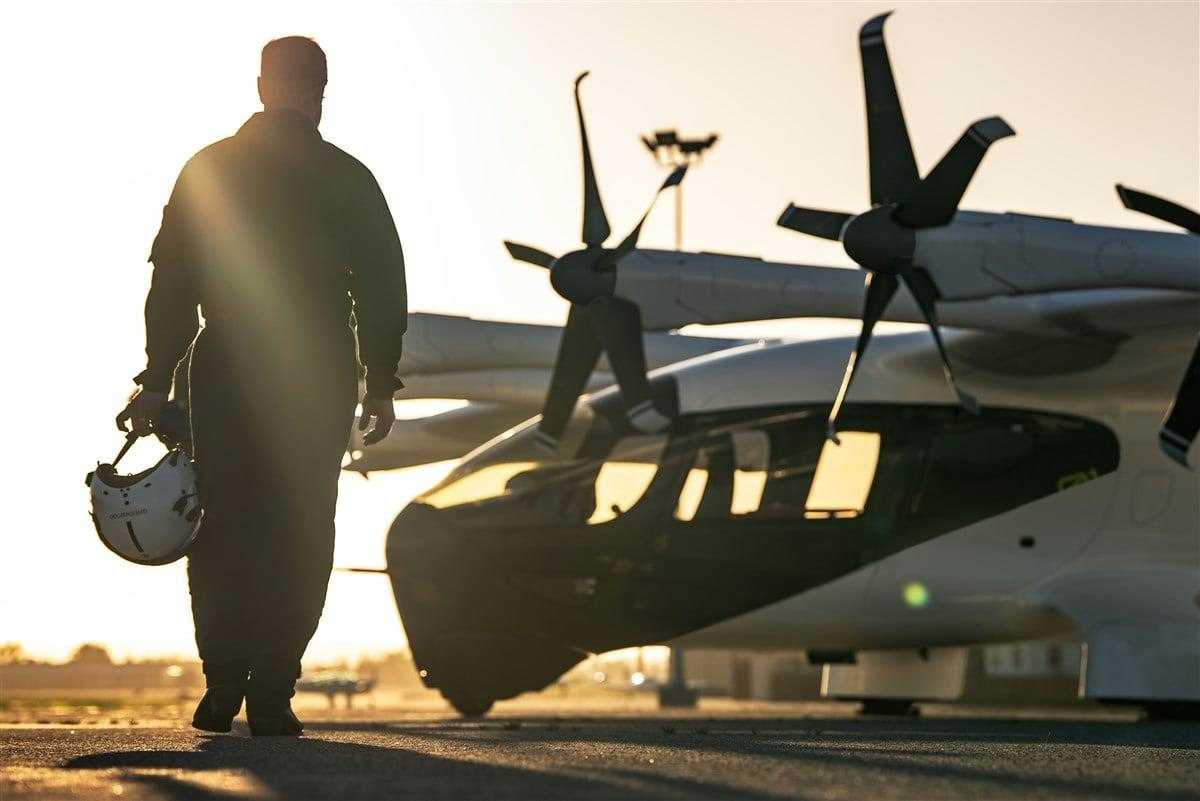
The company’s flagship aircraft, the “Midnight” eVTOL, is engineered to carry a pilot and four passengers up to 100 miles at speeds of 150 miles per hour, targeting urban air taxi and airport shuttle markets. Archer has secured high-profile partnerships with major industry players including United Airlines, Japan Airlines and Sumitomo’s Soracle joint venture, Ethiopian Airlines, Abu Dhabi Aviation, and the U.S. Air Force. Notably, Archer is designated as the official air taxi provider for the 2028 Los Angeles Olympic Games, a commitment that underscores its strategic positioning.
Financial Projections and Operational Realities
Wall Street analysts project rapid revenue growth for Archer over the next several years, with estimates rising from $32 million in 2026 to $1.75 billion by 2029. Based on these forecasts, Archer’s stock trades at less than four times its projected 2029 sales, with some analysts anticipating that the company could achieve adjusted profitability ahead of competitors such as Joby Aviation (JOBY).
Despite these optimistic projections, Archer’s operational track record remains sobering. Since its 2021 merger via a special purpose acquisition company (SPAC), the company has consistently missed aggressive targets. Initial plans envisioned delivering 10 aircraft in 2024 and generating $3.4 billion in revenue by 2027. In reality, Archer delivered only one test aircraft to the U.S. Air Force in 2024, reported negligible revenue, and posted a net loss of $537 million. As of August 2025, the company had built just two commercial prototypes, with six additional units under development.
Challenges and Competitive Landscape
Archer faces significant hurdles on its path to commercial viability. Manufacturing scale remains a critical concern, as the company depends on contract manufacturing through its major investor Stellantis (STLA). Progress in this area has been slower than anticipated, casting doubt on Archer’s goal to produce 650 aircraft annually by 2030. Regulatory certification also poses a formidable challenge. Archer requires four separate Federal Aviation Administration (FAA) certifications in the United States, having secured only maintenance and air carrier certificates to date, while the essential type certification remains pending.
The absence of meaningful revenue has intensified skepticism regarding Archer’s ability to fulfill its substantial order backlog. This uncertainty has contributed to pronounced stock price volatility and created opportunities for competitors—including Joby Aviation, Beta Technologies, and Eve Air Mobility—to accelerate their development and marketing efforts, seeking to capitalize on any perceived instability at Archer.
In response, Archer has pursued strategic differentiation through partnerships, notably collaborating with NVIDIA to develop advanced artificial intelligence technology for aviation applications. While this initiative could provide a competitive edge, it requires significant investment and time before yielding tangible results.
As Archer Aviation continues to navigate these operational and regulatory challenges, its future remains a high-stakes proposition, contingent on its ability to convert substantial orders into sustainable revenue streams.

Etihad Airways Suspends Airbus A380 Flights on Key Route

Aditya Birla Group Seeks Approval for Aircraft Leasing in GIFT City

Qatar Airways Highlights Innovation and Connectivity at Arabian Travel Market 2026

Hong Kong's Five-Year Plan Includes Andrew Fan's Aircraft Parts Processing Hub Proposal

ACIA Aero Leasing Delivers ATR72-600 to Air Nostrum

RTX Appoints Jill Albertelli as Head of Pratt & Whitney

TAT Technologies Joins Beyond Aero Hydrogen Aircraft Program

AURAK Study Highlights Barriers to Air Taxi Adoption in Emerging Economies

Xiamen Air Selects Altitude for 787 Maintenance at Heathrow

Etihad and Swissport Extend Global Partnership
