
حوّل رؤى الذكاء الاصطناعي إلى أفعال منسّقة

الرائج الآن
Categories
Qantas Reflects on Its $20 Billion Boeing Order
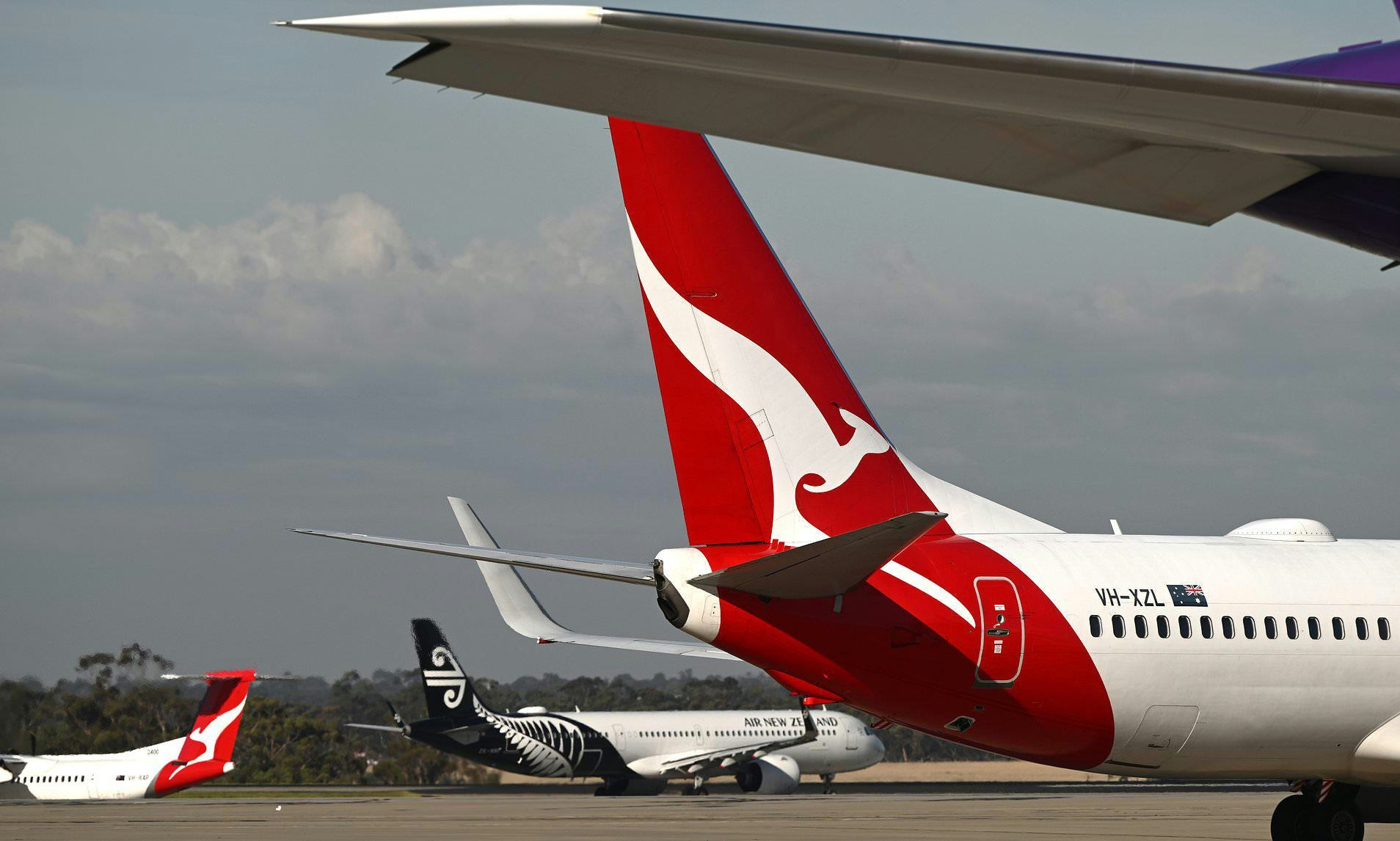
Qantas Reflects on Its $20 Billion Boeing Order
Historical Context: The 777 Decision
Qantas, the Australian flag carrier, played a significant role in the development of the Boeing 777, collaborating with Boeing alongside seven other major airlines. Despite this involvement, Qantas notably never placed an order for the 777 or its successor, the 777X. This decision has been a subject of considerable debate within the aviation industry and has even drawn reflection from former Qantas CEO Alan Joyce. Instead, in 2000, under then-CEO James Strong, Qantas opted for a mixed fleet strategy that favored Airbus widebodies alongside enhanced Boeing 747 variants. The airline placed a landmark order comprising seven Airbus A330-200s, six A330-300s, twelve Airbus A380-800s (then known as the A3XX), and six Boeing 747-400ERs. This move marked a strategic pivot from Qantas’s traditionally Boeing-dominated fleet, which included 737s, 747s, and 767s, and shaped its long-haul operations for decades.
Market and Operational Considerations
At the time of Qantas’s 2000 order, the Boeing 777 family was still emerging, with the highly successful 777-300ER only recently introduced and yet to prove its operational and economic advantages. The aircraft’s later acclaim, largely driven by the fuel-efficient GE90-115B engine, was not fully apparent when Qantas made its fleet decisions. Concurrently, the collapse of Ansett Australia created an opportunity for Qantas to expand its domestic network, necessitating aircraft that could serve both domestic and regional Asian routes effectively. The Airbus A330-200 and A330-300 models offered the right balance of capacity and fuel efficiency for medium-haul routes, outperforming the 777-200ER in these respects and providing greater operational flexibility across Qantas’s network. For high-capacity, long-haul trunk routes such as Sydney to London, Hong Kong, Singapore, and Los Angeles, Qantas continued to rely on Boeing 747s, which remained the backbone of its ultra-long-haul fleet.
Regulatory and Economic Factors
Regulatory challenges also influenced Qantas’s fleet choices. Although the Boeing 777 entered service with ETOPS 180 approval from the U.S. Federal Aviation Administration, Australia’s Civil Aviation Safety Authority imposed more stringent requirements, including case-by-case certification and higher compliance costs. These regulatory hurdles diminished the attractiveness of twin-engine aircraft like the 777 for ultra-long-haul operations at that time. Economic considerations, including fuel efficiency and operational flexibility, further reinforced Qantas’s preference for a mixed fleet approach.
Current Challenges and Future Outlook
Qantas’s recent $20 billion order with Boeing is now under renewed scrutiny amid evolving geopolitical and economic pressures. Heightened U.S.-China tensions have disrupted Boeing’s delivery schedules and order book in the Asia-Pacific region, potentially complicating Qantas’s fleet renewal plans. Additionally, rising jet fuel prices, exacerbated by ongoing conflicts in the Middle East, are placing further strain on airline profitability and may influence market dynamics and competitor strategies. Despite these headwinds, Boeing’s improving financial position, with forecasts indicating positive free cash flow by 2026, may provide some reassurance to Qantas and its stakeholders as the airline navigates a complex global environment and reflects on its pivotal fleet decisions.
Embraer Delivers 2,000th E-Jet as Airbus A220 Seeks Market Share
iniBuilds Releases Second In-Depth A380 Video
Ryanair and Alaska Airlines Apply AI to Operational Decision-Making

Digital Payments, AI, and Aviation Strengthen Philippines-India Relations
PlaneSense Suspends PC-12 Jet Card Sales
How AI Could Transform Bird-Strike Prevention for Business Aviation
American Airlines and Boeing Complete First 737 MAX Landing Gear Swap

Vietjet and Thales sign major MRO and AI deals in Paris
Etihad CEO Cites Aircraft Capacity as Limiting Factor Amid Growth in China and Africa
Artificial Intelligence Enters the Cockpit
