
Orquesta conocimientos de IA para convertirlos en acción

Tendencias
Categories
FAA Approves Saab Runway Safety System for 26 Additional U.S. Airports
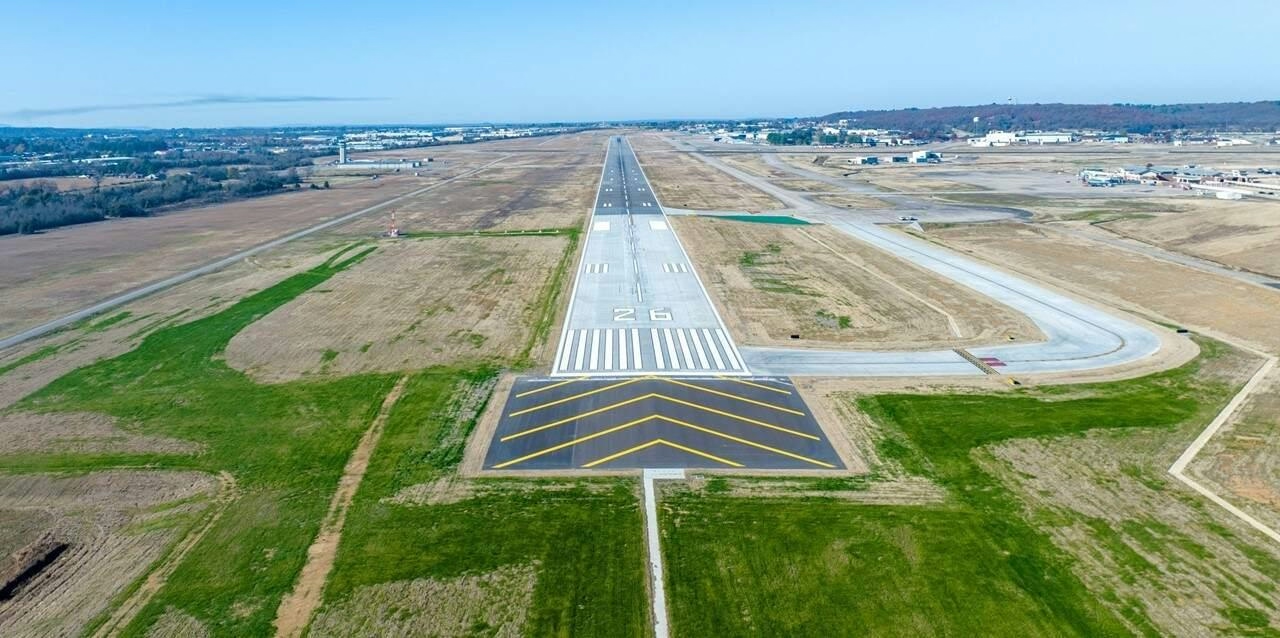
FAA Expands Deployment of Saab Runway Safety System to 26 Additional U.S. Airports
The Federal Aviation Administration (FAA) has awarded Saab a significant contract to extend its Aerobahn Runway and Surface Safety service to 26 more airports across the United States. This initiative forms part of the FAA’s Surface Awareness Initiative (SAI) Block 3 deployment, which seeks to enhance runway safety nationwide through the integration of advanced, technology-driven solutions.
Enhancing Situational Awareness and Operational Efficiency
Saab’s Aerobahn system improves situational awareness for air traffic controllers by providing precise tracking of aircraft and vehicles on airport surfaces, even under adverse weather conditions. The system builds upon the foundation established by the earlier ASDE-X program, incorporating proven components from Saab’s commercial Aerobahn software suite. Operating on a cloud-based infrastructure, the solution employs Saab’s Software as a Service (SaaS) model alongside its Trusted ADS-B service, which utilizes cooperative surveillance sensors. This design significantly reduces the need for extensive physical infrastructure, thereby lowering installation and maintenance costs.
A notable advantage of Saab’s system is its rapid deployment capability, with full installation achievable within approximately 90 days. This allows airports to modernize their surface safety systems swiftly, contributing to a safer and more efficient national airspace system. The technology is already operational at several major airports, including Nashville (BNA), San Antonio (SAT), Long Beach (LGB), and Hollywood Burbank (BUR).
Market Dynamics and Industry Competition
The FAA’s approval of Saab’s runway safety system occurs within a competitive and evolving market landscape. Integrating the new system with existing airport infrastructure and protocols may present challenges, as airports strive to ensure seamless operation alongside legacy technologies. Saab faces competition from other industry players, notably Honeywell, which recently announced that Southwest Airlines will implement its SmartRunway and SmartLanding software across its Boeing 737 fleet. These developments highlight the increasing demand for sophisticated runway safety solutions and may prompt competitors to accelerate their technology deployments and marketing strategies to secure market share.
The agreement with Saab is structured to extend over a period exceeding ten years, with orders to be placed incrementally. Saab U.S. President and CEO Erik Smith underscored the importance of the partnership with the FAA, emphasizing that the solution addresses a critical safety need in a cost-effective and scalable manner, ultimately benefiting both air traffic controllers and passengers.
As the FAA continues to prioritize runway safety, the adoption of advanced systems such as Saab’s reflects a broader industry trend toward leveraging technology to improve operational safety and efficiency at airports across the country.
Adobe Warns AI-Driven Trip Planning Challenges Travel Sites

The Global Parts Shortage
GE Aerospace's Robust Capital Position Fuels Higher Shareholder Returns
AI Advances Support Sustainable Aviation and Efficient Flight Paths

Airbus Faces Freighter Deadline Amid Weak Order Growth and Stagnant Shares
Integrated CNS System for Low-Altitude Aircraft

Chinese Robots Debut in Aviation and Military Roles at WRC 2026
Kenya Airways Aims to Resume Operations of Grounded Fleet by Early 2027
Avora Aviation Completes A320 Sale-Leaseback Agreement with FTAI
StandardAero Expands Bombardier Global MRO Services at Van Nuys Facility
