
Orquesta conocimientos de IA para convertirlos en acción

Tendencias
Categories
Federal Officials Cite Mechanical Failure and Low Altitude in 2024 Anaconda Helicopter Crash
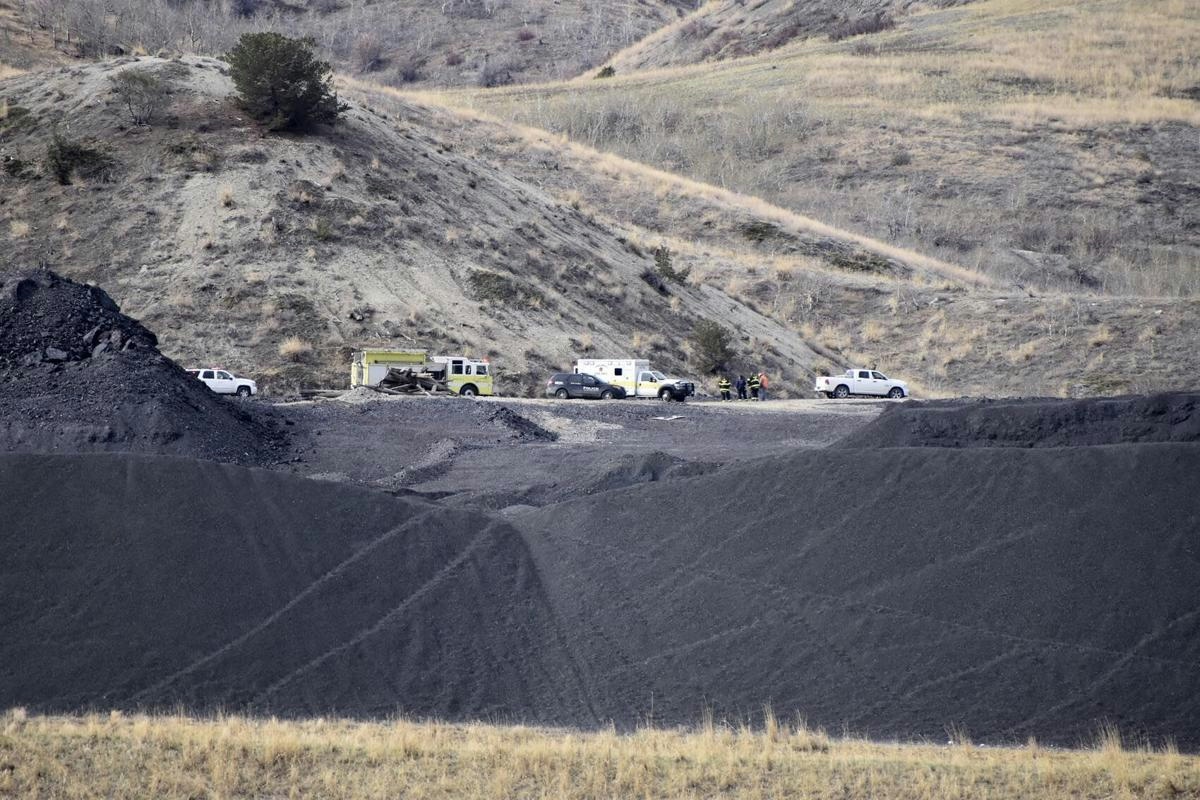
Mechanical Failure and Low Altitude Flight Cited in 2024 Anaconda Helicopter Crash
A fatal helicopter crash in Anaconda-Deer Lodge County in April 2024 has been attributed to mechanical failure compounded by low-altitude flight, according to the National Transportation Safety Board’s (NTSB) final report. The investigation focused on the April 26 flight piloted by 28-year-old Justin Paul Price, revealing critical engine issues, including the disintegration of O-rings within the turbine-to-compressor coupling shaft. These O-rings, vital for maintaining a leak-free seal, failed for reasons that remain undetermined.
The helicopter involved was a 2005 Bell 206-L4 powered by a Rolls-Royce engine, which depends on intact O-rings to prevent oil leaks. The manufacturer emphasized that damaged or incorrect O-rings could cause oil loss, potentially resulting in catastrophic engine failure. The NTSB report stated, “The initiating event for the disintegration of the O-rings could not be determined,” underscoring the unresolved nature of the mechanical failure.
Circumstances of the Crash and Contributing Factors
At the time of the accident, Price was engaged in contract remediation work for the Atlantic Richfield Company, addressing environmental damage from historic operations at the Anaconda Smelter site. He was conducting aerial fertilizer application, flying at low altitude with a spreader suspended beneath the helicopter. The NTSB highlighted that such low-level flight operations inherently limit a pilot’s ability to execute emergency maneuvers.
Wes Van Dell, chief helicopter flight instructor at the University of North Dakota Aerospace, explained that low altitude restricts the possibility of autorotation—a controlled descent maneuver that allows a helicopter to glide safely to the ground following engine failure. The NTSB concluded that, given the helicopter’s altitude and speed at the time of engine power loss, Price likely lacked sufficient altitude to establish autorotation and perform a successful emergency landing.
The report identified several probable contributors to the crash, including total engine power loss due to the loss of cooling oil to the turbine-to-compressor coupling shaft, fracture of the shaft at an altitude too low for autorotation, carbon buildup in the piccolo tube screen and nozzles, and the unexplained disintegration of the spur adapter gearshaft O-rings.
The Federal Aviation Administration (FAA) has previously noted that maintenance issues frequently contribute to helicopter engine and tail rotor failures. The helicopter’s engine had last undergone overhaul in March 2019, approximately 1,141 flight hours before the accident.
Industry Impact and Regulatory Response
The crash has drawn significant attention from aviation safety regulators and may prompt revisions to safety protocols governing helicopter operations. Industry analysts suggest that such incidents often lead to increased insurance premiums for operators and raise concerns among investors, potentially affecting the stock valuations of companies involved in helicopter manufacturing and maintenance.
In response, competitors within the industry may implement enhanced safety measures and launch public relations initiatives aimed at reassuring stakeholders and the public. The FAA’s recent suspension of visual separation requirements between helicopters and fixed-wing aircraft in congested airspace reflects ongoing efforts to mitigate risks and prevent similar tragedies in the future.

Etihad Airways Suspends Airbus A380 Flights on Key Route

Aditya Birla Group Seeks Approval for Aircraft Leasing in GIFT City

Qatar Airways Highlights Innovation and Connectivity at Arabian Travel Market 2026

Hong Kong's Five-Year Plan Includes Andrew Fan's Aircraft Parts Processing Hub Proposal

ACIA Aero Leasing Delivers ATR72-600 to Air Nostrum

RTX Appoints Jill Albertelli as Head of Pratt & Whitney

TAT Technologies Joins Beyond Aero Hydrogen Aircraft Program

AURAK Study Highlights Barriers to Air Taxi Adoption in Emerging Economies

Xiamen Air Selects Altitude for 787 Maintenance at Heathrow

Etihad and Swissport Extend Global Partnership
