
Orquesta conocimientos de IA para convertirlos en acción

Tendencias
Categories
Five Companies Driving AI Innovation in Defense and Aerospace
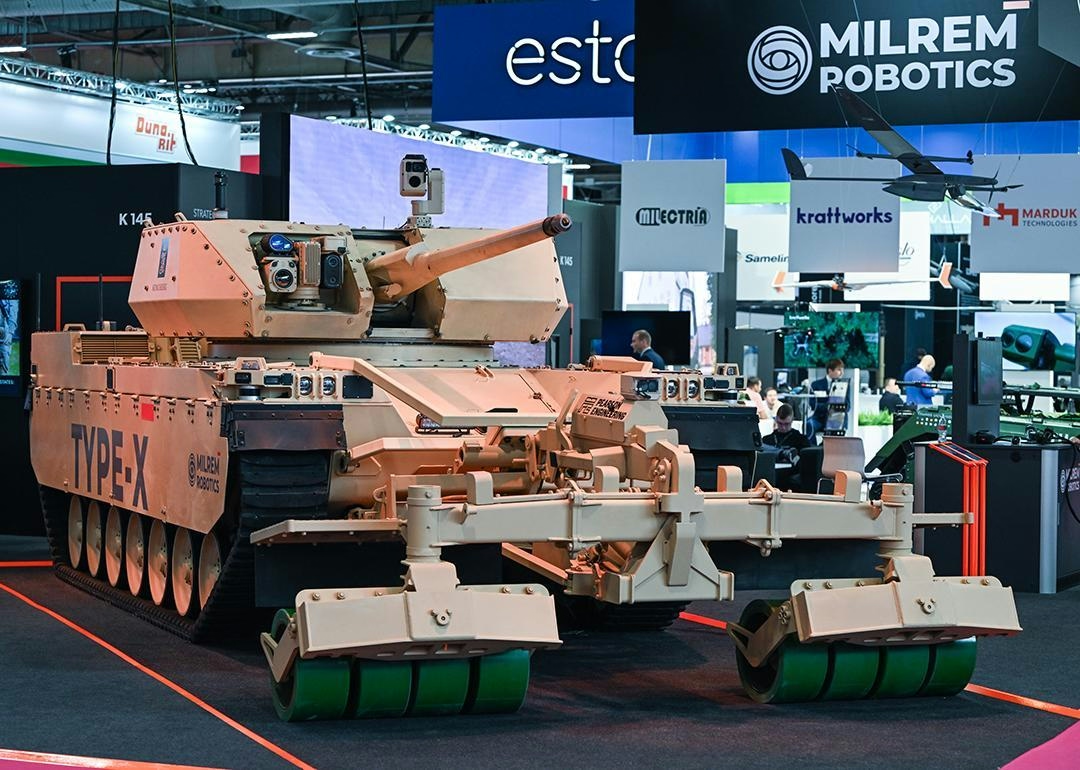
Five Companies Driving AI Innovation in Defense and Aerospace
The U.S. Department of Defense has requested $66 billion in information technology spending for fiscal year 2026, representing a $1.8 billion increase from the previous year. Artificial intelligence (AI) has emerged as a top priority across all military branches, reflecting its growing significance in defense strategy. Industry analysts forecast that the global AI market within defense and aerospace will expand dramatically, from $4.2 billion today to an estimated $42.8 billion by 2036. This growth is largely driven by advancements in autonomous systems and real-time intelligence processing capabilities.
Leading Innovators at the Intersection of Aerospace and AI
Five companies stand out as key players in this evolving landscape: Starfighters Space (NYSE American: FJET), Archer Aviation (NYSE: ACHR), AeroVironment (NASDAQ: AVAV), Redwire (NYSE: RDW), and V2X (NYSE: VVX). These firms operate at the nexus of aerospace technology, artificial intelligence, and national security, navigating a rapidly shifting environment shaped by technological breakthroughs and changing market dynamics.
The global space economy, valued at $626 billion in 2025, is projected to exceed $1 trillion by 2034. Defense and sovereignty concerns are primary drivers of this expansion. Concurrently, NASA continues to advance medical research for long-duration spaceflight, with International Space Station crews conducting real-time cardiovascular and psychological assessments to prepare for future deep-space missions.
Starfighters Space recently reached a significant milestone by advancing to the Critical Design Review (CDR) phase for its STARLAUNCH 1 vehicle, with support from GE Aerospace. The CDR process rigorously evaluates design maturity, configuration control, manufacturability, and test readiness, setting the stage for full-scale fabrication and integration. This achievement follows successful subsonic and supersonic wind tunnel tests that validated computational fluid dynamics models and demonstrated clean separation behavior at Mach 0.85 and Mach 1.3. The company is now preparing for instrumented drop tests to assess separation dynamics under actual flight conditions.
GE Aerospace has been instrumental in Starfighters’ development, providing engineering expertise and supporting recent supersonic flight test campaigns conducted at Kennedy Space Center. These efforts align with GE Aerospace’s ATLAS program, which seeks to advance solid fuel ramjet propulsion technology under funding from the U.S. Department of Defense.
The Intensifying AI Arms Race and Market Consolidation
The broader AI arms race within defense and aerospace is accelerating. Prominent companies such as Anthropic, xAI, and True Anomaly are moving toward public markets to secure capital for expanding AI infrastructure. Anthropic positions itself as a safety-focused alternative in the AI space, while xAI, now integrated with SpaceX, targets space-based AI applications. True Anomaly aligns its mission with U.S. space defense priorities, emphasizing deterrence and operational freedom in orbit.
This competitive environment has triggered a surge in mergers and acquisitions, with U.S. megadeals increasing by 111.5% amid what is being described as an AI supercycle. Consolidation is reshaping the sector as companies race to integrate advanced AI technologies to maintain strategic advantages. However, challenges persist. For example, Anthropic’s $200 million contract with the Pentagon is reportedly at risk due to disagreements over the ethical use of AI in lethal operations and surveillance, underscoring the complex ethical and strategic issues confronting the industry.
As defense and aerospace sectors continue to adapt to these rapid changes, strategic pivots, technological integration, and consolidation will be essential for companies aiming to lead in the next era of AI-driven innovation.

Etihad Airways Suspends Airbus A380 Flights on Key Route

Aditya Birla Group Seeks Approval for Aircraft Leasing in GIFT City

Qatar Airways Highlights Innovation and Connectivity at Arabian Travel Market 2026

Hong Kong's Five-Year Plan Includes Andrew Fan's Aircraft Parts Processing Hub Proposal

ACIA Aero Leasing Delivers ATR72-600 to Air Nostrum

RTX Appoints Jill Albertelli as Head of Pratt & Whitney

TAT Technologies Joins Beyond Aero Hydrogen Aircraft Program

AURAK Study Highlights Barriers to Air Taxi Adoption in Emerging Economies

Xiamen Air Selects Altitude for 787 Maintenance at Heathrow

Etihad and Swissport Extend Global Partnership
