
Orquesta conocimientos de IA para convertirlos en acción

Tendencias
Categories
Government Considers Fractional Aircraft Ownership and Classifying Aircraft as Infrastructure, Says Civil Aviation Minister

Government Explores Fractional Aircraft Ownership and Infrastructure Classification for Aviation Sector
The Indian government is actively formulating policies to introduce fractional ownership in aviation and is considering the classification of aircraft as infrastructure assets, Civil Aviation Minister Ram Mohan Naidu announced on Friday. These initiatives are designed to strengthen India’s aviation financing and leasing framework, aiming to elevate the country’s position within the global aviation market.
Policy Developments and Strategic Collaboration
Addressing the India Aircraft Leasing and Financing Summit 2.0 held at GIFT City in Gandhinagar, Minister Naidu highlighted the ongoing cooperation between the Ministry of Civil Aviation and the Ministry of Finance to develop progressive aviation financing policies. He stated, “We are continuously engaging with the Ministry of Finance… We are trying to create a policy so that fractional ownership also becomes a reality in our country.” Both the introduction of fractional ownership and the potential reclassification of aircraft as infrastructure remain works in progress, reflecting the government’s commitment to fostering innovation in the sector.
Recognizing aircraft as infrastructure could significantly impact the industry by attracting new investments and facilitating easier access to financing. Market analysts suggest that this reclassification may stimulate greater interest in fractional aircraft ownership, particularly within the business aviation segment. This trend aligns with international developments, where companies such as China’s Sino Jet have expanded their charter fleets with additions like the Gulfstream G700, and European operators like HansJet have increased their PC-12 fractional ownership offerings to capture larger market shares.
Challenges and the Role of GIFT City
Experts caution that achieving these ambitions will require a holistic approach that addresses not only financing but also the enhancement of production, maintenance, and repair capabilities to meet growing demand. The government’s policy framework is expected to incorporate these considerations to ensure the sector’s long-term viability.
Minister Naidu also emphasized the strategic vision for GIFT City, clarifying that India does not intend to compete directly with established global leasing hubs but aims to complement them. “GIFT City is not merely a competitive option for India-related leasing, but it is the natural home. What we are building at GIFT City is a home for India’s aviation financing needs,” he remarked. He further noted that GIFT City offers distinct advantages over global centers such as Dublin, Singapore, and Dubai, positioning it as a specialized hub for aviation financing.
Gujarat Chief Minister Bhupendra Patel, speaking at the summit, highlighted GIFT City’s emergence as a global fintech hub. Reflecting on the previous year’s summit, Patel expressed confidence that the ongoing discussions would provide renewed momentum toward building a developed India by 2047. He conveyed optimism that the summit’s dialogues would translate into tangible outcomes and visible benefits for the aviation sector in the near future.

Joby Aviation Extends Autonomous Flight Capabilities with Cross-Country Tour

Strengthening Europe's Aviation Supply Chain Amid Uncertainty
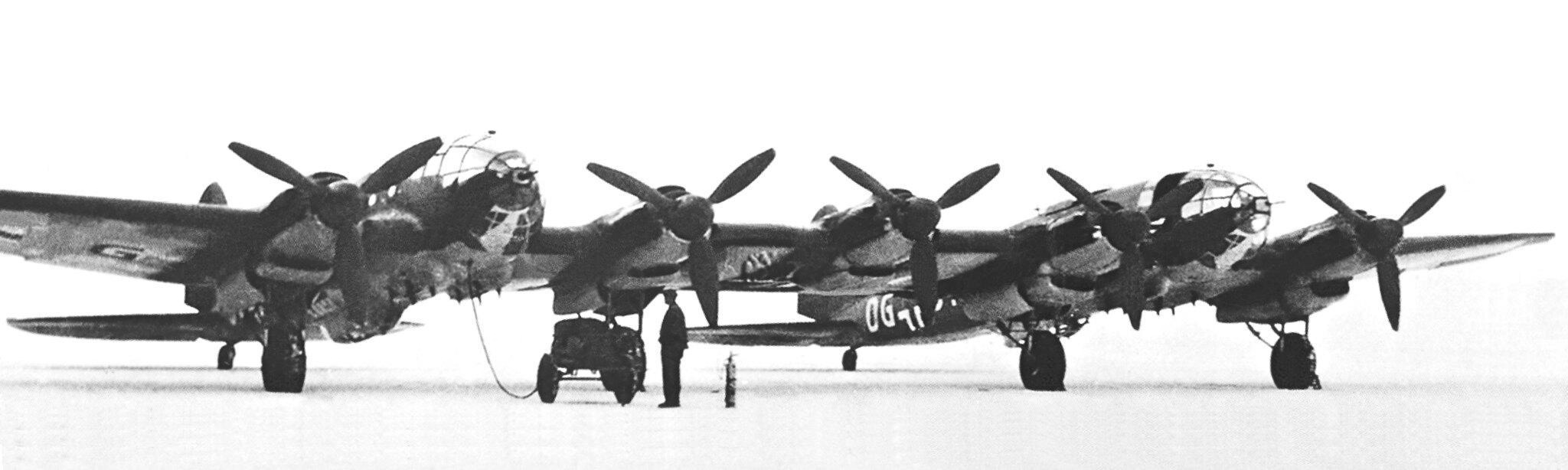
He 111Z Zwilling: Twin Fuselages, Five Engines, One Pilot

Monacair Plans Electric Air Taxi Service Between Monaco and Nice by 2029

Somalia’s Starsky Aviation Plans International Expansion

Precision and Care Essential in Aerospace Coating Applications

Drukair Chooses LEAP Engines for Five Airbus Aircraft

GE Aerospace Advances XA102 Adaptive Cycle Engine Toward Assembly for U.S. Air Force Combat Aircraft

Russia Tests Air Taxis with Passenger Flights Possible in 2-3 Years

AEG Fuels Launches Equipment Leasing Subsidiary
