
Orquesta conocimientos de IA para convertirlos en acción

Tendencias
Categories
Oregon National Guard Innovation Adopted as Army Standard for MEDEVAC Operations
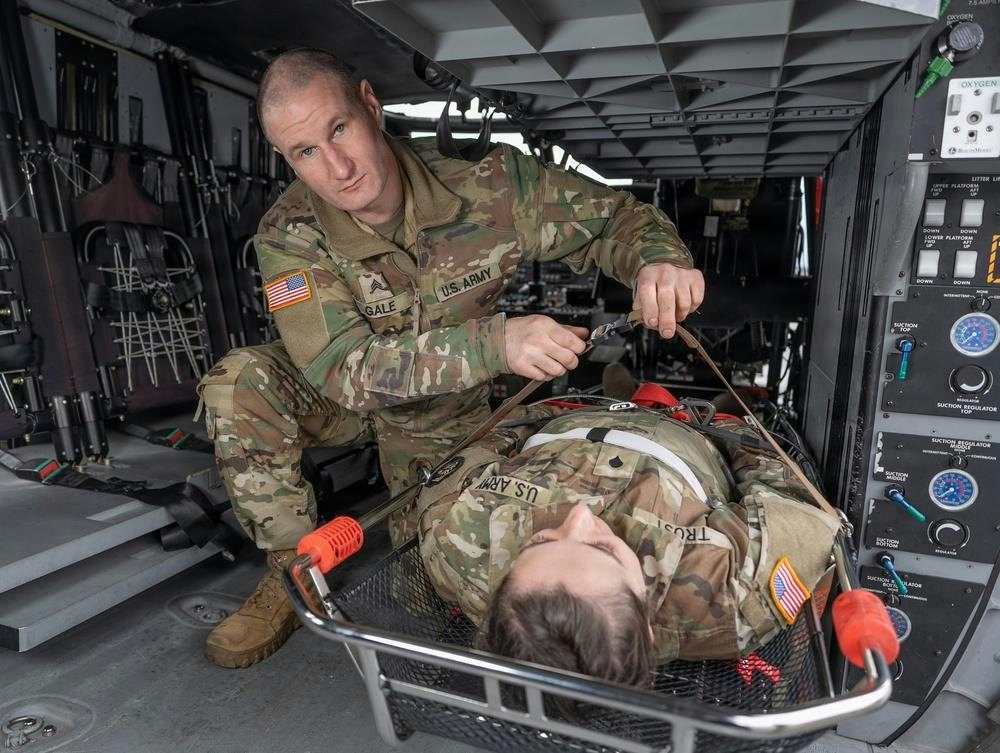
Oregon National Guard Innovation Adopted as Army Standard for MEDEVAC Operations
A Breakthrough in Medical Evacuation Technology
SALEM, Ore. — An innovative piece of equipment developed by aircrews of the Oregon Army National Guard is poised to become the new standard for medical evacuation (MEDEVAC) operations throughout the U.S. Army. This advancement marks a significant step forward in military rescue technology, enhancing both safety and efficiency during critical missions.
The innovation centers on a redesigned litter strap, officially designated SK-1189-V, named after Golf Company, 1st Battalion, 189th Aviation Regiment—the Oregon unit responsible for its creation. This new strap addresses a vital compatibility issue with the Army’s advanced Vita Vertical Rescue System (VRS), a device that stabilizes rescue baskets during helicopter hoist operations and eliminates the need for traditional taglines.
Development and Certification of the SK-1189-V Strap
The necessity for this innovation became apparent during a June 2025 training exercise, when Oregon’s Golf Company became only the third Army unit to receive the VRS. During initial operations, aircrews discovered that the standard Black Hawk helicopter seat belts were too short to secure patients and the VRS device together within the litter basket. Chief Warrant Officer 4 Josiah Zeiner, Aviation Safety Officer with the 2nd Battalion, 641st Aviation Regiment, reflected on the moment: “That was the moment when we realized that this was a great device, but it still had some refining that needed to be done.”
Rather than awaiting a top-down solution, Oregon’s aircrews, including Sgt. James Gale—a crew chief and civilian heavy equipment technician—took the initiative to design and test the SK-1189-V strap. Their efforts were rewarded when the U.S. Army Aeromedical Research Laboratory certified the new strap, which will now be issued to every Army MEDEVAC unit.
Advancements in Rescue Safety and Broader Implications
The Vita Vertical Rescue System itself represents a significant leap forward in rescue safety. Utilizing four fans and air pressure, the VRS automatically stabilizes hoisted litters, even during high-altitude rescues. Zeiner noted, “We’ve never had any litter spin out of control in the Oregon Army National Guard, but we have had challenging situations with very high hoists over 280 feet, where the tagline is only 300 feet. This device would eliminate, in certain scenarios, the need for a tagline, and we could just hoist straight up at full speed.”
While the Army’s adoption of the Oregon innovation is widely regarded as a positive development, it arrives amid ongoing debates about the role and deployment of National Guard units. Previous federal attempts to deploy National Guard troops in cities such as Chicago and Portland encountered legal challenges and court rulings that blocked such actions. As the new MEDEVAC standard is implemented, local governments and communities—particularly in regions with a history of opposing federal Guard deployments—may closely scrutinize its application.
Furthermore, National Guard units in other states may seek to adopt similar innovations, potentially fostering a competitive edge in military operations. This could also introduce new legal and logistical complexities as standards are harmonized across different jurisdictions.
Despite these challenges, Oregon’s contribution is receiving recognition at the highest levels. Zeiner expressed pride in the achievement, stating, “I’m happy that the legacy we’ve built in Oregon from Golf Company, 1-189th Aviation, will be represented in this new technology. Oregon has a part in making this a reality.”

Etihad Airways Suspends Airbus A380 Flights on Key Route

Aditya Birla Group Seeks Approval for Aircraft Leasing in GIFT City

Qatar Airways Highlights Innovation and Connectivity at Arabian Travel Market 2026

Hong Kong's Five-Year Plan Includes Andrew Fan's Aircraft Parts Processing Hub Proposal

ACIA Aero Leasing Delivers ATR72-600 to Air Nostrum

RTX Appoints Jill Albertelli as Head of Pratt & Whitney

TAT Technologies Joins Beyond Aero Hydrogen Aircraft Program

AURAK Study Highlights Barriers to Air Taxi Adoption in Emerging Economies

Xiamen Air Selects Altitude for 787 Maintenance at Heathrow

Etihad and Swissport Extend Global Partnership
