Imagen

AeroGenie — Tu copiloto inteligente.

Pregunta cualquier cosa. Analiza todo. Actúa al instante.

Tendencias

Categories

Rolls-Royce unveils £9bn share buyback as profits soar
February 26, 2026By ePlane AI
Rolls-Royce unveils £9bn share buyback as profits soar
0
0
Rolls-Royce
Share Buyback
Aerospace Profits

Rolls-Royce Announces £9 Billion Share Buyback Amid Soaring Profits

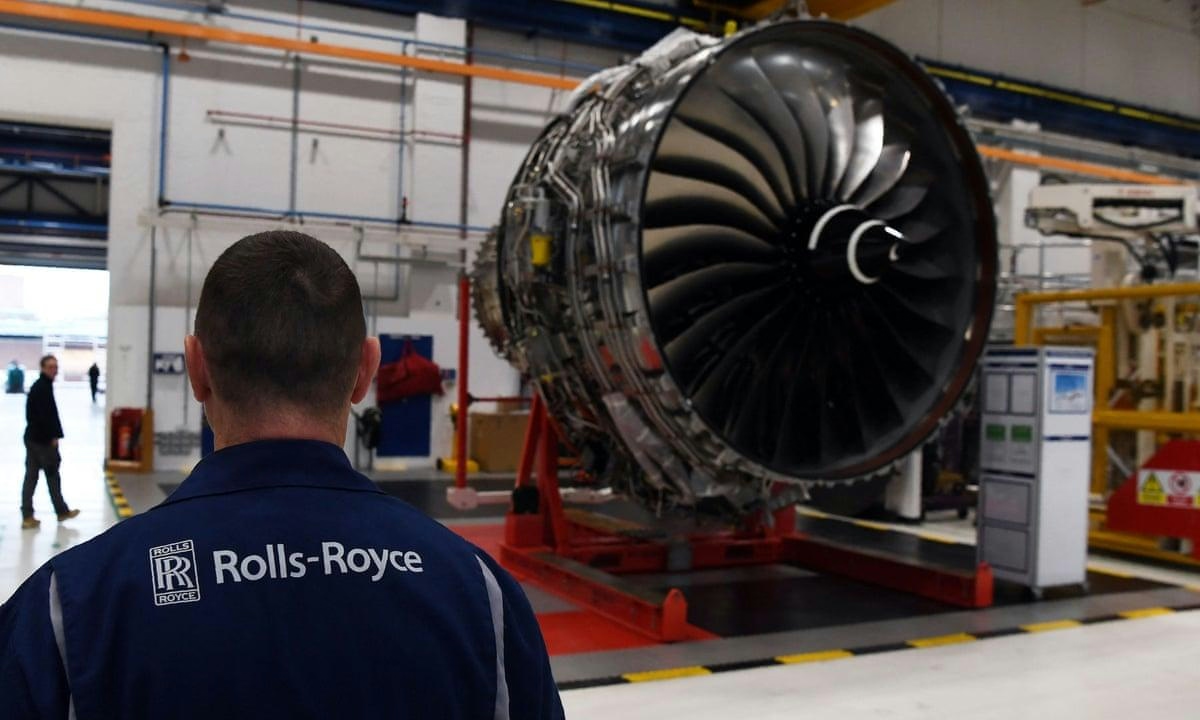
Rolls-Royce has revealed plans for a substantial share buyback programme valued at up to £9 billion, reflecting a remarkable financial turnaround. The engineering conglomerate expects profits over the next three years to exceed previous forecasts by 33%, underscoring a significant improvement in its business performance. For 2025, the company projects a 40% increase in underlying operating profits, reaching £3.46 billion. Revenues are anticipated to rise by 12% to £21.2 billion, while cash generated from operations is forecasted at £3.2 billion.

Strengthened Financial Outlook and Diversified Operations

Renowned for producing the Trent XWB engines in Derby, which power the Airbus A350, Rolls-Royce has expanded its portfolio to include military aircraft engines, submarine propulsion systems, and backup generators for data centres. The company’s outlook remains robust, with underlying operating profits expected to climb further to between £4 billion and £4.2 billion in 2026. Additionally, Rolls-Royce has raised its financial targets for 2028, signaling management’s confidence in sustained growth and operational resilience.

Market Reaction and Competitive Implications

The announcement has generated considerable interest among investors, who have welcomed the buyback as a clear indication of Rolls-Royce’s strong financial position and commitment to returning value to shareholders. This move is likely to intensify competitive pressures within the aerospace and defence sectors, as rivals may find it challenging to match Rolls-Royce’s accelerated growth and profitability. The company’s ambitious targets could prompt competitors to reevaluate their strategic priorities in order to maintain market relevance.

Rolls-Royce’s resurgence stands in stark contrast to the difficulties it faced over the past decade, including multiple profit warnings and near collapse during the Covid-19 pandemic. With a reinforced balance sheet and renewed investor confidence, the group is well-positioned to seize emerging opportunities and address the challenges of a rapidly evolving global market.

More news
Electric Air Taxis Added to Uber App

Electric Air Taxis Added to Uber App

Electric Air Taxis Integrated into Uber App A transformative development in urban transportation is underway as Uber and Joby Aviation prepare to launch all-electric air taxi services later this year in Dubai. This initiative represents a significant advancement in their partnership, aiming to introduce multi-modal, on-demand mobility solutions to cities globally and bring the concept of futuristic, “Jetsons”-style travel closer to everyday reality. Booking and Aircraft Features Users will soon be able to book electric air taxis directly through the Uber app. By entering a destination in the familiar “Where to?” search bar, eligible trips will present the option “Uber Air powered by Joby.” With a single tap, the app will seamlessly coordinate the entire journey, including ground transportation via Uber Black for both pickup and drop-off. Joby’s electric aircraft is engineered to accommodate up to four passengers, providing spacious seating and expansive panoramic views of the city through large windows. Operated by certified commercial pilots, the aircraft employs six tilting propellers enabling vertical takeoff and landing, transitioning smoothly to forward flight. It can reach speeds of up to 200 miles per hour and cover distances of approximately 100 miles on a single battery charge. Regulatory Challenges and Safety Considerations While Dubai will host the inaugural commercial flights, expansion into the United States and other international markets faces considerable regulatory obstacles. The Federal Aviation Administration (FAA) mandates rigorous testing and certification before permitting commercial operations. Joby Aviation has completed over 50,000 miles of flight testing and is currently in the final stages of the FAA certification process, reflecting the industry’s commitment to safety and regulatory compliance. Similar regulatory delays have affected other cities, including Paris, where planned public launches have been postponed. These challenges underscore the complexity of integrating electric air taxis into existing urban airspace and infrastructure. Competitive Landscape and Industry Implications Uber and Joby are part of a growing field of companies striving to revolutionize urban air mobility. Competitors such as Blade Air Mobility and Eve Air Mobility are advancing their own electric air taxi initiatives, intensifying competition within this emerging sector. The increasing number of entrants is expected to accelerate innovation and heighten the urgency to obtain regulatory approvals. Market Response and Infrastructure Concerns The announcement has garnered significant interest from investors and urban planners, particularly regarding the environmental advantages of electric air taxis and their potential to alleviate urban congestion. Nonetheless, concerns persist about the readiness of essential supporting infrastructure, including charging facilities and dedicated landing zones, which are vital for widespread adoption. As the industry continues to address regulatory, safety, and infrastructure challenges, the integration of electric air taxis into the Uber app marks a pivotal moment in urban mobility, potentially ushering in a new era of airborne commuting for city residents worldwide.
Honeywell Charts a New Course Through Corporate Restructuring and Innovation

Honeywell Charts a New Course Through Corporate Restructuring and Innovation

Honeywell Charts a New Course Through Corporate Restructuring and Innovation Honeywell, the global industrial conglomerate, is embarking on a significant transformation as it prepares to divide into three independent publicly traded companies. This strategic restructuring coincides with major technological advancements in aviation and defense, positioning each future business unit for focused growth and enhanced market leadership. Dividend Stability Amid Corporate Transition Amid the complexities of this separation, Honeywell has reaffirmed its commitment to shareholder value by confirming a dividend payment of $1.19 per share, scheduled for March 13, 2026. This assurance provides a measure of stability for investors during a period of operational change. The market has responded positively, with Honeywell shares trading near a 52-week high at 204.55 euros and year-to-date gains surpassing 22%. Nonetheless, the stock’s Relative Strength Index (RSI) of 81.6 indicates potential short-term overbought conditions. Advancing Sustainable Aviation Fuel Initiatives Central to Honeywell’s forward-looking strategy is its expansion into sustainable aviation fuel (SAF). In partnership with Verso Energy, Honeywell plans to deploy its proprietary “eFining” technology across seven production facilities in Europe and the United States. This initiative aims to enable large-scale manufacturing of low-carbon fuels by utilizing captured carbon dioxide. The adoption of standardized plant designs is expected to reduce capital expenditures and accelerate market entry. Regulatory support for these projects is robust, with initiatives such as “DEZiR” and “ReSTart” already securing funding from the European Union’s Innovation Fund. Strengthening the Defense Portfolio Concurrently, Honeywell is intensifying its focus on the defense sector. The U.S. Air Force recently awarded the company a prototype contract for the “SkyShot 1600” propulsion system, designed to serve as the core engine for autonomous combat aircraft. Employing advanced digital modeling techniques, this new engine is anticipated to significantly shorten development timelines, directly benefiting Honeywell’s forthcoming standalone Aerospace business. Navigating Competitive and Market Challenges Honeywell’s restructuring unfolds within a dynamic competitive landscape. Industry rivals are advancing their own strategic initiatives, including ST Engineering’s defense modernization partnerships and LIG Nex1’s memorandum of understanding to explore unmanned aerial vehicle (UAV) development and commercialization. Honeywell’s record backlog, now exceeding $37 billion, alongside an accelerated timeline for the aerospace spin-off, has contributed to a recent surge in its share price. However, the company faces a range of market-specific and internal challenges that could impact its growth trajectory. The ongoing reshoring trend in U.S. manufacturing has led to labor shortages and intensified the drive toward industrial automation. While this trend presents opportunities for Honeywell’s automation business, it also raises concerns regarding the company’s capacity to manage higher domestic production costs and evolving workforce demands. Progress Toward a Three-Way Corporate Split Honeywell aims to complete its separation into three distinct listed entities—Aerospace, Automation, and Specialty Materials—by the second half of 2026. Management remains focused on maintaining operational strength throughout the transition, with immediate priorities including scaling sustainable aviation fuel production and advancing autonomous propulsion technologies. Preparations for the triple stock market listing are proceeding according to plan. As Honeywell navigates this ambitious restructuring, its success will depend on its ability to balance innovation, operational execution, and responsiveness to shifting market dynamics.
ExecuJet Haite Certified for Gulfstream G700 Line and Heavy Maintenance by Multiple Authorities

ExecuJet Haite Certified for Gulfstream G700 Line and Heavy Maintenance by Multiple Authorities

ExecuJet Haite Certified for Gulfstream G700 Line and Heavy Maintenance by Multiple Authorities Multi-National Certification Strengthens ExecuJet Haite’s Position ExecuJet Haite Aviation Services has reached a significant milestone by securing certification from the US Federal Aviation Administration (FAA), Qatar Civil Aviation Authority (QCAA), and Vietnam Civil Aviation Authority (CAAV) to perform both line and heavy maintenance on the Gulfstream G700. This achievement enhances ExecuJet Haite’s standing as a premier maintenance, repair, and overhaul (MRO) provider in the Asia-Pacific region, responding to the growing demand for Gulfstream’s latest aircraft models. The Vietnam Civil Aviation Authority has officially expanded ExecuJet Haite’s approval scope to include the G700, while the company’s MRO facilities in Tianjin and Beijing Daxing have received FAA authorization to conduct comprehensive G700 line and base maintenance checks, including 1A and 2C inspections. Additionally, the QCAA has certified ExecuJet Haite to deliver full maintenance services for business jets registered in Qatar, particularly the G700, building upon the company’s existing FAA certifications. Context of Gulfstream’s Market Momentum and Regional Impact These certifications arrive at a crucial juncture for Gulfstream, whose G700 and G800 models have recently obtained key approvals from Transport Canada and the FAA, essential for global market acceptance. Gulfstream’s robust sales performance, with 158 business jets delivered in 2025 and the company recording its second-best quarter to date, reflects strong market demand. The Qatari fleet, which extensively operates Gulfstream G650ER and G700 aircraft for premium charter services, is poised to benefit from ExecuJet Haite’s expanded maintenance capabilities, now supported by FAA, QCAA, CAAV, Cayman, and Bermuda regulatory approvals. Industry analysts observe that ExecuJet Haite’s multi-jurisdictional certifications not only affirm its technical proficiency but also underscore the competitive dynamics within the MRO sector. Rival providers may intensify marketing efforts to highlight their own capabilities and safety standards. The industry continues to navigate challenges such as increased regulatory scrutiny. Notably, previous threats from former US President Donald Trump to decertify Canadian-made aircraft raised concerns about potential disruptions to market confidence and regulatory frameworks, though Gulfstream’s recent certifications indicate sustained progress. ExecuJet Haite’s Commitment to Excellence Paul Desgrosseilliers, General Manager at ExecuJet Haite, emphasized the significance of these certifications, stating, “Obtaining these certifications is a strong recognition by international regulatory authorities of ExecuJet Haite’s technical expertise and service quality. Following rigorous audits, these achievements confirm that our maintenance, inspection systems, and personnel fully comply with the world’s most stringent standards. Our investment in continuous training, state-of-the-art tooling, and robust quality systems ensures we are fully prepared to support new platforms like the G700 from day one. Supporting this flagship aircraft is a natural progression of our deep, long-standing expertise in Gulfstream maintenance.” With these latest approvals, ExecuJet Haite is strategically positioned to support the next generation of Gulfstream aircraft, addressing the evolving requirements of business aviation operators across multiple regulatory jurisdictions.
Aircraft Refurbishing Market Projected to Reach $9 Billion by 2030

Aircraft Refurbishing Market Projected to Reach $9 Billion by 2030

Aircraft Refurbishing Market Projected to Reach $9 Billion by 2030 The global aircraft refurbishing market is anticipated to reach a valuation of $9 billion by 2030, propelled by increasing passenger traffic, technological innovations, and ongoing efforts to modernize fleets. According to the "Aircraft Refurbishing Market Report 2026" published by ResearchAndMarkets.com, the market is expected to grow from $6.65 billion in 2025 to $7.08 billion in 2026, reflecting a compound annual growth rate (CAGR) of 6.5%. This upward trajectory is projected to continue through 2030, with a sustained CAGR of 6.2%. Drivers of Market Growth The expansion of the aircraft refurbishing sector is largely driven by rising demand for upgraded cabin interiors, comprehensive engine and airframe refurbishments aimed at extending aircraft operational life, and the integration of lightweight, advanced materials in modern designs. Airlines and operators are increasingly investing in refurbishment projects to enhance passenger comfort and improve aircraft resale value. A notable example is Air India’s $400 million refurbishment initiative launched in September 2024, which introduced next-generation seating and advanced inflight entertainment systems across its widebody fleet. Such initiatives underscore a strategic shift towards refurbishing existing aircraft as a cost-effective and sustainable alternative to new acquisitions. Broader industry trends also play a significant role in shaping refurbishment strategies. The adoption of modern cabin designs, the use of lightweight materials, and the expansion of Maintenance, Repair, and Overhaul (MRO) facilities are key factors influencing market dynamics. Passenger growth remains a critical driver; Eurostat reported an 11.5% increase in air passengers within the European Union during the first quarter of 2024 compared to the previous year, highlighting the correlation between rising traffic volumes and refurbishment demand. Challenges and Industry Response Despite positive growth prospects, the aircraft refurbishing market faces several challenges. Supply chain disruptions and geopolitical tensions, including global trade disputes and tariffs, have increased costs for refurbishment components and encouraged a shift towards localized manufacturing. Leading aircraft manufacturers such as Airbus and Boeing continue to contend with these supply chain issues, which have affected both aircraft and engine production since the onset of the COVID-19 pandemic. The competitive landscape is further complicated by developments such as the Royal Australian Air Force’s divestment of eight heritage aircraft and ongoing production rate adjustments at major planemakers. Nevertheless, industry leaders remain optimistic, particularly regarding growth opportunities in the Asia-Pacific region. The market’s resilience is evident as companies adapt to short-term disruptions while pursuing long-term expansion strategies. Strategic acquisitions, such as Flexjet’s purchase of Constant Aviation in February 2023, are enhancing maintenance capabilities and expanding business aviation services to meet increasing refurbishment demands. Regional and Market Outlook Key players in the aircraft refurbishing market include Autotrade Aviation, Duncan Aviation, and Gulfstream Aerospace, among others. North America led the market in 2025, with significant activity also recorded in the Asia-Pacific and Western European regions. As airlines and operators continue to modernize their fleets and improve passenger experience, the aircraft refurbishing market is positioned for sustained growth amid a complex and evolving global environment.
British Airways expands use of 8tree’s dentCHECK technology

British Airways expands use of 8tree’s dentCHECK technology

British Airways Expands Use of 8tree’s dentCHECK Technology British Airways has announced an expansion in its use of 8tree’s dentCHECK technology, reinforcing its commitment to operational excellence and innovation within its maintenance operations. The airline, which has employed dentCHECK since 2017, currently utilises the technology across both line and base maintenance to streamline and standardise damage inspection and reporting processes. In 2025, British Airways plans to enhance its digital inspection capabilities by adding three additional dentCHECK units. One will be installed at its Glasgow narrow-body base maintenance facility, while two more will be deployed at London Heathrow to support both line and base maintenance activities. This expansion reflects the airline’s ongoing efforts to digitise and optimise its maintenance, repair, and overhaul (MRO) procedures, aiming to improve efficiency and safety across its engineering network. Advancing Maintenance with Augmented Reality Technology dentCHECK is a handheld, augmented reality-enabled 3-D dent-mapping tool specifically designed for the aviation maintenance environment. It is the only system of its kind recognised and approved by major original equipment manufacturers (OEMs) including Airbus, Boeing, and Embraer. The technology enables airlines and MRO providers to conduct inspections up to 90% faster than traditional methods, while producing fully traceable, SRM-compliant digital reports with up to 20 times greater consistency. British Airways’ investment in dentCHECK supports faster decision-making and enhances inspection traceability, contributing to improved maintenance outcomes. Navigating Competitive Pressures Amid Technological Advancements The expansion of dentCHECK technology comes at a time when British Airways faces intensifying competition within the UK airline market. The carrier’s recent transition to a spend-based loyalty system has generated dissatisfaction among some mid-tier members, prompting competitors such as Virgin Atlantic and easyJet to increase efforts to attract these customers. Virgin Atlantic, in particular, has launched an aggressive status-match campaign targeting British Airways’ loyalty members, with other rivals expected to follow suit. These developments suggest a potential reshaping of the UK airline loyalty landscape as carriers seek to capitalise on British Airways’ controversial changes. As British Airways advances its technological capabilities to enhance operational efficiency and safety, it must also address the challenges posed by a rapidly evolving market and shifting customer loyalties. Balancing innovation with customer retention will be essential as the airline navigates both internal ambitions and external competitive pressures.
Nominations Open for IATA Diversity and Inclusion Awards in Aviation

Nominations Open for IATA Diversity and Inclusion Awards in Aviation

Nominations Open for IATA Diversity and Inclusion Awards in Aviation The International Air Transport Association (IATA) has officially opened nominations for its 2026 Diversity & Inclusion (D&I) Awards, which aim to highlight innovation and progress within the aviation sector. Founded in 1945 and headquartered in Montreal and Geneva, IATA represents airlines worldwide and has long been a leading advocate for industry standards. The D&I Awards seek to recognize exceptional achievements in promoting diversity and inclusion across the aviation industry—a sector increasingly scrutinized for its commitment to these principles. As global attention on workplace diversity intensifies, these awards function both as recognition of current efforts and as motivation for continued advancement. This focus is particularly pertinent as the industry navigates challenges such as slowed traffic growth and supply chain disruptions, underscoring diversity and inclusion as critical priorities for its future development. Award Categories and Criteria The 2026 IATA Diversity & Inclusion Awards are presented in three distinct categories. The Inspirational Role Model Award honors a senior woman in aviation who has made a significant global impact on diversity and inclusion through leadership, advocacy, and influence. Recipients of this award are recognized for driving lasting change and inspiring others, often overcoming substantial barriers to attain senior positions. The High Flyer Award targets female aviation professionals under the age of 40 who have demonstrated exceptional commitment to advancing diversity and equality. Candidates are evaluated based on tangible contributions such as mentoring, leadership, and the implementation of concrete workplace initiatives. The Diversity & Inclusion Team Award celebrates airlines that have achieved measurable improvements in diversity and inclusion through sustained organizational efforts. Open to all IATA member airlines, this category highlights companies that have successfully implemented strategies fostering a more inclusive workplace environment. Industry Challenges and Significance While the awards aim to celebrate progress, the nomination and selection process must address challenges including ensuring comprehensive representation across diverse demographics and mitigating potential biases. As nominations open, stakeholders and industry observers are expected to scrutinize how airlines and IATA manage these issues, viewing the awards as a benchmark for authentic commitment to diversity. In response, competitors may enhance their own diversity initiatives or publicly endorse the awards, thereby raising industry standards. The heightened focus on diversity and inclusion arrives at a pivotal moment as the aviation sector seeks to attract talent from all backgrounds and adapt to evolving market expectations. Submission Process Nominations for the 2026 IATA Diversity & Inclusion Awards are now being accepted. Individuals and organizations interested in submitting candidates can access detailed criteria and application procedures on the IATA website. The forthcoming awards ceremony will not only recognize outstanding achievements but also serve as a catalyst for ongoing progress throughout the global aviation industry.
China to Purchase Up to 120 Additional Airbus Aircraft, Says German Chancellor

China to Purchase Up to 120 Additional Airbus Aircraft, Says German Chancellor

China to Acquire Up to 120 Additional Airbus Aircraft, Announces German Chancellor During his official visit to Beijing, German Chancellor Friedrich Merz revealed that China plans to purchase up to 120 additional aircraft from the European aerospace manufacturer Airbus. This announcement came following Merz’s meeting with Chinese President Xi Jinping and marks the chancellor’s first official trip to China since assuming office in 2025. Strengthening Sino-European Aerospace Relations Chancellor Merz highlighted the significance of the agreement, stating that the Chinese leadership intends to place a substantial order with Airbus, though he did not disclose specific aircraft models or a timeline for delivery. He further indicated that additional contracts between China and Europe are currently under negotiation. The prospective deal reflects a deepening of economic ties between China and the European aerospace sector, particularly as the global aviation industry recovers from the disruptions caused by the COVID-19 pandemic. Analysts suggest that such a large-scale order could bolster Airbus’s stock performance and solidify its competitive standing in the international market. Challenges and Competitive Implications Despite the promising outlook, the aviation sector continues to grapple with challenges including supply chain disruptions, geopolitical tensions, and regulatory complexities, all of which may affect the pace and execution of the order. The announcement also carries strategic implications for Airbus’s primary rival, Boeing. With China signaling a preference for Airbus aircraft, Boeing may face increased pressure to reclaim market share in one of the world’s largest aviation markets. Industry experts anticipate that Boeing might respond by accelerating its own aircraft orders and increasing production to maintain competitiveness. Airbus has yet to issue an official statement regarding the reported order. The development is expected to attract close attention from industry stakeholders and financial markets, as it may indicate evolving dynamics within the global aerospace sector.
Uber Expands App to Include Parking, Air Taxis, and Autonomous Rides

Uber Expands App to Include Parking, Air Taxis, and Autonomous Rides

Uber Expands App to Include Parking, Air Taxis, and Autonomous Rides Uber Technologies (NYSE: UBER) is significantly broadening its mobility platform, moving beyond its traditional ride-hailing and delivery services. The company has announced the acquisition of SpotHero, a leading parking platform, which will enable users to reserve parking spaces directly through the Uber app in over 400 cities. This integration targets drivers who may not require a ride but still need convenient parking solutions, marking a strategic expansion into urban parking management. Launch of Uber Air and Autonomous Vehicle Partnerships In a further step into new mobility sectors, Uber is commercially launching Uber Air, powered by Joby Aviation. This service allows users to book air taxi rides within the existing Uber app interface, representing the company’s entry into the emerging urban air mobility market. Uber Air offers a premium travel option on select routes, aiming to provide faster and more efficient urban transportation. Simultaneously, Uber is deepening its involvement in autonomous vehicle technology through partnerships with companies such as Wayve, Nuro, and WeRide. These collaborations focus on deploying autonomous ride options in major markets, positioning Uber as a central platform for a diverse range of mobility services, including robotaxis. This multi-modal approach reflects Uber’s ambition to become a comprehensive provider of urban transportation solutions. Challenges and Market Response Despite the promising expansion, Uber faces considerable challenges. Regulatory hurdles loom large as the company ventures into air taxis and autonomous vehicles, both of which are subject to evolving safety and operational standards. Competition is intensifying, with established players like Waymo and Lyft also investing heavily in autonomous and multi-modal mobility solutions. Integrating parking, ride-hailing, air travel, and autonomous services into a seamless user experience presents significant technological complexity. Market reactions to Uber’s announcements have been mixed. Some investors recognize the potential for Uber to capture a larger share of the end-to-end urban journey, while others remain skeptical about the feasibility and profitability of these new services. The expansion increases operational complexity and exposes Uber to heightened regulatory scrutiny and substantial capital requirements across multiple transportation modes. Competitors are likely to accelerate their own innovations, intensifying the race to dominate the future of urban mobility. Looking forward, critical questions remain regarding user adoption, regulatory approvals, and the speed at which these services can be deployed across different regions. Investors will closely monitor how Uber manages pricing strategies, user experience, and safety standards as it integrates these diverse offerings into a unified platform. Uber’s recent initiatives underscore its commitment to redefining urban transportation amid uncertainty and fierce competition. The company’s success in executing these ambitious plans will be pivotal in shaping its future role within the evolving mobility landscape.
First GE90-94B Engines Surpass 100,000 Flight Hours

First GE90-94B Engines Surpass 100,000 Flight Hours

First GE90-94B Engines Surpass 100,000 Flight Hours The GE90 engine program marked a significant milestone this October as the first two GE90-94B engines surpassed 100,000 flight hours each. Operated by Austrian Airlines and KLM Royal Dutch Airlines, these engines join an elite group of fewer than 500 GE Aviation and CFM International engines worldwide to have reached this level of operational endurance, equivalent to more than 11 years of continuous flying. Endurance and Operational History This achievement highlights the exceptional durability and reliability of the GE90-94B model, placing it alongside other long-serving engines such as the CF6-6, CF6-50, CF6-80C2, CF6-80E1, and CFM56-5C in terms of longevity. Additional GE90-94B engines are anticipated to reach the 100,000-hour milestone in the near future. Jim Elliott, principal engineer for GE90 Services Systems Engineering, emphasized the significance of this milestone, stating that reaching 100,000 flight hours is a testament to the fundamental design of the engine. He noted that the GE90-94B design has served as the foundation for all of GE’s commercial turbofan engines introduced since its debut. Elliott also highlighted how the GE90 program helped establish enhanced customer and product support operations that continue to benefit GE’s latest engine programs. The Austrian Airlines engine, delivered in September 1997, has completed approximately 11,500 flight cycles and transported around three million passengers globally. The KLM engine, originally delivered to Air France in March 1998, has completed 12,574 cycles. Following the 2004 merger of Air France and KLM, the airlines’ GE90-94B and GE90-115B fleets have been managed jointly. The milestone KLM engine accumulated roughly 49,000 flight hours with Air France and 51,000 hours with KLM. KLM’s Boeing 777 fleet currently includes 15 777-200 aircraft powered by GE90-94B engines and 16 777-300 aircraft equipped with GE90-115B engines. Program Legacy and Industry Context The GE90 program celebrated its 25th service anniversary in 2020, with the entire fleet—comprising both GE90-94B and GE90-115B variants—surpassing 100 million engine flight hours. To date, more than 2,800 GE90 engines have been delivered worldwide. This milestone arrives at a critical juncture for GE Aviation. While the GE90 continues to power Boeing 777-300ERs and 777 Freighters globally, the introduction of the next-generation GE9X engine for the long-delayed Boeing 777X faces market scrutiny, particularly concerning a potential seal issue. These delays have extended the operational relevance of the GE90, as airlines maintain reliance on the engine for their widebody fleets. Meanwhile, competitors are advancing in response to evolving market demands. ST Engineering recently unveiled a business aviation thrust reverser demonstrator, and MTU Aero Engines is experiencing robust demand for maintenance services, especially for Pratt & Whitney’s geared turbofan (GTF) engines. These developments underscore the dynamic nature of the commercial aviation propulsion sector, where proven reliability and continuous innovation remain paramount. *CFM International is a 50-50 joint venture between GE and Safran Aircraft Engines.*
The Last Airworthy Douglas DC-8s

The Last Airworthy Douglas DC-8s

The Last Airworthy Douglas DC-8s The Douglas Aircraft Company, established in 1921 by Donald Wills Douglas Sr. in Southern California, played a foundational role in the development of American aviation. The company earned early acclaim through landmark achievements such as the first aerial circumnavigation and the production of iconic World War II aircraft, including the C-47 Skytrain and A-26 Invader. Following the war, Douglas continued to innovate with piston-engine airliners like the DC-6 and DC-7 before making a significant leap into the jet age with the introduction of the DC-8. This model became a cornerstone of global commercial air travel for decades. After merging with McDonnell Aircraft Corporation to form McDonnell Douglas, the company sustained production of the DC-8, which emerged as one of the most recognizable jetliners of its time. Today, only two Douglas DC-8 aircraft remain airworthy worldwide, a testament both to the aircraft’s robust engineering and the evolving dynamics of the commercial aviation industry. The Last Two Airworthy DC-8s The first of these surviving aircraft is OB-2231P, a 56-year-old plane originally delivered to Air Canada in February 1970. After serving as a passenger airliner, it was converted to cargo operations in 1982. Over the years, OB-2231P changed ownership multiple times, including a nearly twenty-year tenure with Astar Air Cargo, before being acquired by SkyBus Cargo Charters in December 2017. Currently, it operates regular short-haul cargo flights from Miami International Airport, primarily servicing routes to Port-au-Prince, Haiti, and Santo Domingo in the Dominican Republic. Recent flight tracking data confirms its ongoing activity, with round trips between Miami and Port-au-Prince lasting just under two hours. The second active DC-8, registered as 9S-AJO and now 55 years old, was first delivered to World Airways in March 1971. Throughout its operational life, it has flown under several operators, including Capitol International Airways, Viasa, Emery Worldwide, and Gestair Cargo. Since November 2011, it has been operated by Trans Air Cargo Service, based in the Democratic Republic of the Congo. Flight tracking indicates that 9S-AJO continues to operate primarily out of Kinshasa, maintaining the DC-8’s presence in African cargo transport. Challenges in a Changing Industry The continued operation of these last airworthy DC-8s is particularly notable given the mounting challenges facing the aviation sector. Recent logistics reports highlight increasing pressures on operators, including tariffs, trade uncertainties, labor shortages, rising material costs, and volatile freight markets. These factors complicate the maintenance and operation of aging aircraft such as the DC-8, which depend on parts that are becoming increasingly scarce and require specialized technical expertise. Furthermore, the commercial airliner market is now dominated by Boeing and Airbus, as noted in a recent Forbes analysis. Airlines today are largely confined to selecting aircraft from these two manufacturers, leaving little room for legacy models like the DC-8. Both Boeing and Airbus are themselves grappling with production and supply chain difficulties, which continue to influence the competitive landscape and the strategic decisions of cargo and passenger carriers worldwide. Enduring Legacy Despite these challenges, the ongoing operation of OB-2231P and 9S-AJO highlights the DC-8’s enduring reliability and the adaptability of its operators. As the aviation industry confronts new obstacles and consolidates around a limited number of major manufacturers, these last flying DC-8s stand as living testaments to a transformative era in aerospace history.
line










