
Orquesta conocimientos de IA para convertirlos en acción

Tendencias
Categories
Safran S.A.: The Quiet Powerhouse Behind the Next Era of Aviation and Defense
Safran S.A.: The Quiet Powerhouse Behind the Next Era of Aviation and Defense
Safran S.A. is steadily transforming the global aviation and defense sectors by providing the high-bypass engines, avionics, and propulsion systems that support both commercial airlines and military fleets worldwide. Although the company’s name rarely appears to the traveling public, its technology forms the essential foundation of modern flight, operating as an invisible yet indispensable force beneath the wings and fuselages of aircraft.
The Industrial Engine Behind Aviation
Unlike consumer-facing brands, Safran functions as a critical infrastructure provider within the aerospace industry. Its extensive portfolio encompasses commercial jet engines, aircraft interiors, avionics, landing systems, military propulsion, and initiatives aimed at sustainable aviation. The company’s influence extends across multiple dimensions: enabling airlines to reduce fuel consumption, assisting air forces in modernizing their fleets, and supporting Europe’s strategic pursuit of aerospace autonomy.
Safran confronts a complex array of challenges, including the urgent need for aviation to decarbonize, reduce operating costs, and reinforce supply chains amid geopolitical uncertainties. Concurrently, defense clients demand enhanced range, stealth capabilities, and independence from foreign technologies. Positioned at the nexus of these pressures, Safran leverages its deep expertise in propulsion and avionics to reshape both the economics and capabilities of flight.
Propulsion at the Core
Central to Safran’s integrated portfolio is its propulsion and systems business, which serves both commercial and military aircraft. This ecosystem is anchored by several key pillars.
At the forefront of Safran’s commercial strategy is its 50/50 joint venture with GE Aerospace, CFM International, which produces the CFM LEAP engine family. These engines power prominent aircraft models such as the Airbus A320neo, Boeing 737 MAX, and COMAC C919. Safran supplies critical components including high-pressure turbines and advanced composite materials. The LEAP engine achieves significant fuel-burn reductions compared to its predecessors, driven by innovations such as advanced composite fan blades and cases that reduce weight and enhance efficiency, 3D-woven composite materials that improve hot-section durability, and a high-bypass architecture that enables quieter and more efficient operation. These technological advances directly contribute to lowering airline fuel costs and carbon dioxide emissions, positioning Safran at the forefront of aviation’s decarbonization efforts.
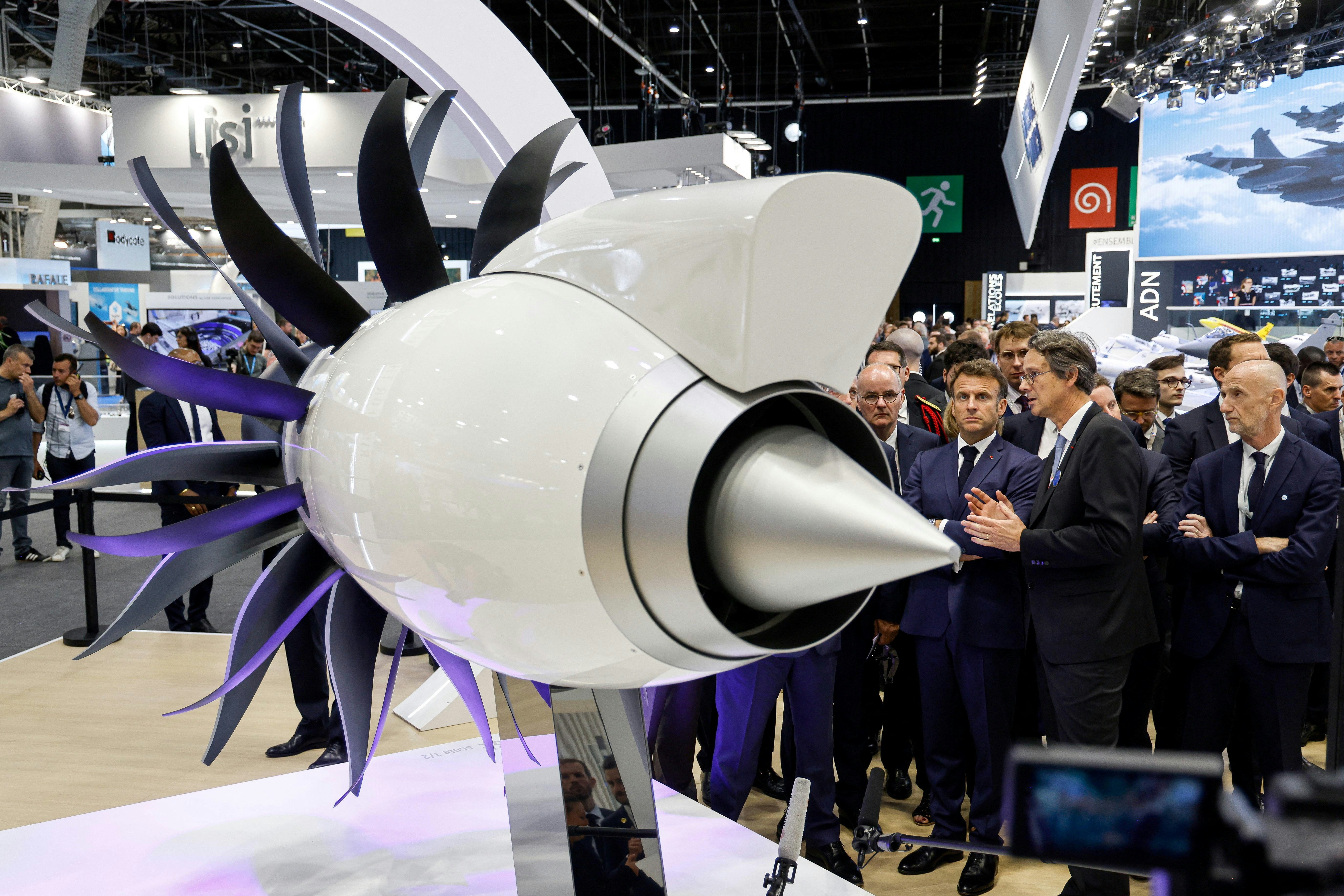
Looking to the future, Safran is co-developing the CFM RISE (Revolutionary Innovation for Sustainable Engines) program, which introduces an open-fan propulsion concept designed to deliver up to 20% additional fuel savings. The RISE engine features an unducted open-fan design that achieves ultra-high bypass ratios, hybrid-electric capabilities that anticipate evolving power grids and airframe technologies, and full compatibility with 100% sustainable aviation fuel (SAF) from the outset.
Navigating a Competitive Landscape
Safran’s leadership in aerospace innovation faces mounting challenges. The civil engine market is expected to become increasingly competitive, with 2026 potentially marking the beginning of a new “engine war” as rivals accelerate their technological advancements. In response, Safran has undertaken strategic initiatives such as divesting its in-flight entertainment and connectivity (IFEC) unit to Kingswood and integrating Skyted’s silent call technology into its passenger connectivity systems. These moves reflect the company’s efforts to sharpen its focus and maintain a competitive edge.
At the same time, competitors are advancing rapidly. Saab is developing software-defined fuselage technology, while Gogo’s Galileo system is poised to enter the inflight connectivity market, intensifying the race for technological supremacy.
As the aviation and defense industries confront increasing demands for efficiency, sustainability, and resilience, Safran S.A. remains a pivotal, though often unseen, force shaping the future of flight. Its capacity to innovate across propulsion, systems, and connectivity will influence not only its own trajectory but also the broader evolution of the aerospace sector.

Etihad Airways Suspends Airbus A380 Flights on Key Route

Aditya Birla Group Seeks Approval for Aircraft Leasing in GIFT City

Qatar Airways Highlights Innovation and Connectivity at Arabian Travel Market 2026

Hong Kong's Five-Year Plan Includes Andrew Fan's Aircraft Parts Processing Hub Proposal

ACIA Aero Leasing Delivers ATR72-600 to Air Nostrum

RTX Appoints Jill Albertelli as Head of Pratt & Whitney

TAT Technologies Joins Beyond Aero Hydrogen Aircraft Program

AURAK Study Highlights Barriers to Air Taxi Adoption in Emerging Economies

Xiamen Air Selects Altitude for 787 Maintenance at Heathrow

Etihad and Swissport Extend Global Partnership
