
Orquesta conocimientos de IA para convertirlos en acción

Tendencias
Categories
SpaceX Fires All 33 Engines in Starship Booster Test Ahead of Flight 13 Launch
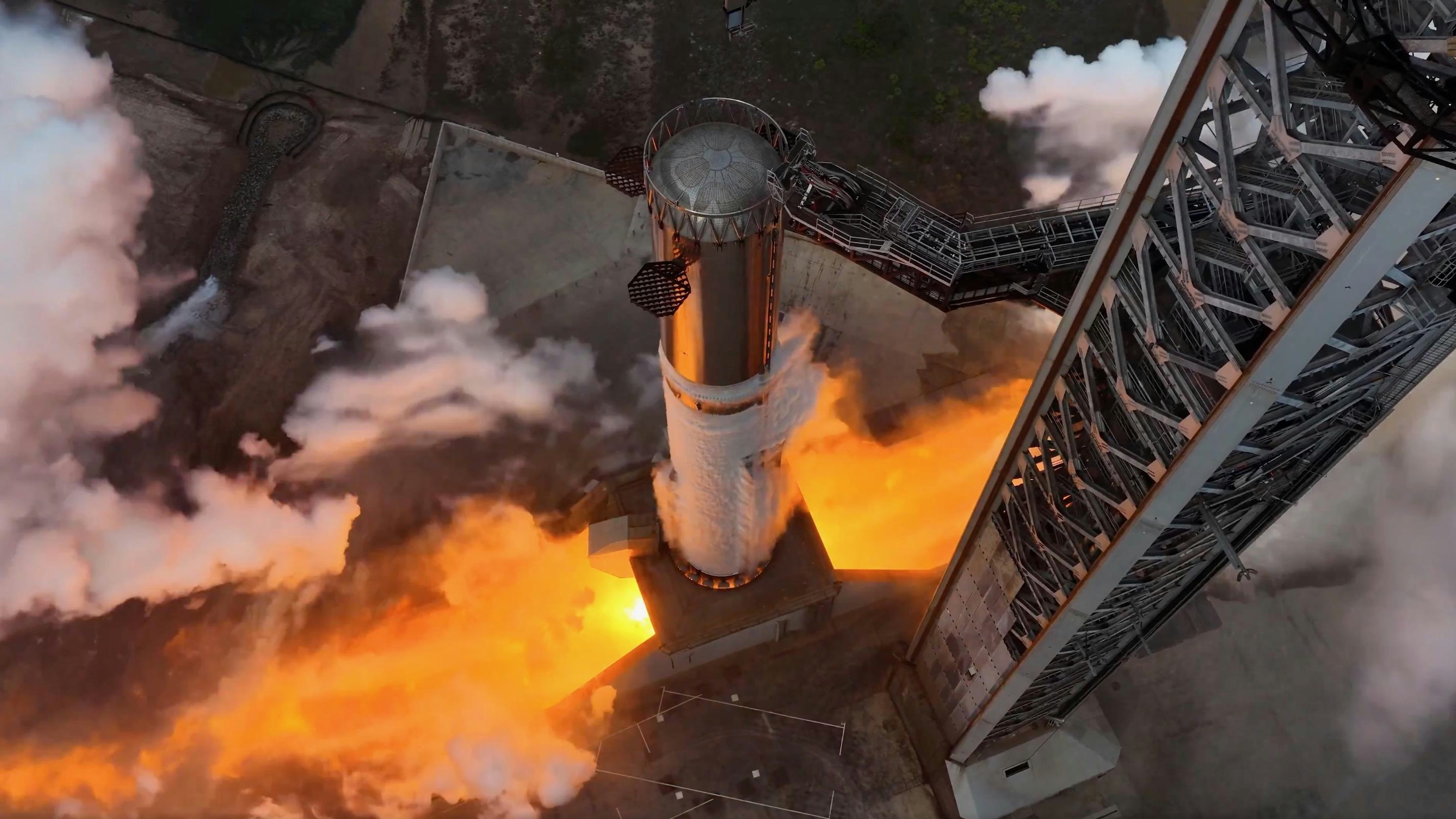
SpaceX Successfully Conducts Full Engine Static Fire Test on Starship Booster Ahead of Flight 13
SpaceX has achieved a significant milestone in its Starship program by successfully igniting all 33 engines of its Super Heavy booster during a static fire test at its Starbase facility in Texas. The test, conducted on July 10, involved Booster 20, the latest iteration of the "Version 3" (V3) Super Heavy model, as the company prepares for the upcoming Flight 13 launch, currently scheduled for July 14, 2026.
Booster 20 Static Fire Test and Preparations for Flight 13
Booster 20 was transported to the launch pad on July 9 and positioned on its support structure using the launch tower’s “Mechazilla” chopstick arms. Early the following day, SpaceX closed Boca Chica beach to commence fueling operations. The static fire test began just before 11 a.m. EDT (1500 GMT), with all 33 upgraded Raptor 3 engines firing simultaneously for approximately 25 seconds. This test simulated actual launch conditions and represented a critical step in the preflight validation process.
This successful static fire follows a related milestone achieved on July 2, when SpaceX fired all six Raptor engines on Ship 40, the upper stage that will be paired with Booster 20 for Flight 13. These consecutive tests highlight SpaceX’s ongoing efforts to refine Starship’s systems and operational procedures following challenges encountered during earlier missions.
Context and Upgrades in the V3 Starship
Flight 13 is set to build upon the lessons learned from Flight 12, which launched in May as the first mission to utilize the upgraded V3 Starship. While Flight 12 reached a suborbital trajectory and achieved a soft splashdown of the upper stage in the Indian Ocean, it also exposed areas requiring improvement. Notably, the Super Heavy booster (Booster 19) failed to perform a controlled ocean landing, and Ship 39 experienced an engine anomaly that prevented an in-space engine relight demonstration.
The V3 Starship incorporates several enhancements over its predecessor, including advanced avionics designed to reduce mass and increase payload capacity, a taller and larger-volume fuel tank, and new equipment to facilitate in-space propellant transfer. These improvements are essential for the ambitious missions Starship aims to support, including NASA’s Artemis program, which seeks to return astronauts to the lunar surface. As one of two lunar landers contracted by NASA, Starship’s development is under heightened scrutiny amid tightening Artemis timelines.
According to a Federal Aviation Administration notice, Flight 13 could launch as early as July 15. The mission is expected to follow a profile similar to Flight 12, emphasizing incremental progress and risk mitigation as SpaceX continues to advance its next-generation launch system.
Despite previous setbacks, SpaceX remains optimistic about the upcoming test flight, viewing the recent static fire tests as significant progress toward demonstrating Starship’s capabilities and furthering the company’s broader ambitions in space exploration.

Etihad Airways Suspends Airbus A380 Flights on Key Route

Aditya Birla Group Seeks Approval for Aircraft Leasing in GIFT City

Qatar Airways Highlights Innovation and Connectivity at Arabian Travel Market 2026

Hong Kong's Five-Year Plan Includes Andrew Fan's Aircraft Parts Processing Hub Proposal

ACIA Aero Leasing Delivers ATR72-600 to Air Nostrum

RTX Appoints Jill Albertelli as Head of Pratt & Whitney

TAT Technologies Joins Beyond Aero Hydrogen Aircraft Program

AURAK Study Highlights Barriers to Air Taxi Adoption in Emerging Economies

Xiamen Air Selects Altitude for 787 Maintenance at Heathrow

Etihad and Swissport Extend Global Partnership
