
Orquesta conocimientos de IA para convertirlos en acción

Tendencias
Categories
United Nigeria Airlines Calls for Tax Relief Amid Rising Costs
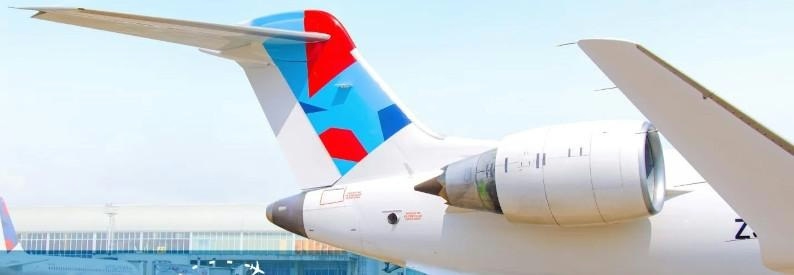
United Nigeria Airlines Urges Tax Relief Amid Rising Operational Costs
Adedayo Olawuyi, Chief Commercial Officer of United Nigeria Airlines, has appealed to the Nigerian government to reduce aviation taxes and charges, warning that escalating costs are placing domestic carriers under significant financial pressure. Speaking at the AeroWest conference in Lagos on September 2, 2026, Olawuyi outlined the structural challenges facing Nigerian airlines, particularly the currency mismatch that forces them to generate revenue in naira while incurring critical expenses—such as aircraft financing, maintenance, and pilot training—in US dollars.
Financial and Operational Challenges
Olawuyi highlighted that borrowing costs represent a major obstacle for Nigerian carriers, with interest rates reaching as high as 30%, while profit margins remain below 5%. This disparity severely constrains the airlines’ ability to invest and expand. Additionally, a shortage of qualified pilots has left some operators unable to deploy available aircraft due to insufficient crew, further limiting capacity. The absence of local maintenance, repair, and overhaul (MRO) facilities exacerbates the situation, compelling airlines to send aircraft abroad for heavy maintenance and thereby increasing their exposure to volatile foreign exchange fluctuations.
Fuel prices have also surged dramatically, rising from approximately NGN900 (USD 0.60) per litre in December 2025 to NGN3,000 (USD 2.25) per litre in 2026. Olawuyi noted that these soaring fuel costs leave airlines with little option but to pass expenses onto passengers through higher ticket prices, all while maintaining stringent safety standards.
Industry Implications and Calls for Collaboration
The call for tax relief comes amid broader industry challenges, including heightened regulatory scrutiny and intense competition. Some market observers have expressed skepticism regarding the sustainability and effectiveness of government tax relief measures, suggesting that competitors may respond by maintaining current pricing or pursuing their own cost-cutting strategies to remain viable.
Recent trends indicate that fare increases may become more widespread across the sector. United Airlines CEO Scott Kirby has signaled that gradual fare hikes are likely in 2027 due to ongoing fuel cost pressures, a development that could influence pricing strategies throughout the industry as carriers seek to offset rising operational expenses.
Olawuyi argued that reducing government-imposed charges and taxes would help lower fares and enhance the long-term sustainability of Nigeria’s aviation sector. He cautioned against viewing airlines primarily as revenue sources for other stakeholders and called for closer collaboration among government authorities, regulators, airlines, and the tourism sector to improve air connectivity across West and Central Africa. He emphasized the importance of deploying appropriately sized aircraft on the region’s numerous low-demand routes, noting that narrowbody jets are often uneconomical where passenger volumes are limited.
As Nigerian airlines continue to confront mounting costs and operational constraints, the debate over tax relief and industry support is expected to intensify, carrying significant implications for travelers and the broader aviation market.

Etihad Airways Suspends Airbus A380 Flights on Key Route

Aditya Birla Group Seeks Approval for Aircraft Leasing in GIFT City

Qatar Airways Highlights Innovation and Connectivity at Arabian Travel Market 2026

Hong Kong's Five-Year Plan Includes Andrew Fan's Aircraft Parts Processing Hub Proposal

ACIA Aero Leasing Delivers ATR72-600 to Air Nostrum

RTX Appoints Jill Albertelli as Head of Pratt & Whitney

TAT Technologies Joins Beyond Aero Hydrogen Aircraft Program

AURAK Study Highlights Barriers to Air Taxi Adoption in Emerging Economies

Xiamen Air Selects Altitude for 787 Maintenance at Heathrow

Etihad and Swissport Extend Global Partnership
