
Orquesta conocimientos de IA para convertirlos en acción

Tendencias
Categories
USAF Pilot Explains Why the Boeing 747 Lost the Fly-Off Tanker Competition
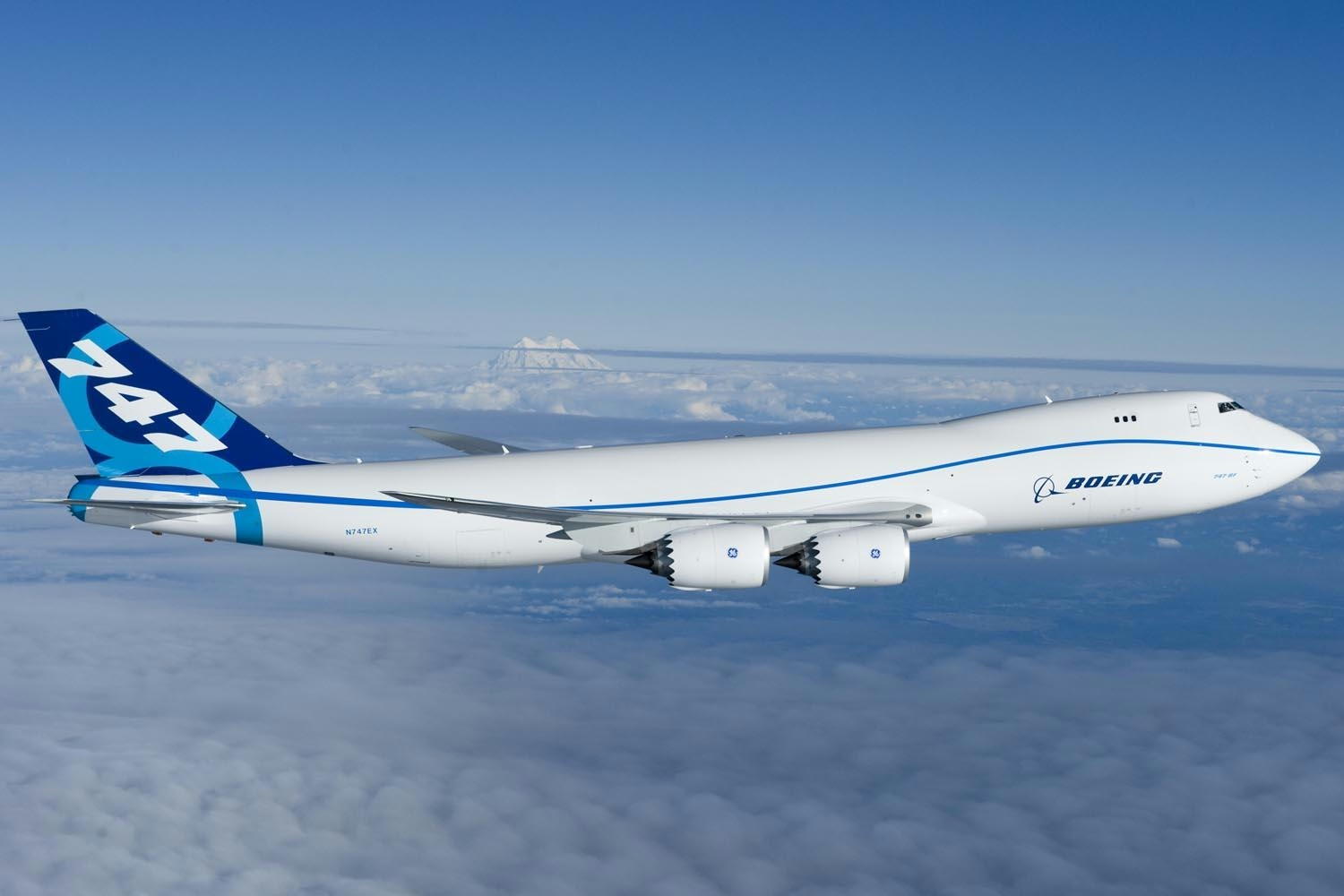
USAF Pilot Reflects on Boeing 747’s Loss in the Fly-Off Tanker Competition
The Boeing 747, heralded as the world’s first “Jumbo Jet,” marked a transformative milestone in aviation history. Developed in an extraordinary 16-month period during the late 1960s by a dedicated workforce of 50,000 Boeing employees—known as “the Incredibles”—the 747 emerged as the largest civilian aircraft of its era, fundamentally reshaping international air travel. Its maiden flight on February 9, 1969, was followed by rapid adoption among airlines worldwide. The original 747 prototype, designated N1352B (RA001), not only served as a platform for testing Boeing’s commercial jet innovations but was also adapted into a tanker configuration for evaluation by the U.S. Air Force (USAF).
The Fly-Off Competition and Evaluation
Despite the 747’s impressive performance and capabilities, it was ultimately not selected as the USAF’s next-generation aerial refueling tanker. Richard Klaus, a former USAF pilot who took part in the “Fly-off” competition at McChord Air Force Base in Washington, provides insight into the evaluation process. Klaus recalls that for several weeks, the base hosted three aircraft: the Boeing 747, the McDonnell Douglas DC-10, and the Lockheed L-1011. Each was assessed for dual roles as both tanker and heavy-lift freighter, with particular attention paid to loading procedures and turbulence effects in the wake of the aircraft. Klaus stated, “At the end of the test we were all convinced that we were getting 747 tankers. The 747 by a great margin was the better plane.”
However, Klaus emphasizes that the final decision was heavily influenced by political considerations rather than purely technical merit. “The big problem, or as we heard it at the time, was that the 747 was built in the wrong state. Congress got involved and Douglas in California got the contract with the DC-10, known by the Air Force designation KC-10. The KC-10 was slower to load with cargo, could not ‘nose load’ oversize items, and had a shorter range with less fuel offload capability. But it was built in California, where the more powerful Congressman lived.”
Legacy and Modern Implications
The 747 prototype used in the competition featured a non-functional fuel boom, limiting its tanker capabilities during testing. Although Iran later operated a third-party converted KC-747, that aircraft was reportedly destroyed in a 2025 Israeli Air Force raid. The original 747 prototype, later re-registered as N7470, is now preserved at The Museum of Flight in Seattle.
The USAF’s decision to bypass the 747 in favor of the KC-10 continues to resonate amid ongoing challenges in modernizing the Air Force’s mobility fleet. Reba Sonkiss, the Air Force’s mobility chief, recently underscored the urgent need to replace aging C-5 and C-17 transport aircraft, as well as KC-135 tankers, ahead of previous schedules. Despite these pressing requirements, the Air Force has ruled out the Embraer KC-390, instead endorsing the KC-46 as the cornerstone of its tanker fleet. Concurrently, Boeing is advancing modernization efforts on the C-17 flight deck through a $266 million contract, while Embraer, in collaboration with Northrop Grumman, is developing a refueling boom for the KC-390 to enhance its operational versatility.
The story of the 747’s tanker bid remains a poignant example of how political and industrial dynamics can overshadow technical excellence—a dynamic that continues to influence the Air Force’s strategic decisions in fleet modernization today.

Etihad Airways Suspends Airbus A380 Flights on Key Route

Aditya Birla Group Seeks Approval for Aircraft Leasing in GIFT City

Qatar Airways Highlights Innovation and Connectivity at Arabian Travel Market 2026

Hong Kong's Five-Year Plan Includes Andrew Fan's Aircraft Parts Processing Hub Proposal

ACIA Aero Leasing Delivers ATR72-600 to Air Nostrum

RTX Appoints Jill Albertelli as Head of Pratt & Whitney

TAT Technologies Joins Beyond Aero Hydrogen Aircraft Program

AURAK Study Highlights Barriers to Air Taxi Adoption in Emerging Economies

Xiamen Air Selects Altitude for 787 Maintenance at Heathrow

Etihad and Swissport Extend Global Partnership
