
Orquesta conocimientos de IA para convertirlos en acción

Tendencias
Categories
Why Airbus Chose Four Engines for the A380
Why Airbus Chose Four Engines for the A380
The Airbus A380 remains one of the most iconic aircraft in aviation history, distinguished by its two full-length passenger decks, an expansive wingspan of nearly 80 meters (262 feet), and four powerful high-bypass turbofan engines. Despite its engineering marvel and impressive size, the A380 faced significant operational challenges. Its large dimensions often rendered it unprofitable for many airlines, and its fuel consumption was notably higher than that of its twin-engine competitors.
The Four-Engine Configuration and Its Implications
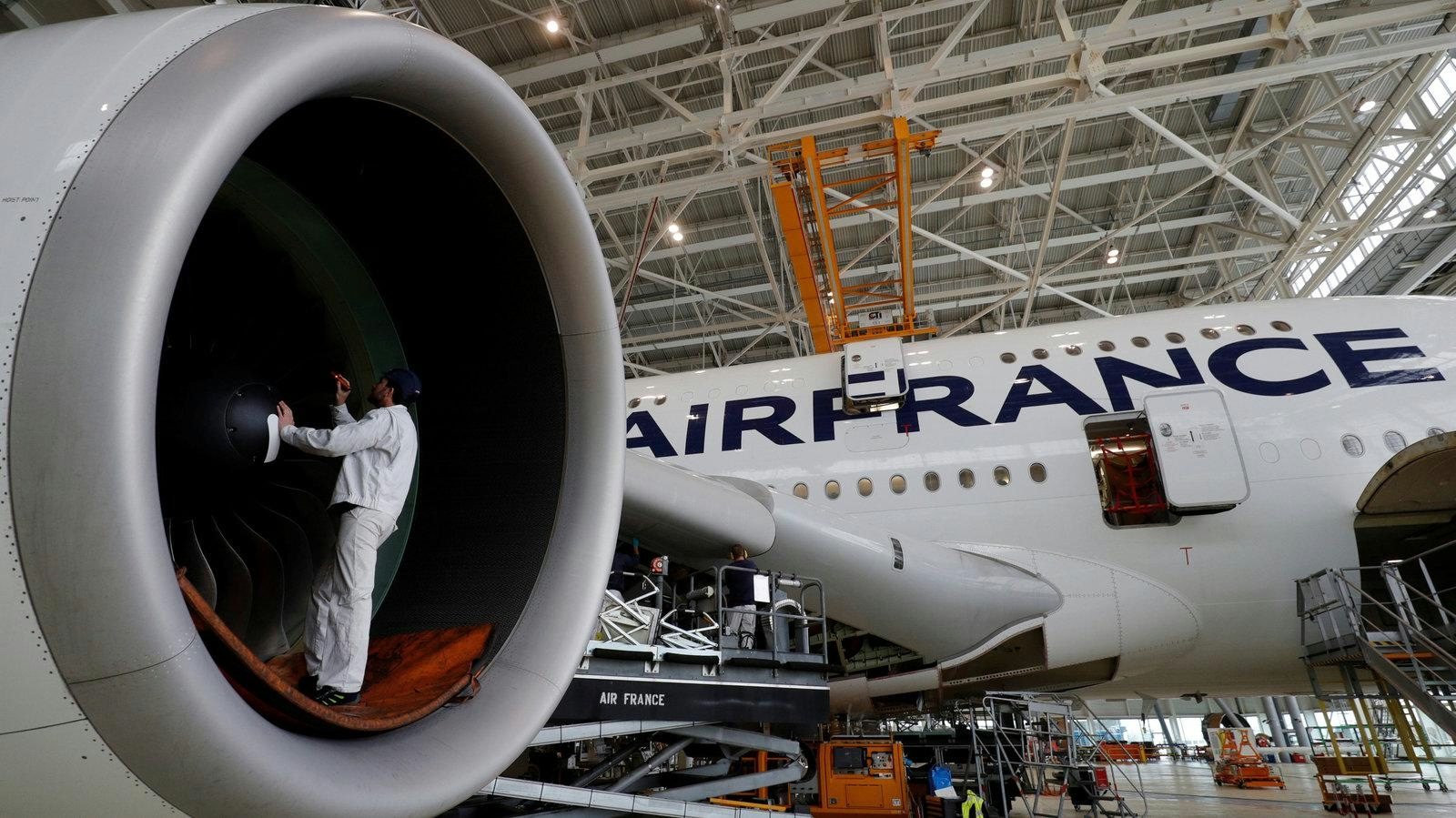
A central factor contributing to the A380’s operational difficulties was its four-engine design. The aircraft was equipped with either the Engine Alliance GP7200 or Rolls-Royce Trent 900 engines, both advanced for their time. However, the presence of four engines inherently resulted in greater fuel consumption and elevated maintenance costs compared to twinjets such as the Boeing 777. The complexity and expense of maintaining two additional engines increased the overall operating costs, making the A380 less appealing to airlines prioritizing efficiency and cost-effectiveness.
This dynamic is evident in the aircraft’s sales performance. Airbus delivered only 251 A380s, a stark contrast to the over 800 units sold of Boeing’s largest 777 variant, the 777-300ER. The market’s preference for twin-engine aircraft has only intensified, as demonstrated by the commercial success of the Airbus A350 and Boeing 787, both designed around the principle of maximizing efficiency with just two engines.
The Necessity Behind Four Engines
Airbus’s decision to equip the A380 with four engines was driven primarily by the aircraft’s unprecedented scale. With a maximum takeoff weight (MTOW) of 575 tonnes—significantly heavier than the 777-300ER’s 351 tonnes—the A380 required more thrust than the most powerful twinjet engines available could deliver. Each of the A380’s engines produces up to 76,752 pounds of thrust, enabling the aircraft to generate over 307,000 pounds of thrust at takeoff, a level unattainable with a twin-engine configuration.
The timing of the A380’s development further influenced its design and commercial trajectory. Its engines were based on late-1990s technology, introduced after earlier widebody aircraft but before the advent of the next generation of highly efficient engines featured on the Boeing 787 and Airbus A350. Consequently, the A380 was caught between technological eras, unable to capitalize on the latest advancements in fuel efficiency.
Market Response and Airbus’s Broader Challenges
Reactions within the aviation industry to Airbus’s four-engine strategy have been mixed. Some carriers, such as Global Airlines, continue to operate the A380 despite skepticism and rising operational costs. Meanwhile, competitors have intensified their focus on developing more fuel-efficient twinjets, further diminishing the A380’s market share.
Compounding Airbus’s challenges are recent issues with its A320 family, including a software recall and concerns over the quality of metal panels. These problems have complicated Airbus’s position in an increasingly competitive market.
In essence, the A380’s four-engine configuration was a technical necessity born of ambition and the aircraft’s immense size. However, it also came to symbolize the commercial difficulties faced by the A380 in an era dominated by the pursuit of efficiency.

Etihad Airways Suspends Airbus A380 Flights on Key Route

Aditya Birla Group Seeks Approval for Aircraft Leasing in GIFT City

Qatar Airways Highlights Innovation and Connectivity at Arabian Travel Market 2026

Hong Kong's Five-Year Plan Includes Andrew Fan's Aircraft Parts Processing Hub Proposal

ACIA Aero Leasing Delivers ATR72-600 to Air Nostrum

RTX Appoints Jill Albertelli as Head of Pratt & Whitney

TAT Technologies Joins Beyond Aero Hydrogen Aircraft Program

AURAK Study Highlights Barriers to Air Taxi Adoption in Emerging Economies

Xiamen Air Selects Altitude for 787 Maintenance at Heathrow

Etihad and Swissport Extend Global Partnership
