
Orchestrer les insights d’IA pour les transformer en actions

Tendances
Categories
Accurate Measurement and AI Enhance Situational Awareness in Aviation
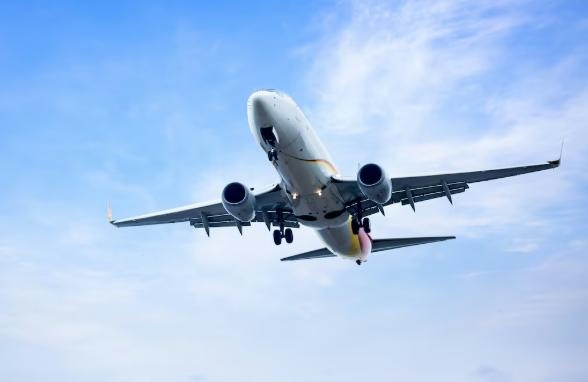
Accurate Measurement and AI Enhance Situational Awareness in Aviation
Situational awareness remains fundamental to aviation safety, guiding the decisions of pilots, air traffic controllers, and automated systems alike. As global airspace becomes increasingly congested and operational environments grow more complex, maintaining a clear and accurate understanding of real-time conditions presents significant challenges. Artificial intelligence (AI) is emerging as a vital tool to address these complexities by analyzing vast streams of visual, sensor, and telemetry data. Through this analysis, AI detects potential risks, interprets dynamic environments, and supports timely decision-making processes.
The Evolving Definition of Situational Awareness
In contemporary aviation, situational awareness encompasses the perception of relevant environmental elements, comprehension of their significance, and anticipation of future developments. Traditionally, this awareness relied heavily on human perception supported by instruments such as radar and cockpit displays. However, today’s aviation ecosystem generates data volumes far exceeding human processing capabilities. Continuous information streams from aircraft sensors, surveillance systems, ground-based cameras, and satellites feed into operational platforms. AI technologies are increasingly deployed to interpret this data in real time, serving to augment human awareness rather than replace it.
The Critical Role of Accurate Measurement
Accurate measurement underpins every aspect of aviation safety. Operational decisions depend on precise information regarding position, speed, altitude, weather conditions, and surrounding traffic. Measurement errors can rapidly escalate into hazardous situations. AI systems do not perform direct measurements; instead, they interpret data collected from a variety of sensors, including cameras, infrared devices, LiDAR, and satellites. The transformation of raw sensor data into structured, analyzable formats presents its own challenges. For AI to effectively enhance situational awareness, input data must be precise, consistent, and truly representative of real-world conditions.
Data Preparation: A Key Challenge
Raw aviation data is inherently complex and often affected by noise. Visual feeds may be distorted by lighting conditions, weather phenomena, or sensor limitations, while radar and telemetry data can contain gaps or ambiguities. Without meticulous structuring and validation, such data cannot be reliably interpreted by AI models. Preparing training data involves rigorous annotation, validation, and alignment with operational definitions—processes that are especially critical in aviation, where even minor errors can have significant consequences. Robust data collection and analysis systems are essential to ensure AI models learn to prioritize relevant information and operate safely within the demanding aviation environment.
Applications and Industry Response
AI-supported situational awareness is being applied across multiple domains within aviation. In air traffic management, AI analyzes radar, transponder signals, and surveillance imagery to detect conflicts, predict trajectories, and assist controllers in managing increasingly dense and variable traffic conditions. Effective deployment in this area requires diverse and representative datasets to ensure reliable performance. Within flight operations and cockpit assistance, AI aids pilots by interpreting sensor data, monitoring aircraft systems, and identifying potential hazards, thereby enhancing operational safety.
As the aviation industry embraces these technologies, several challenges remain. Ensuring regulatory compliance and managing cybersecurity risks are paramount, given the sensitive nature of aviation data and operations. The market is responding with increased investment in AI and data analytics platforms, while competitors accelerate research and development or form strategic partnerships to integrate advanced AI solutions. The future trajectory of AI in aviation is likely to focus on building integrated systems that enhance both safety and efficiency, while proactively addressing the associated risks.

Etihad Airways Suspends Airbus A380 Flights on Key Route

Aditya Birla Group Seeks Approval for Aircraft Leasing in GIFT City

Qatar Airways Highlights Innovation and Connectivity at Arabian Travel Market 2026

Hong Kong's Five-Year Plan Includes Andrew Fan's Aircraft Parts Processing Hub Proposal

ACIA Aero Leasing Delivers ATR72-600 to Air Nostrum

RTX Appoints Jill Albertelli as Head of Pratt & Whitney

TAT Technologies Joins Beyond Aero Hydrogen Aircraft Program

AURAK Study Highlights Barriers to Air Taxi Adoption in Emerging Economies

Xiamen Air Selects Altitude for 787 Maintenance at Heathrow

Etihad and Swissport Extend Global Partnership
