
Orchestrer les insights d’IA pour les transformer en actions

Tendances
Categories
Airlines Prepare for Disruptions Amid Government Shutdown Ahead of Holidays
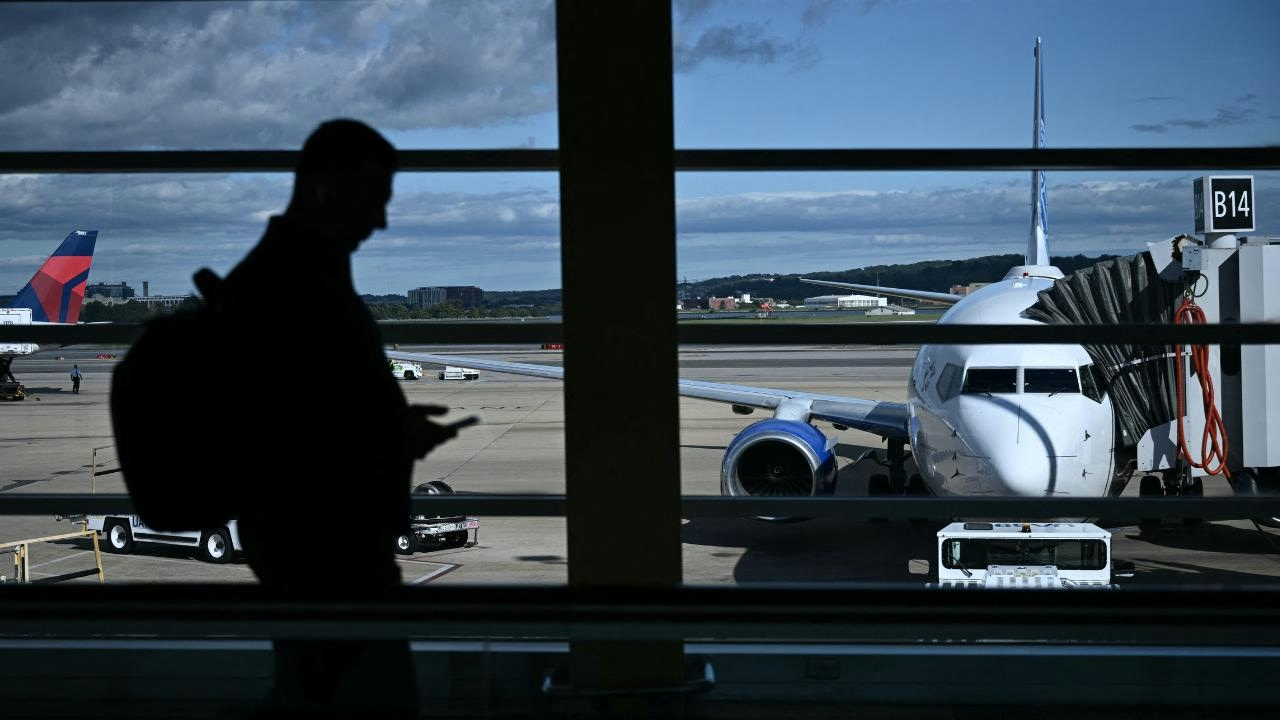
Airlines Prepare for Disruptions Amid Government Shutdown Ahead of Holidays
Ongoing Impact on Holiday Travel
As the Thanksgiving travel season approaches, airlines are cautioning passengers to anticipate continued delays and cancellations stemming from the recent government shutdown. Although Congress ended the 35-day impasse, the Federal Aviation Administration (FAA) remains burdened by severe staffing shortages and operational backlogs that continue to disrupt air travel. The aviation industry is still grappling with the fallout, complicating efforts to restore normal service during one of the busiest travel periods of the year.
During the shutdown, cancellations surged, peaking at 10 percent on a single Sunday—ranking as the fourth worst day for flight cancellations in 2023. The FAA imposed a 4 percent reduction in flights at 40 of the nation’s busiest airports, compelling airlines to preemptively cancel up to 6 percent of flights at major hubs. Airports including Reagan National, Dulles International, and Baltimore/Washington International (BWI) faced further cuts as carriers sought to mitigate the disruption for travelers.
Chris Sununu, president of Airlines for America, underscored the lingering effects, stating that “airlines cannot flip a switch and resume normal operations immediately after a vote—there will be residual effects for days.” Airlines continue to reposition crews and aircraft that were scattered nationwide during the shutdown, a complex logistical challenge exacerbated by the timing, as the Sunday following Thanksgiving is traditionally the busiest travel day of the year.
Structural Challenges in Air Traffic Control
The shutdown has intensified preexisting challenges within the air traffic control system, which has been under strain for nearly 15 years due to chronic staffing shortages. Air traffic controllers face mandatory retirement at age 56, and the training pipeline for new controllers spans two to five years. This pipeline was effectively frozen during the shutdown as all new hiring was halted, despite the FAA keeping its training academy in Oklahoma City operational. The agency has yet to announce when recruitment will resume.
Tim Kiefer, a former air traffic controller and current instructor at Embry-Riddle Aeronautical University, acknowledged that delays are an inherent part of air travel due to weather, equipment issues, or staffing. However, he emphasized that the shutdown has significantly worsened the situation, with persistent delays and cancellations continuing even after the Senate reached a deal to end the shutdown.
The financial uncertainty faced by federal workers adds further strain. Many controllers, already working mandatory overtime to cover staffing gaps, are still awaiting full back pay—a process that may take weeks. Kiefer warned that this instability could discourage prospective recruits, noting the risk that potential controllers might be deterred by the prospect of being subject to recurring appropriations battles and delayed compensation.
As millions of Americans prepare to travel for the holidays, the aviation system remains under considerable pressure. Airlines and air traffic controllers are continuing to manage the repercussions of the shutdown, with operational challenges expected to persist throughout the holiday season.

Etihad Airways Suspends Airbus A380 Flights on Key Route

Aditya Birla Group Seeks Approval for Aircraft Leasing in GIFT City

Qatar Airways Highlights Innovation and Connectivity at Arabian Travel Market 2026

Hong Kong's Five-Year Plan Includes Andrew Fan's Aircraft Parts Processing Hub Proposal

ACIA Aero Leasing Delivers ATR72-600 to Air Nostrum

RTX Appoints Jill Albertelli as Head of Pratt & Whitney

TAT Technologies Joins Beyond Aero Hydrogen Aircraft Program

AURAK Study Highlights Barriers to Air Taxi Adoption in Emerging Economies

Xiamen Air Selects Altitude for 787 Maintenance at Heathrow

Etihad and Swissport Extend Global Partnership
