
Orchestrer les insights d’IA pour les transformer en actions

Tendances
Categories
AutoFlight Unveils First eVTOL Air Taxi Water Landing Platform
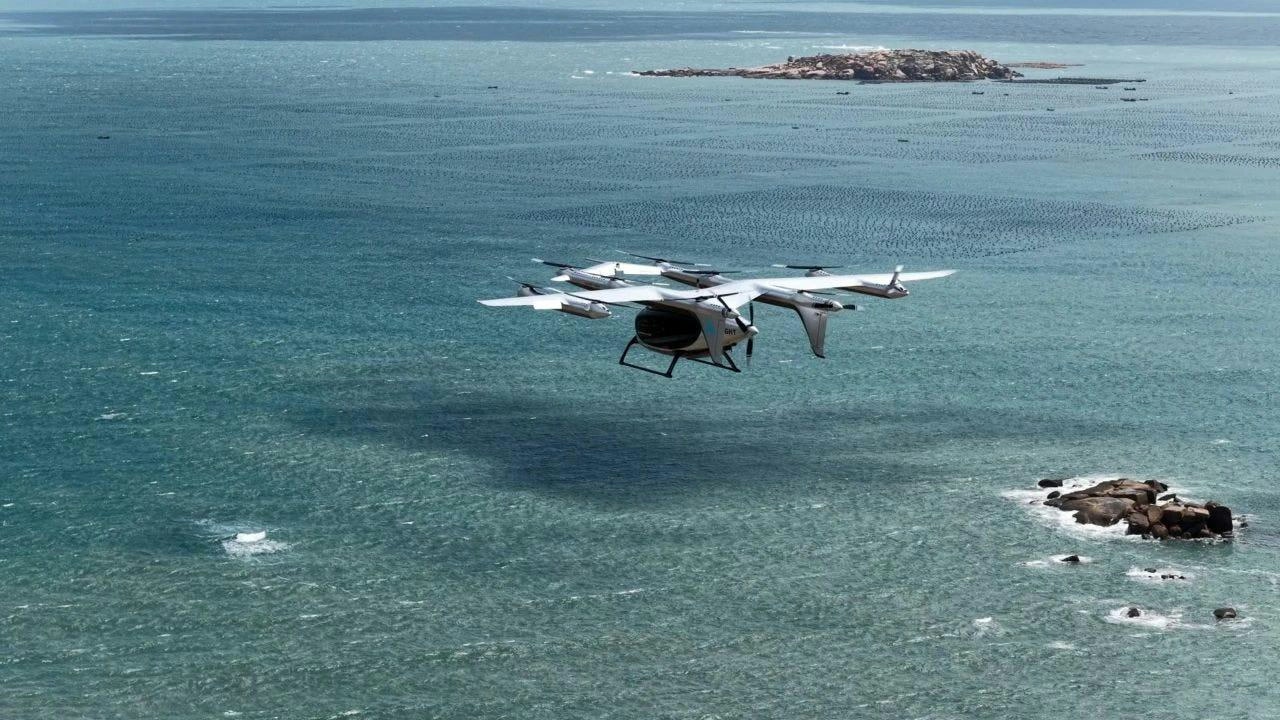
AutoFlight Introduces the World’s First eVTOL Water Landing Platform
AutoFlight, a prominent manufacturer of commercial electric vertical take-off and landing (eVTOL) aircraft supported by battery giant CATL, has unveiled the world’s first autonomous floating airport designed specifically for eVTOL operations. Named the "Water Vertiport," this innovative platform facilitates sea-air mobility by enabling eVTOL aircraft to take off and land on water. It is engineered for rapid deployment across various aquatic environments, including lakes, rivers, and open seas.
Features and Operational Capabilities
The Water Vertiport operates fully autonomously and incorporates integrated solar panels alongside energy storage systems to provide on-site charging for aircraft. It also houses a dispatch center and communications hub, supporting a broad spectrum of applications such as passenger air taxis, cargo delivery, emergency response, and offshore maintenance. AutoFlight envisions the deployment of multiple Water Vertiports to form distributed "Vertiport clusters" or even a large-scale "Sea-Air Super Hub," facilitating coordinated operations in both urban and remote settings.
Backed by CATL’s substantial investment—amounting to hundreds of millions of dollars—and its development of specialized batteries for electric aircraft, AutoFlight has already secured orders exceeding 2,000 units. The company asserts that the Water Vertiport could halve emergency response times and accelerate maintenance operations for offshore wind farms and oil rigs by up to tenfold. For urban air taxi services, the platform offers direct routes to airports or city centers, potentially alleviating congestion on conventional transport networks.
Challenges and Market Dynamics
Despite its promising potential, the Water Vertiport faces significant challenges, foremost among them regulatory approval. Authorities worldwide are still in the process of establishing frameworks for advanced air mobility (AAM), and integrating new technologies into existing airspace and maritime environments raises complex safety and operational concerns.
Nonetheless, market interest in eVTOL technology is intensifying. In the Middle East, Falcon Aviation Services has committed to purchasing 50 AutoFlight eVTOL aircraft, reflecting strong regional demand. Meanwhile, competitors are accelerating their initiatives; for instance, Eve, a leading AAM developer, recently signed a framework agreement with Bahrain’s Ministry of Transportation and Telecommunications to launch commercial eVTOL operations by 2028.
CATL is also expanding its technological portfolio beyond electric vehicle batteries, developing condensed batteries capable of powering electric planes with ranges up to 2,000 miles. The company is simultaneously working on standardized battery swap stations and charging infrastructure, innovations that could further propel the adoption of eVTOL aircraft and transform urban and regional mobility.
As the eVTOL sector advances rapidly, AutoFlight’s Water Vertiport represents a significant milestone in integrating air, land, and sea transport. Its ultimate success will depend on navigating regulatory, safety, and technological challenges amid intensifying global competition.

Etihad Airways Suspends Airbus A380 Flights on Key Route

Aditya Birla Group Seeks Approval for Aircraft Leasing in GIFT City

Qatar Airways Highlights Innovation and Connectivity at Arabian Travel Market 2026

Hong Kong's Five-Year Plan Includes Andrew Fan's Aircraft Parts Processing Hub Proposal

ACIA Aero Leasing Delivers ATR72-600 to Air Nostrum

RTX Appoints Jill Albertelli as Head of Pratt & Whitney

TAT Technologies Joins Beyond Aero Hydrogen Aircraft Program

AURAK Study Highlights Barriers to Air Taxi Adoption in Emerging Economies

Xiamen Air Selects Altitude for 787 Maintenance at Heathrow

Etihad and Swissport Extend Global Partnership
