
Orchestrer les insights d’IA pour les transformer en actions

Tendances
Categories
Aviation to AI: How Boeing Engines Are Powering the Data Center Boom
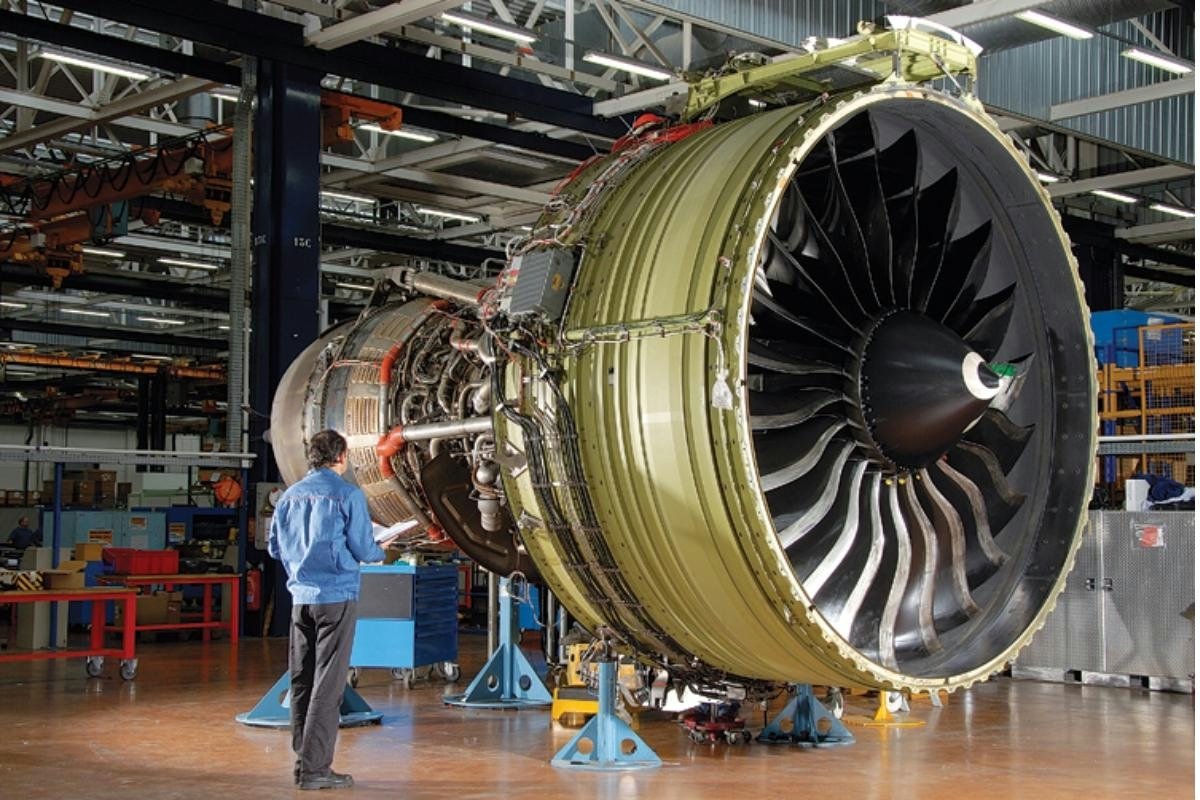
Aviation to AI: How Boeing Engines Are Powering the Data Center Boom
Repurposing Jet Engines for Data Center Power
As the demand for energy escalates in tandem with the rapid expansion of artificial intelligence infrastructure, companies are increasingly exploring unconventional solutions to meet power needs. One such approach involves converting jet engines into gas turbines to supply electricity for data centers. This innovative strategy addresses capacity shortages and long lead times associated with traditional turbines, providing a faster alternative for technology firms striving to scale their AI operations.
FTAI Aviation, a specialist in leasing and repairing aircraft engines, is leading this emerging trend. The company plans to market a modified version of the Boeing 737’s CFM56 engine, adapted for land-based power generation. These solutions could become commercially available as early as 2026. Following the announcement of FTAI’s new energy turbine business in December 2025, the company’s share price surged by 42%, although it later retreated to $286 in premarket trading on February 23, according to TradingView.
David Moreno, President of FTAI Aviation, explained that converting an aircraft engine into a power turbine requires 30 to 45 days after an 18-month development period. The process typically involves modifying the engine to operate on natural gas instead of jet fuel and replacing the large fan with a smaller, power-optimized variant.
Industry Dynamics and Market Opportunities
Other players are also entering this niche market. ProEnergy is offering turbines based on Boeing 747 engines, while Boom Supersonic is developing similar units tailored for AI data centers, including fulfilling an order from the startup Crusoe. Experts emphasize that jet engines are well-suited for stationary power generation due to their high output and reliability.
Established manufacturers such as GE Vernova, Siemens Energy, and Mitsubishi Heavy Industries already produce aeroderivative turbines, but their delivery schedules often extend over several years. This delay has created an opening for newer entrants like FTAI and Boom Supersonic, which promise more rapid deployment. Analysts estimate that around 1,600 aircraft engines are retired annually, representing a substantial opportunity to increase available capacity and help close the power gap faced by data centers.
Challenges and Market Outlook
Despite the potential, Boeing and its partners confront several challenges in adapting jet engines for stationary power applications. Competition among engine manufacturers is intensifying, and significant engineering modifications are necessary to repurpose aircraft engines for land-based use. Additionally, there is skepticism within the market regarding the efficiency and cost-effectiveness of jet engines compared to conventional power sources. In response, competitors may accelerate the development of alternative technologies or enhance their existing offerings for data center power generation.
The stakes are considerable as technology companies continue to invest heavily in AI infrastructure. Global capital expenditures on AI are projected to surpass $700 billion by 2026, driving demand for innovative and reliable energy solutions. OpenAI alone is expected to allocate $600 billion toward AI compute by 2030, underscoring the urgent need for scalable power sources.
As the race to power the AI revolution intensifies, the conversion of jet engines into gas turbines presents both a promising opportunity and a formidable engineering challenge for the aviation and energy sectors.

Etihad Airways Suspends Airbus A380 Flights on Key Route

Aditya Birla Group Seeks Approval for Aircraft Leasing in GIFT City

Qatar Airways Highlights Innovation and Connectivity at Arabian Travel Market 2026

Hong Kong's Five-Year Plan Includes Andrew Fan's Aircraft Parts Processing Hub Proposal

ACIA Aero Leasing Delivers ATR72-600 to Air Nostrum

RTX Appoints Jill Albertelli as Head of Pratt & Whitney

TAT Technologies Joins Beyond Aero Hydrogen Aircraft Program

AURAK Study Highlights Barriers to Air Taxi Adoption in Emerging Economies

Xiamen Air Selects Altitude for 787 Maintenance at Heathrow

Etihad and Swissport Extend Global Partnership
