
Orchestrer les insights d’IA pour les transformer en actions

Tendances
Categories
Boeing 777-9 and Airbus A350-1000: Comparing the Next Generation of Widebody Jets
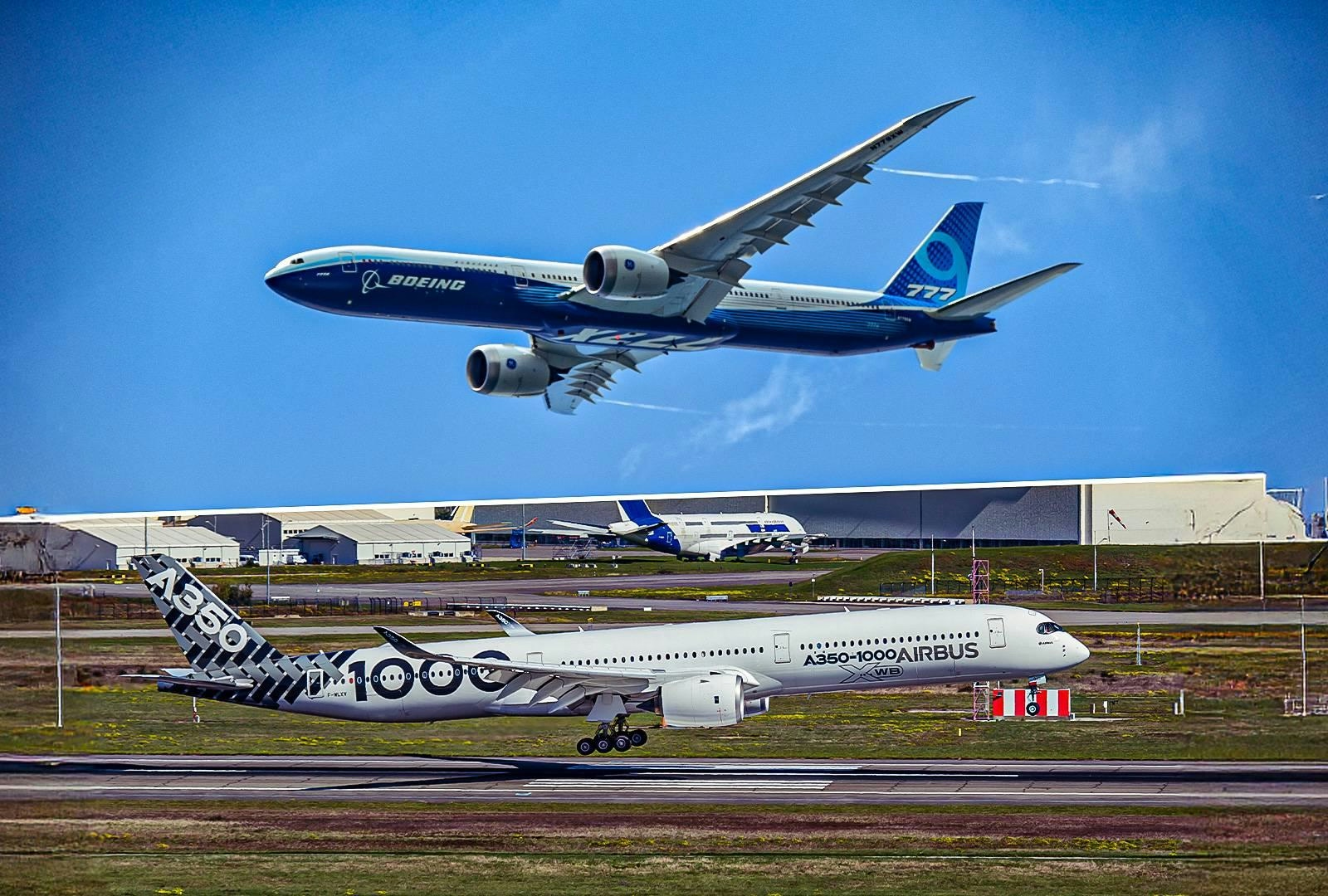
Boeing 777-9 and Airbus A350-1000: Comparing the Next Generation of Widebody Jets
The impending entry of the Boeing 777-9 into commercial service will mark the arrival of the largest twin-engine airliner ever constructed. However, by that time, its primary competitor, the Airbus A350-1000, will have already been in operation for nearly a decade. During this period, the A350-1000 has established a robust global customer base and demonstrated its capabilities on some of the world’s longest routes. This staggered timeline frames the competition between the two aircraft less as a comparison of theoretical specifications and more as a test of whether Boeing’s larger, higher-capacity design can surmount Airbus’s significant operational head start.
The rivalry between the 777-9 and the A350-1000 extends beyond mere seat counts and range figures. Airlines and industry analysts consider a range of factors including passenger capacity, operating economics, engine technology, certification schedules, real-world route applicability, and order volumes. These considerations underscore the complex decisions faced by carriers such as Lufthansa, which must weigh the distinct advantages offered by each model.
Capacity and Range: Critical Performance Metrics
Boeing states that the 777-9 accommodates between 375 and 450 passengers in a two-class configuration, with some layouts seating up to 426. In contrast, Airbus positions the A350-1000 with a typical three-class seating capacity ranging from 350 to 410 passengers, with a maximum around 369 seats. This translates to approximately a 16% capacity advantage for the 777-9, a significant factor in lowering seat-mile costs, as highlighted by aviation consultancy AirInsight.
In terms of range, the A350-1000 holds a clear lead. Airbus and British Airways documentation cite a maximum range of up to 8,700 nautical miles (16,112 kilometers), with some sources suggesting capabilities extending to 9,000 nautical miles. Boeing has recently increased the 777-9’s advertised range to 8,000 nautical miles (14,816 kilometers), narrowing the gap but still trailing the Airbus offering. This range advantage makes the A350-1000 particularly well-suited for ultra-long-haul routes, a market segment where it has already secured a strong foothold.
Engineering Innovations and Operational Efficiency
The Airbus A350-1000 incorporates advanced materials, with carbon-fiber reinforced polymer comprising 53% of its structural weight. This use of lightweight composites contributes to reduced overall weight, lower fuel consumption, and decreased maintenance costs over the aircraft’s operational lifespan. Boeing, on the other hand, emphasizes the 777-9’s larger cabin size, which allows fixed costs to be distributed across more seats, thereby enhancing efficiency on routes with high passenger demand.
A distinctive engineering feature of the 777-9 is its record-breaking wingspan of 235 feet, 5 inches (71.75 meters). To accommodate existing airport gate infrastructure, Boeing has developed folding wingtips that reduce the wingspan to 212 feet, 9 inches (64.85 meters) while on the ground. Airbus did not require such a solution, as the A350-1000’s wingspan of 64.75 meters fits within current airport facilities. Boeing asserts that the extended wingspan in flight contributes to up to 20% lower fuel consumption, underscoring the aircraft’s aerodynamic efficiency.
Market Dynamics and Future Prospects
Market responses to these aircraft reflect their respective strengths. The A350-1000’s superior range secures its position in ultra-long-haul markets, while the 777-9’s greater capacity appeals to airlines focused on high-density routes. Airbus continues to refine the A350 family to address growing demand for large widebody aircraft, balancing technological innovation with shareholder expectations. Concurrently, Boeing is advancing the capabilities of the 777X series to maintain its competitive edge.
The ongoing competition between the Boeing 777-9 and Airbus A350-1000 is poised to shape the trajectory of long-haul aviation. Each aircraft offers unique advantages, and their rivalry will influence airline fleet strategies and passenger experiences well into the coming decade.

Etihad Airways Suspends Airbus A380 Flights on Key Route

Aditya Birla Group Seeks Approval for Aircraft Leasing in GIFT City

Qatar Airways Highlights Innovation and Connectivity at Arabian Travel Market 2026

Hong Kong's Five-Year Plan Includes Andrew Fan's Aircraft Parts Processing Hub Proposal

ACIA Aero Leasing Delivers ATR72-600 to Air Nostrum

RTX Appoints Jill Albertelli as Head of Pratt & Whitney

TAT Technologies Joins Beyond Aero Hydrogen Aircraft Program

AURAK Study Highlights Barriers to Air Taxi Adoption in Emerging Economies

Xiamen Air Selects Altitude for 787 Maintenance at Heathrow

Etihad and Swissport Extend Global Partnership
