
Orchestrer les insights d’IA pour les transformer en actions

Tendances
Categories
Boeing Deal Shifts Archer’s Strategy as Joby Advances Commercial Air Taxis
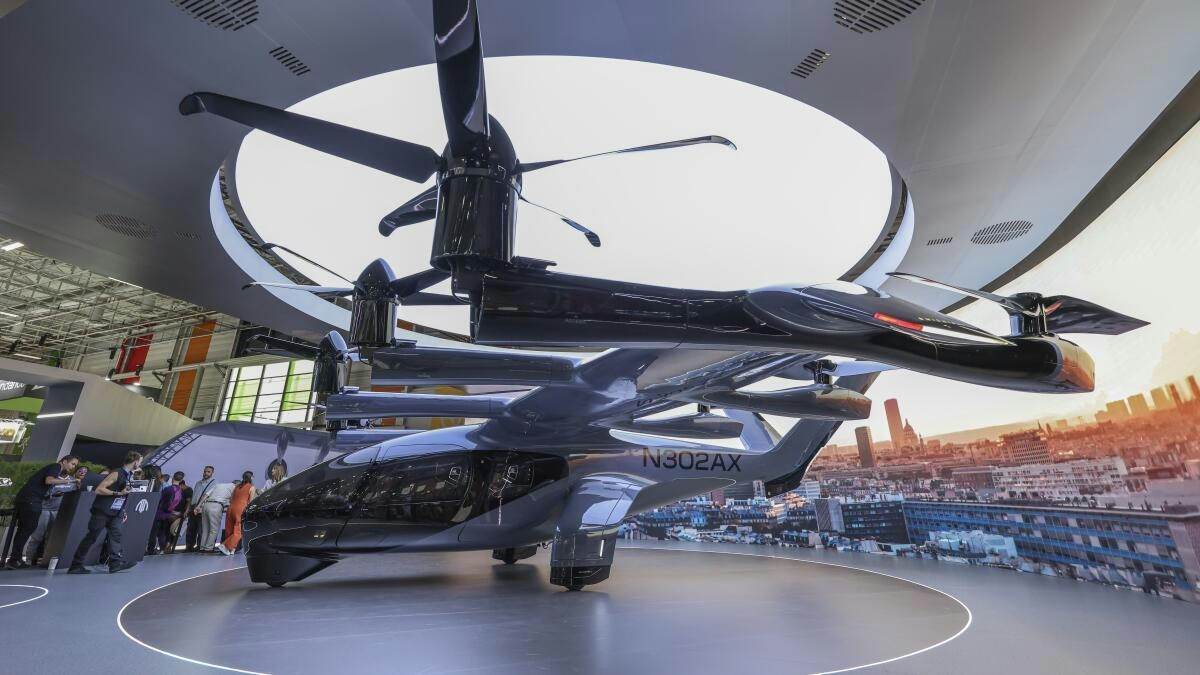
Boeing Deal Shifts Archer’s Strategy as Joby Advances Commercial Air Taxis
Archer Expands Horizons with Boeing Acquisition
Archer Aviation and Joby Aviation, prominent contenders in the electric vertical takeoff and landing (eVTOL) sector, are pursuing the shared vision of commercial air taxis but are adopting markedly different strategic approaches, as reflected in their recent quarterly results.
Archer reported second-quarter revenue of $5 million, representing a 213% increase from the previous quarter and surpassing analyst expectations. Despite this growth, the company recorded a net loss of $263.2 million, highlighting the substantial expenses involved in developing next-generation aviation technologies. A pivotal development for Archer is its agreement to acquire three Boeing-owned aerospace and defense entities—Wisk Aero, Insitu, and SkyGrid—in exchange for Boeing shares. This acquisition signals a strategic shift, positioning Archer as a more diversified player in commercial aerospace, defense, and autonomous flight technology, rather than focusing exclusively on air taxis.
The acquired businesses bring significant capabilities to Archer’s portfolio. Wisk Aero specializes in eVTOL aircraft development, Insitu provides unmanned aerial systems primarily for surveillance and defense applications, and SkyGrid develops advanced technology for managing autonomous aircraft within complex airspace environments. Collectively, these companies have accumulated nearly two million flight hours, offering Archer valuable operational data and technological assets to enhance its ZEE AI platform, which integrates flight, weather, terrain, and aircraft data to improve safety and operational efficiency.
Boeing’s decision to invest in Archer while integrating its flying-taxi venture Wisk Aero into Archer reflects a strategic recalibration. For Boeing, this move may represent a withdrawal from direct competition in the challenging air taxi market. For Archer, it presents an opportunity to consolidate capabilities in defense and autonomy, though it also introduces challenges related to scaling operations, navigating regulatory frameworks, and developing the necessary infrastructure to meet commercial demand.
Joby Advances Through Partnerships and Commercial Momentum
In contrast, Joby Aviation reported $39 million in revenue for the second quarter, an increase of $14 million from the previous quarter, and raised its 2026 revenue forecast to between $115 million and $125 million. This growth is largely driven by its Blade helicopter business, which generated $36.2 million in revenue with seat sales increasing by more than 50% year-over-year. Despite leading in revenue, Joby also posted a net loss of $245 million.
Joby is capitalizing on its partnership with Blade and manufacturing support backed by Toyota to advance its commercial air taxi ambitions. CEO JoeBen Bevirt announced plans to commence pilot electric air taxi flights in Texas next month as part of a White House-supported initiative, marking a significant step toward operationalizing commercial services.
Market Dynamics and Competitive Landscape
The divergent strategies of Archer and Joby underscore the evolving dynamics within the eVTOL industry. Archer’s broadened focus through the Boeing acquisition may appeal to investors interested in defense and autonomous technologies but also introduces operational complexities and regulatory challenges. Meanwhile, Joby’s revenue growth and strategic partnerships position it as a formidable contender in the race to launch commercial air taxi services.
Both companies continue to expend significant capital to develop and scale their technologies, eliciting mixed reactions from the market. Boeing’s move may be interpreted as a strategic retreat from a difficult market, while Archer’s expanded capabilities and Joby’s commercial progress highlight the intensifying competition. As the industry advances, the realization of electric air taxis as a commercial reality appears increasingly imminent.

Etihad Airways Suspends Airbus A380 Flights on Key Route

Aditya Birla Group Seeks Approval for Aircraft Leasing in GIFT City

Qatar Airways Highlights Innovation and Connectivity at Arabian Travel Market 2026

Hong Kong's Five-Year Plan Includes Andrew Fan's Aircraft Parts Processing Hub Proposal

ACIA Aero Leasing Delivers ATR72-600 to Air Nostrum

RTX Appoints Jill Albertelli as Head of Pratt & Whitney

TAT Technologies Joins Beyond Aero Hydrogen Aircraft Program

AURAK Study Highlights Barriers to Air Taxi Adoption in Emerging Economies

Xiamen Air Selects Altitude for 787 Maintenance at Heathrow

Etihad and Swissport Extend Global Partnership
