
Orchestrer les insights d’IA pour les transformer en actions

Tendances
Categories
Cape Verde Airports Begin New Phase of Expansion
Cape Verde Airports Begin New Phase of Expansion
Progress in Modernization and Connectivity
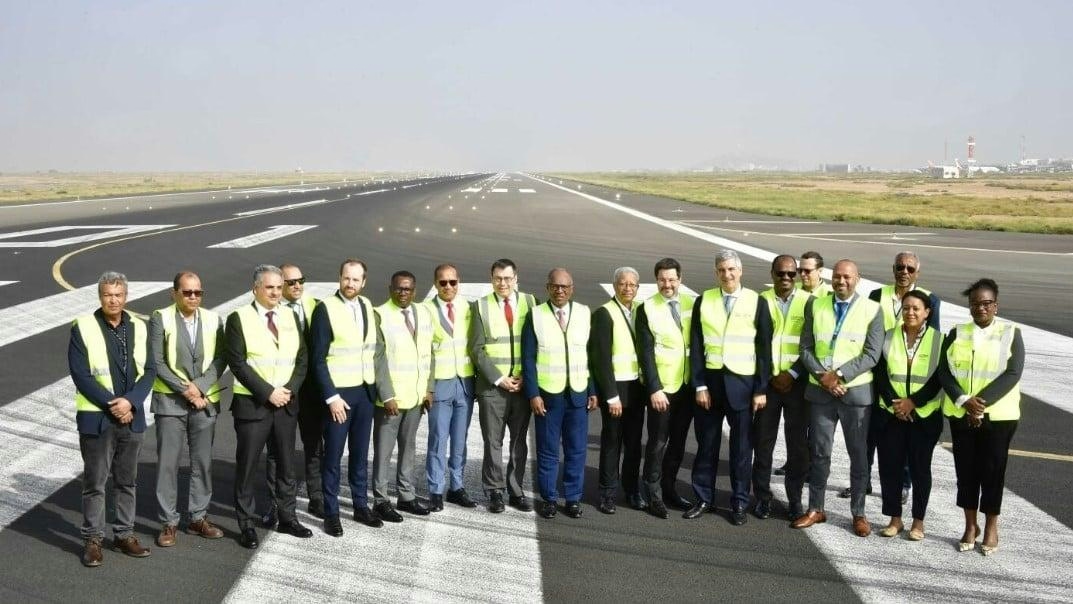
VINCI Airports has marked a significant milestone in Cape Verde with the completion of the first phase of its airport modernization program, accompanied by the announcement of a new investment plan designed to sustain air traffic growth and foster economic development across the archipelago. The announcement was made during a ceremony attended by Prime Minister José Ulisses Correia e Silva, Deputy Prime Minister Olavo Avelino Garcia Correia, and VINCI Airports President Nicolas Notebaert.
Since assuming operational control in 2023, VINCI Airports has enhanced connectivity throughout Cape Verde’s airport network. Passenger traffic is expected to increase by 60 percent between 2022 and 2025, driven by the introduction of 35 new routes—15 launched in 2024 and an additional 20 planned for 2025. Efforts to attract low-cost carriers have improved affordability, stimulated tourism, and facilitated greater mobility for the Cape Verdean diaspora.
The initial phase, known as Phase 1A, concluded in 2025 following an €80 million investment. This phase included critical upgrades such as runway renovations at Sal and São Nicolau airports, modernization of passenger terminals, reconfiguration of aircraft parking areas, installation of self-service check-in facilities, and deployment of advanced IT systems. Environmental sustainability was also a priority, with the implementation of solar power installations, widespread LED lighting, and enhanced oil separation and water treatment measures.
Expansion Plans and Industry Challenges
Building on this foundation, VINCI Airports and Cabo Verde Airports have launched Phase 1B, a €142 million development program scheduled for completion over the next three years. This phase aims to expand terminal capacity, introduce new commercial spaces, and deliver significant operational improvements, including a runway extension at Boa Vista. Upgrades to waste and wastewater treatment facilities are also planned across the airport network. The program is supported by a strong public-private partnership, featuring €60 million in sustainability-linked loans alongside ongoing shareholder equity contributions to ensure long-term investment resilience.
The expansion occurs amid a complex global aviation environment. Recent supply chain disruptions, such as the temporary Jet A-1 fuel shortage at Cape Town International Airport in November 2025, have underscored the sector’s vulnerability to operational interruptions. Market sensitivities remain high, as evidenced by recent volatility in U.S. stock markets influenced by Federal Reserve policy divisions and economic data.
Competitive pressures are intensifying within the region, with neighboring countries like Dominica pursuing ambitious airlift expansions to boost tourism and position themselves ahead of forthcoming infrastructure projects, including a major international airport scheduled to open in 2027. Additionally, regulatory changes such as the U.S. Transportation Security Administration’s enforcement of REAL ID requirements and associated fees beginning February 1, 2026, may affect travel demand and operational costs for airlines and passengers.
Despite these challenges, Cape Verde’s airport modernization program is poised to enhance the country’s connectivity, support economic growth, and strengthen its position within the increasingly competitive West African aviation market.

Etihad Airways Suspends Airbus A380 Flights on Key Route

Aditya Birla Group Seeks Approval for Aircraft Leasing in GIFT City

Qatar Airways Highlights Innovation and Connectivity at Arabian Travel Market 2026

Hong Kong's Five-Year Plan Includes Andrew Fan's Aircraft Parts Processing Hub Proposal

ACIA Aero Leasing Delivers ATR72-600 to Air Nostrum

RTX Appoints Jill Albertelli as Head of Pratt & Whitney

TAT Technologies Joins Beyond Aero Hydrogen Aircraft Program

AURAK Study Highlights Barriers to Air Taxi Adoption in Emerging Economies

Xiamen Air Selects Altitude for 787 Maintenance at Heathrow

Etihad and Swissport Extend Global Partnership
