
Orchestrer les insights d’IA pour les transformer en actions

Tendances
Categories
Civil Aviation Minister Outlines Opportunities for MSMEs in India’s Aviation Sector
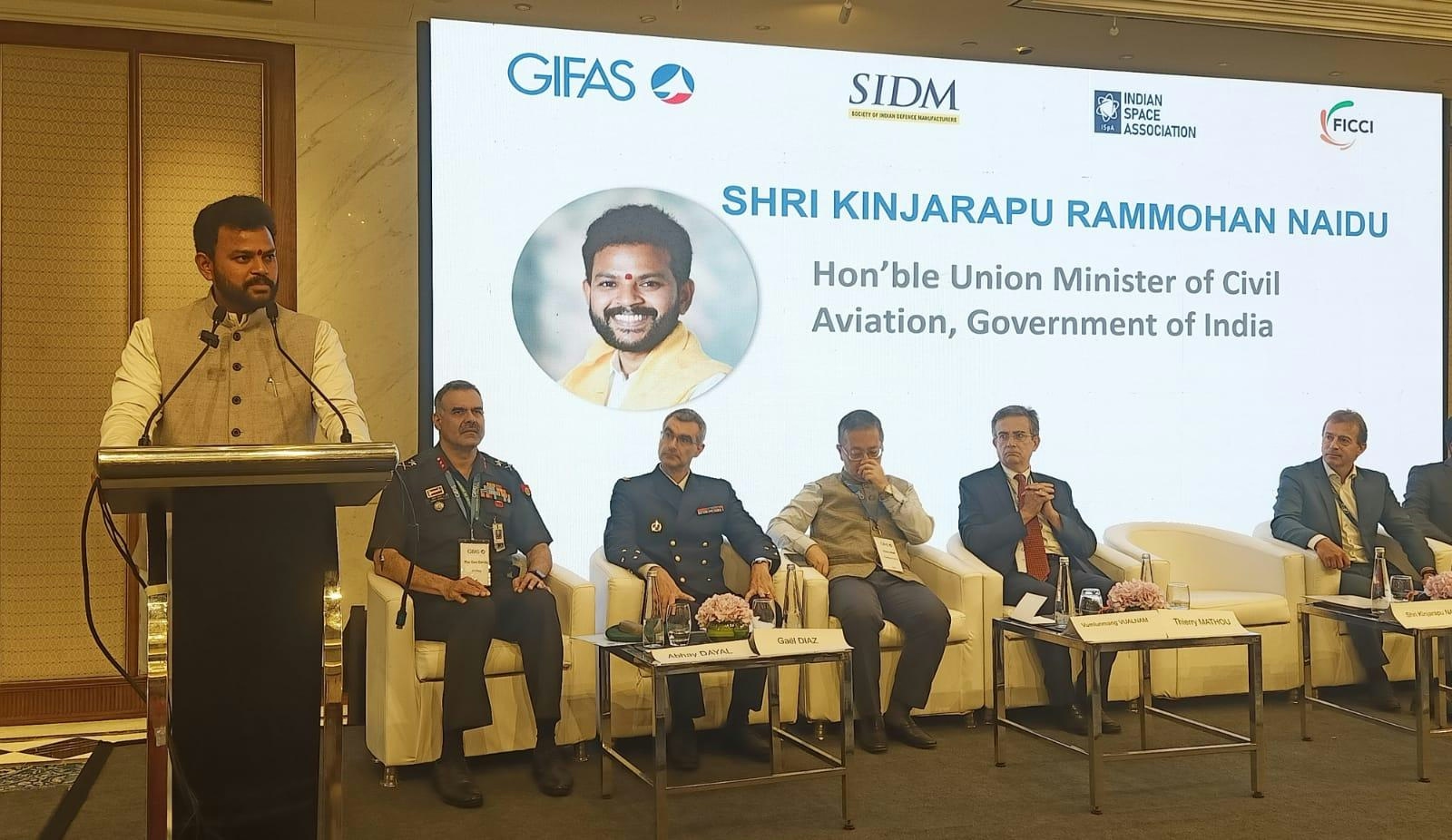
Civil Aviation Minister Outlines Opportunities for MSMEs in India’s Aviation Sector
Expanding Horizons in India’s Aviation Industry
India’s burgeoning aviation sector is presenting significant opportunities for Micro, Small, and Medium Enterprises (MSMEs) to integrate into global aerospace supply chains, according to Civil Aviation Minister K Rammohan Naidu. Addressing a conference organized by the Confederation of Indian Industry (CII) in New Delhi, Naidu highlighted the sector’s rapid growth, driven by substantial aircraft orders and a market expected to double by 2035. This expansion has the potential to transform India from a mere assembly hub into a comprehensive center for designing, certifying, and manufacturing aerospace components.
The Indian aviation market is witnessing remarkable momentum, with domestic airlines placing orders for over 1,600 aircraft. This surge is generating demand for approximately 800 million parts and components. The aerospace and defence market in India is projected to nearly double from over USD 30 billion in 2025 to USD 61 billion by 2035. Concurrently, the commercial aviation fleet is expected to grow to around 2,050 aircraft, creating substantial opportunities for Indian manufacturers and MSMEs to deepen their participation in the sector.
Naidu emphasized that Indian MSMEs and startups already contribute significantly, supplying aircraft components valued at more than USD 4 billion annually to global Original Equipment Manufacturers (OEMs). He pointed out that with Airbus and Boeing holding orders for over 15,000 commercial aircraft worldwide, the expanding market represents a major opportunity for Indian MSMEs to increase their global footprint.
From Assembly to Innovation: Building a Global Aerospace Hub
The minister underscored the necessity for India to evolve beyond its current role as an assembly destination and emerge as a hub for aerospace design, certification, and manufacturing. He stressed that realizing this potential requires the deliberate creation of an enabling ecosystem supported by robust policy frameworks and industry collaboration. “Potential does not automatically become production,” Naidu remarked, highlighting the importance of strategic interventions to foster innovation and capacity building.
Supporting this vision, Salil Gupte, President of Boeing India and South Asia, revealed that Boeing sources products and services worth nearly Rs 14,000 crore annually from India. Notably, about 25 percent of Boeing’s 300 Indian suppliers are MSMEs, reflecting the growing integration of smaller enterprises into global aerospace supply chains.
Addressing Challenges and Strategic Initiatives
Despite the optimistic outlook, industry leaders acknowledge several challenges that must be addressed to sustain growth. India’s dependence on Gulf hubs for international connectivity exposes the aviation sector to geopolitical risks, including potential disruptions from regional conflicts such as the ongoing tensions in Iran. Such events can significantly affect airline operations and international traffic flows.
To mitigate these vulnerabilities, Naidu emphasized the importance of strengthening the domestic workforce, particularly by reducing reliance on foreign pilots through enhanced training programs. Additionally, the sector is actively exploring the adoption of digital technologies, including artificial intelligence and automation, to improve productivity and maintain global competitiveness. Manufacturing industry leaders have highlighted these technological advancements as critical to the sector’s future success.
Efforts are also underway to develop domestic semiconductor and advanced manufacturing capabilities. This strategic push aims to integrate Indian MSMEs more deeply into global value chains by enhancing their technological capacity and expanding market access.
Outlook for MSMEs in India’s Aviation Sector
With global aerospace giants such as Boeing and Airbus increasing their sourcing from India, and with concerted government and industry initiatives focused on ecosystem development, MSMEs are positioned to play a pivotal role in the next phase of India’s aviation growth. However, realizing this potential will require addressing structural challenges, investing in workforce development, and embracing technological innovation to ensure sustained competitiveness on the international stage.

Etihad Airways Suspends Airbus A380 Flights on Key Route

Aditya Birla Group Seeks Approval for Aircraft Leasing in GIFT City

Qatar Airways Highlights Innovation and Connectivity at Arabian Travel Market 2026

Hong Kong's Five-Year Plan Includes Andrew Fan's Aircraft Parts Processing Hub Proposal

ACIA Aero Leasing Delivers ATR72-600 to Air Nostrum

RTX Appoints Jill Albertelli as Head of Pratt & Whitney

TAT Technologies Joins Beyond Aero Hydrogen Aircraft Program

AURAK Study Highlights Barriers to Air Taxi Adoption in Emerging Economies

Xiamen Air Selects Altitude for 787 Maintenance at Heathrow

Etihad and Swissport Extend Global Partnership
