
Orchestrer les insights d’IA pour les transformer en actions

Tendances
Categories
Congress Urges FAA to Accelerate Electric Air Taxi Certification
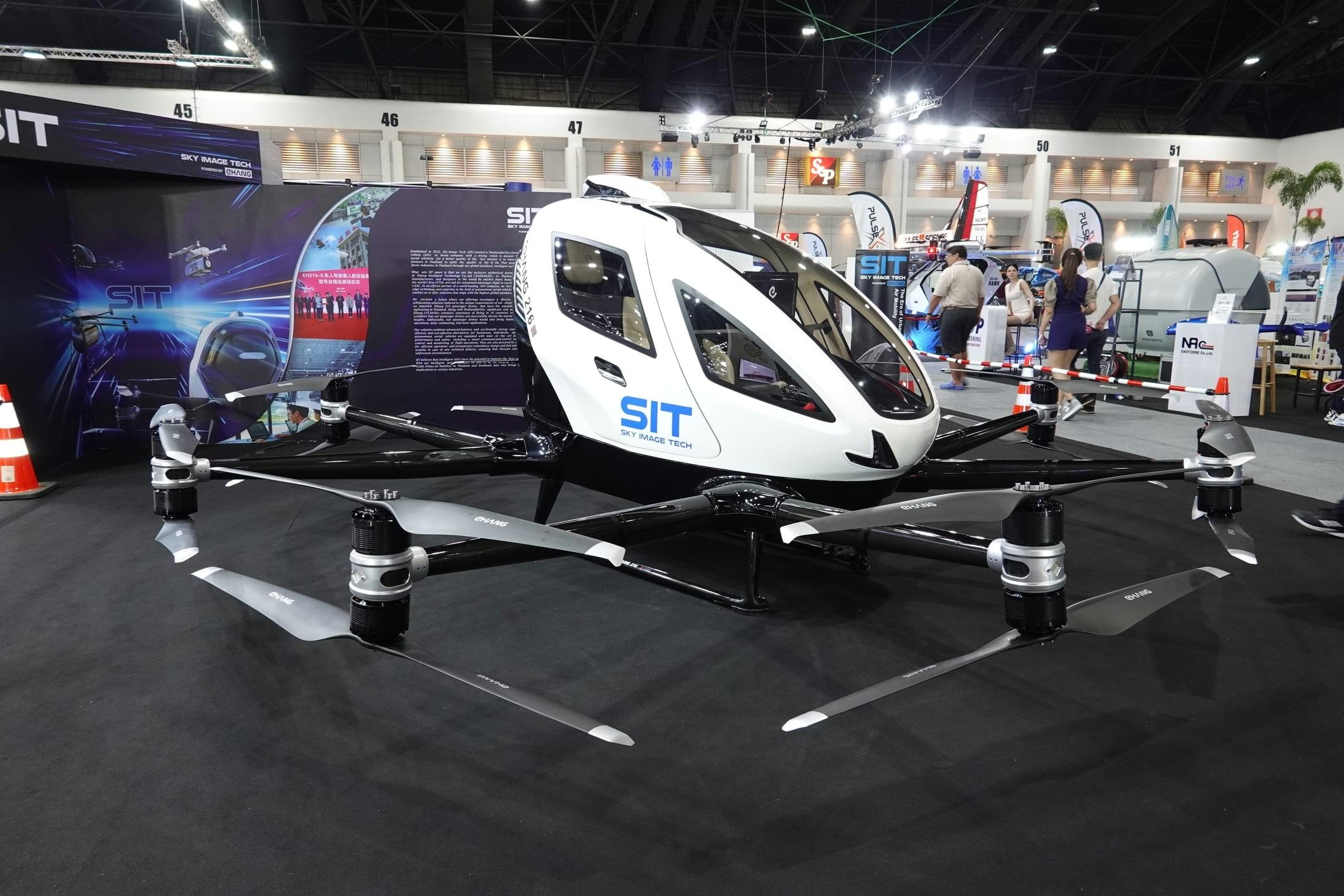
Congress Urges FAA to Accelerate Electric Air Taxi Certification
Legislative Effort to Streamline Certification Process
A bipartisan coalition of U.S. lawmakers has introduced legislation aimed at expediting the Federal Aviation Administration’s (FAA) certification process for electric vertical takeoff and landing (eVTOL) air taxis and other advanced air mobility (AAM) aircraft. The proposed Aviation Innovation and Global Competitiveness Act, introduced simultaneously in the Senate and House of Representatives, mandates the FAA to streamline its type certification procedures. This would potentially allow manufacturers to rely on industry-developed standards to demonstrate the safety of their aircraft for passenger transport, thereby accelerating the path to market.
The bill’s Senate sponsors include Senators Ted Budd (R-N.C.), Peter Welch (D-Vt.), Ben Ray Luján (D-N.M.), and John Curtis (R-Utah). In the House, Representatives Troy Nehls (R-Texas), Jimmy Panetta (D-Calif.), and Jay Obernolte (R-Calif.) have taken the lead. The legislation encompasses a variety of measures designed to hasten the commercial deployment of eVTOL air taxis, an industry projected to reach a valuation of $115 billion by 2030 and generate hundreds of thousands of jobs, according to Ed Bolen, president of the National Business Aviation Association (NBAA).
Industry Support and Regulatory Challenges
The bill has garnered broad support from key industry stakeholders, including the NBAA, Aerospace Industries Association (AIA), Airports Council International-North America (ACI-NA), Association for Uncrewed Vehicle Systems International (AUVSI), General Aviation Manufacturers Association (GAMA), and prominent U.S. air taxi companies such as Joby Aviation, Archer Aviation, Beta Technologies, Boeing, and its subsidiary Wisk Aero. Bolen lauded the legislation for promoting greater transparency, predictability, and accountability within the certification framework.
This legislative push arises amid significant challenges facing the sector. Certification delays have hindered industry momentum, notably causing electric air taxis to miss their anticipated debut at the Paris 2024 Olympics due to regulatory obstacles. Market analysts, including those at CleanTechnica, have underscored investor apprehension regarding the high costs and protracted timelines associated with certifying and scaling eVTOL aircraft production. The competitive environment has also intensified, exemplified by legal disputes such as Archer Aviation’s recent attempt to dismiss a trade-secret lawsuit filed by rival Joby Aviation, highlighting the fierce race to secure regulatory approvals and market dominance.
Current Certification Status and FAA Guidance
Manufacturers have found the FAA’s certification process to be complex and evolving. In 2021, Archer and Joby received FAA-approved certification bases for their air taxis but were required to revisit the process following the FAA’s revised approach to eVTOL certification in 2022. Both companies obtained updated certification bases in 2024. Beta Technologies secured its certification basis in 2023 and is awaiting further FAA guidance, while Wisk Aero’s certification basis was accepted later in 2024. All four companies are currently awaiting FAA approval of their G-2 issue papers, which will specify how they must demonstrate compliance with previously approved standards. This process includes for-credit flight testing conducted with FAA pilots.
The FAA’s 2024 special federal aviation regulation (SFAR) on pilot training and initial operations for eVTOLs suggested the use of industry consensus standards for compliance. The newly introduced legislation goes further by directing the FAA to adopt these standards “to the maximum extent possible.” This approach could grant manufacturers a more significant role in shaping the certification process, potentially accelerating the introduction of electric air taxis into the U.S. market.

Etihad Airways Suspends Airbus A380 Flights on Key Route

Aditya Birla Group Seeks Approval for Aircraft Leasing in GIFT City

Qatar Airways Highlights Innovation and Connectivity at Arabian Travel Market 2026

Hong Kong's Five-Year Plan Includes Andrew Fan's Aircraft Parts Processing Hub Proposal

ACIA Aero Leasing Delivers ATR72-600 to Air Nostrum

RTX Appoints Jill Albertelli as Head of Pratt & Whitney

TAT Technologies Joins Beyond Aero Hydrogen Aircraft Program

AURAK Study Highlights Barriers to Air Taxi Adoption in Emerging Economies

Xiamen Air Selects Altitude for 787 Maintenance at Heathrow

Etihad and Swissport Extend Global Partnership
