
Orchestrer les insights d’IA pour les transformer en actions

Tendances
Categories
Construction Advances Enhance Passenger Flow and Safety at New England Airports
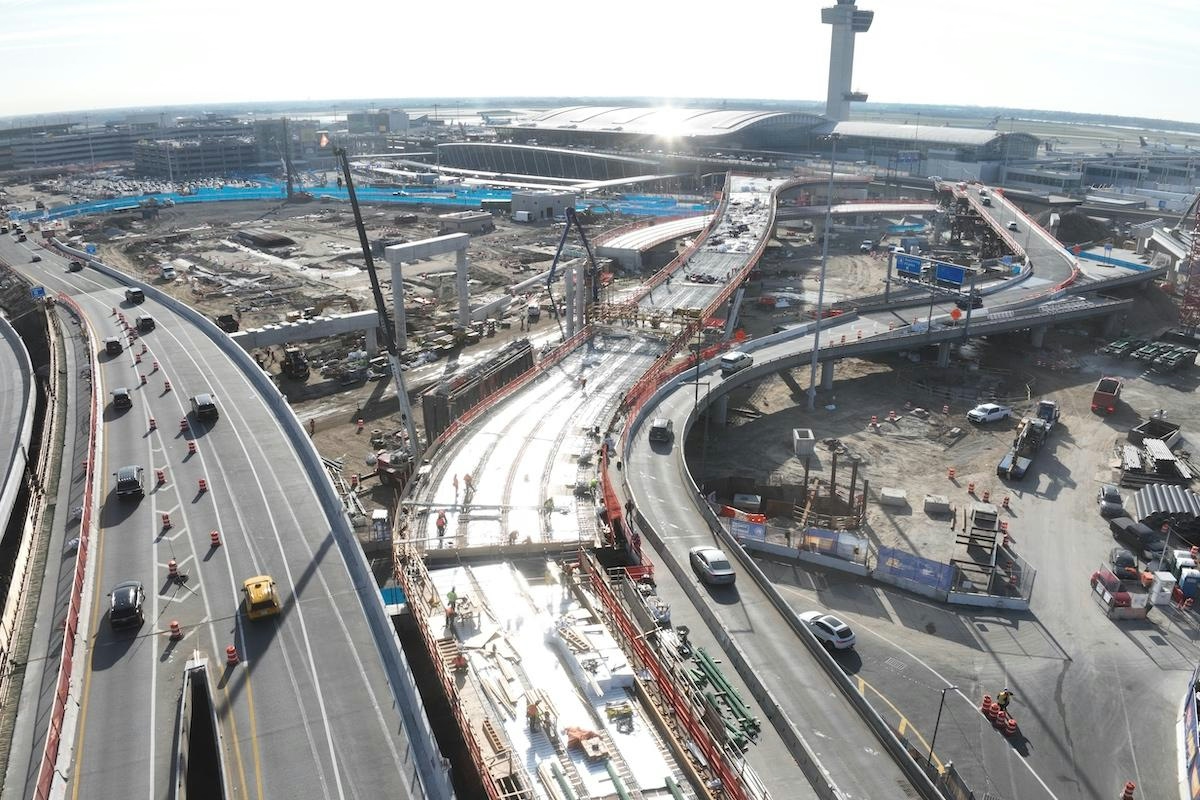
Construction Advances Enhance Passenger Flow and Safety at New England Airports
Airports present some of the most complex challenges for construction professionals, requiring continuous operation even amid extensive upgrades. In New England, Boston Logan International Airport serves as the central hub within a regional network that includes important mid-sized airports such as Rhode Island’s T.F. Green International Airport and Nantucket Memorial Airport. Leading construction firms like Skanska, drawing on decades of aviation experience, are spearheading efforts to modernize airport infrastructure to accommodate increasing passenger volumes, evolving security requirements, and ambitious sustainability objectives.
Innovation in Construction: Enhancing Passenger Experience Amid Ongoing Operations
A primary focus of these modernization projects is improving passenger flow and safety while ensuring uninterrupted airport operations. With millions of travelers passing through annually, any delays or safety compromises are unacceptable. Bryan Northrop, Executive Vice President and General Manager at Skanska USA Building, New England, highlights how innovations in phased construction, modular design, and digital modeling are reducing disruptions and enhancing project outcomes.
At Boston Logan’s Terminal C, Skanska has consolidated security checkpoints and upgraded HVAC systems in high-traffic zones, carefully sequencing work to maintain access and avoid closures. The ongoing $700 million modernization of Terminal E, which includes new parking and international processing facilities, employs phased construction strategies that align with the continuous demands of international travel.
Smaller airports in the region provide valuable examples of adaptability. At T.F. Green Airport, expanded baggage screening and security facilities were completed within an active terminal by scheduling work around operational needs. Nantucket Memorial Airport, constrained by limited space, successfully introduced new passenger screening and hold room facilities while maintaining full operations. In both cases, the use of modular and prefabricated components accelerated construction timelines and minimized disruption.
Digital tools have become increasingly integral to these projects. Building Information Modeling (BIM) allows teams to anticipate conflicts and optimize logistics before construction begins. Advanced planning facilitates smoother passenger flows, while emerging technologies such as robotics and artificial intelligence are being tested for productivity tracking, quality assurance, and safety monitoring.
Managing Complexities at Major International Hubs
Construction within a busy international hub like Boston Logan demands exceptional logistical coordination. Skanska’s two-decade partnership with Massport underscores the precision required to manage pedestrian and aircraft traffic simultaneously. “Heavy construction at an active airport demands consideration of passenger flow, airside operations, and rigorous security measures,” Northrop explains. Each project must integrate seamlessly with the airport’s complex operational systems.
The challenges of maintaining operational efficiency during ongoing construction require meticulous planning and real-time adjustments. Despite these difficulties, the benefits are significant: enhanced security, reduced wait times, and improved passenger satisfaction. These improvements not only support increased airport traffic but also establish new industry benchmarks.
Industry Impact and Competitive Response
The positive impact of these construction advances is evident in passenger experiences marked by smoother journeys and heightened safety. Airports nationwide are responding by investing in similar upgrades to remain competitive. Noteworthy examples include the $608 million terminal lobby expansion at Charlotte Douglas International Airport and the installation of advanced outbound screening lines. Boston Logan’s own $110 million safety improvement project further reflects the growing emphasis on security enhancements, a trend likely to influence airport priorities across the United States.
Through innovative construction practices, New England airports are not only transforming their infrastructure but also setting standards for the next generation of modernization in U.S. aviation.

Etihad Airways Suspends Airbus A380 Flights on Key Route

Aditya Birla Group Seeks Approval for Aircraft Leasing in GIFT City

Qatar Airways Highlights Innovation and Connectivity at Arabian Travel Market 2026

Hong Kong's Five-Year Plan Includes Andrew Fan's Aircraft Parts Processing Hub Proposal

ACIA Aero Leasing Delivers ATR72-600 to Air Nostrum

RTX Appoints Jill Albertelli as Head of Pratt & Whitney

TAT Technologies Joins Beyond Aero Hydrogen Aircraft Program

AURAK Study Highlights Barriers to Air Taxi Adoption in Emerging Economies

Xiamen Air Selects Altitude for 787 Maintenance at Heathrow

Etihad and Swissport Extend Global Partnership
