
Orchestrer les insights d’IA pour les transformer en actions

Tendances
Categories
Developer Projects Live Flight Tracker Onto Ceiling
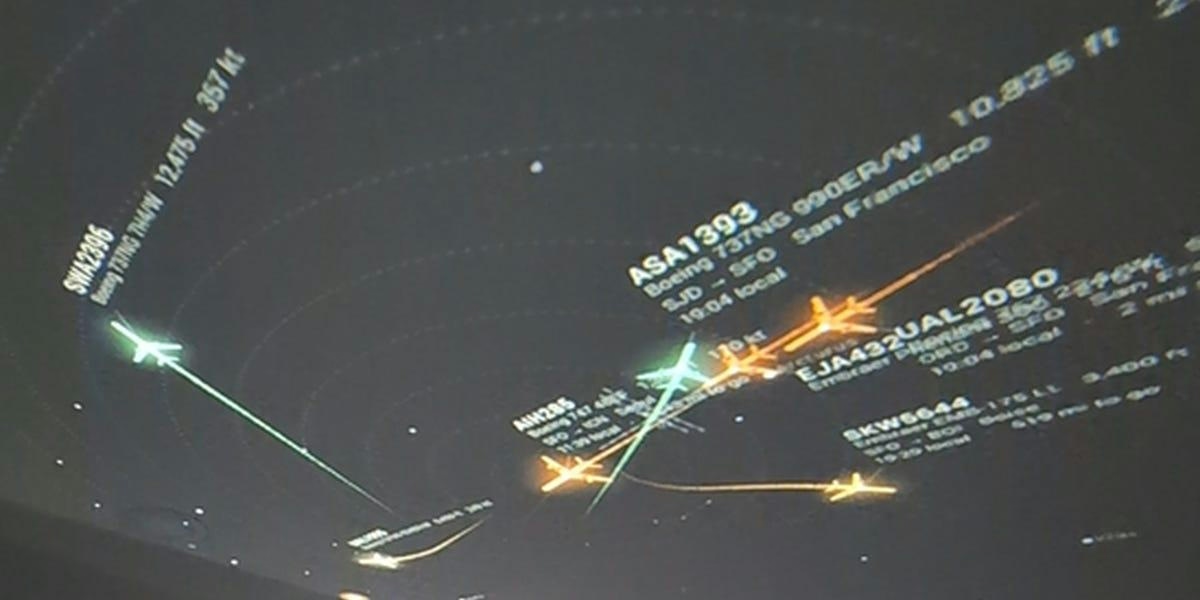
Developer Projects Live Flight Tracker Onto Ceiling
A Unique Fusion of Aviation and Technology
Cameron Paczek, a 24-year-old software engineer, has transformed his passion for aviation into an innovative home project: a real-time flight tracker that projects live aircraft movements onto his ceiling. Residing beneath the busy flight paths of San Francisco International Airport, Paczek often found himself checking flight-tracking applications and stepping outside to observe planes overhead. Seeking a more immersive and continuous experience, he combined a projector, a Raspberry Pi mini-computer, an ADS-B radio receiver, and AI-generated code to create a dynamic ceiling display that visualizes passing aircraft in real time.
The system, which Paczek has named "Skylight," captures GPS transmissions from planes flying between 600 and 1,200 feet above his home using the ADS-B radio receiver. This data is processed by the Raspberry Pi, which generates a live map projected onto the ceiling. The display includes detailed information such as airline, flight number, aircraft type, altitude, and destination. To enhance the experience, Paczek also installed a pan-tilt-zoom (PTZ) camera outside his home that automatically tracks aircraft and streams live video footage to his television.
The Role of AI and Open Source Accessibility
Paczek credits artificial intelligence tools, particularly Anthropic’s Claude, for significantly streamlining the coding process. He described how he inserted a Raspberry Pi SD card into his laptop, accessed Claude Code, directed it to the project’s repository, and requested the installation of the necessary software. This method, sometimes referred to as "vibe coding," enabled rapid prototyping and iterative development despite the code not being production-grade. With a decade of programming experience and a computer science degree from San Francisco State University, Paczek emphasizes that AI tools were instrumental in realizing his vision.
Interest in Skylight has grown rapidly, attracting hundreds of aviation enthusiasts and technology hobbyists eager to acquire the system. Nevertheless, Paczek has chosen to keep the project open source rather than pursue commercialization. The code is freely available for anyone with the appropriate hardware and technical curiosity to download and implement their own version. AI tools like Claude remain accessible to assist users with installation and troubleshooting.
Challenges and Market Response
Despite the enthusiasm surrounding Skylight, Paczek acknowledges several challenges. Regulatory compliance with aviation authorities remains a key consideration, particularly concerning the use of radio receivers and the handling of live aircraft data. Technical obstacles include ensuring the accuracy of projected flight paths and safeguarding the privacy and security of nearby residents. While the project has captivated the aviation community, some observers question its practicality and broader applicability.
The market’s reaction to such AI-driven and interactive flight-tracking innovations has been characterized by cautious optimism. Investor interest in projection technologies and real-time tracking systems is strong, reflecting recent trends in technology coverage. However, there is potential for volatility if market expectations are not met. Competitors may respond by developing similar projection systems or enhancing existing flight-tracking applications with more interactive features.
For now, Paczek’s Skylight stands as a compelling example of the possibilities at the intersection of do-it-yourself engineering, artificial intelligence, and aviation enthusiasm, offering a novel way to experience the skies from the comfort of home.

Etihad Airways Suspends Airbus A380 Flights on Key Route

Aditya Birla Group Seeks Approval for Aircraft Leasing in GIFT City

Qatar Airways Highlights Innovation and Connectivity at Arabian Travel Market 2026

Hong Kong's Five-Year Plan Includes Andrew Fan's Aircraft Parts Processing Hub Proposal

ACIA Aero Leasing Delivers ATR72-600 to Air Nostrum

RTX Appoints Jill Albertelli as Head of Pratt & Whitney

TAT Technologies Joins Beyond Aero Hydrogen Aircraft Program

AURAK Study Highlights Barriers to Air Taxi Adoption in Emerging Economies

Xiamen Air Selects Altitude for 787 Maintenance at Heathrow

Etihad and Swissport Extend Global Partnership
