
Orchestrer les insights d’IA pour les transformer en actions

Tendances
Categories
Engine Tests Advance on Russian Civil Supersonic Demonstrator
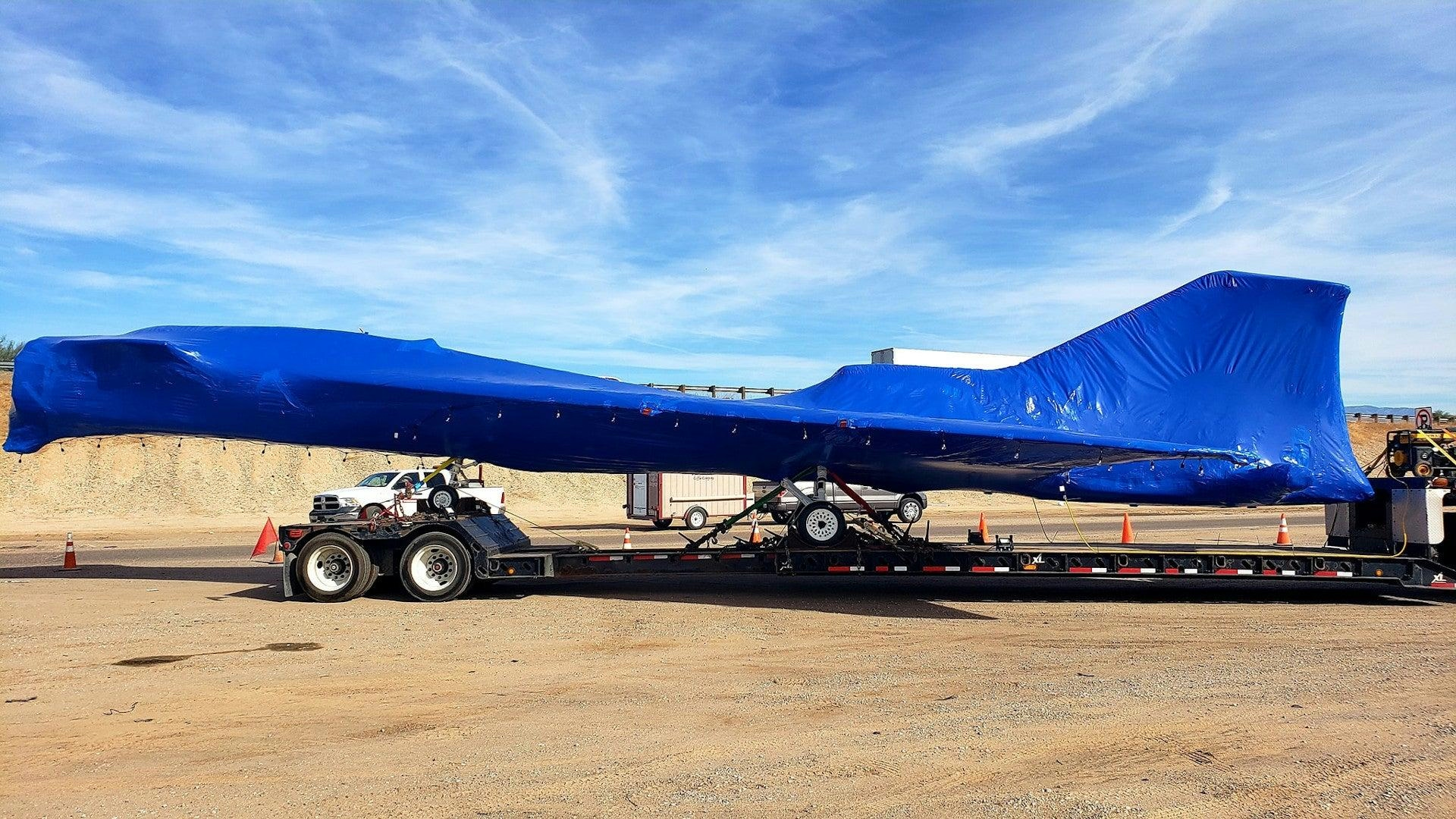
Engine Tests Advance on Russian Civil Supersonic Demonstrator
Russian efforts to develop a new civil supersonic aircraft demonstrator have progressed with the successful completion of a critical phase of engine model testing. The technology demonstrator, named Strizh—meaning “swift” in Russian—is projected to take flight before the end of the decade, contingent upon securing sufficient funding and support from both government and private sectors.
Technological Developments and Testing
The Central Aerohydrodynamic Institute (TsAGI), based in Moscow, has emphasized the development of next-generation supersonic aircraft as a strategic priority for Russia. Kirill Sypalo, TsAGI’s general director, described supersonic civil aviation as “of strategic importance to the state,” highlighting recent research that demonstrates Russia’s technological capabilities and underpins continued progress in this domain.
Strizh incorporates an innovative overhead propulsion system designed to address shockwave challenges commonly encountered during transonic acceleration. As part of the latest research program, TsAGI produced models of the powerplant components, which include two engines equipped with shallow oblique intakes positioned overhead. Wind tunnel testing revealed that these unconventional intakes performed beyond standard expectations, with thrust losses considered “acceptable” by the institute.
The project involves collaboration among several research centers and industrial partners, including United Aircraft, the Klimov division of United Engine, and the Central Institute of Aviation Motors. The demonstrator employs Klimov’s RD-93MS engine—an adaptation of the powerplant used in the Chengdu/PAC JF-17 combat aircraft—for ground testing purposes. To address noise concerns, TsAGI developed a noise-suppression system fitted to the engine’s flat nozzle, aiming to reduce takeoff noise. Test results indicate that thrust performance met the required technical specifications.
Challenges and Competitive Landscape
Despite these technical advances, the project faces considerable challenges. The adaptation of a military engine for civil aviation introduces complex technical hurdles, particularly in complying with international aviation regulations and noise standards. Furthermore, the future of the Strizh demonstrator depends heavily on sustained financial support, which remains uncertain.
Market reception is expected to be cautious, as international airlines assess the risks associated with adopting unproven supersonic technology. Meanwhile, global competitors are closely monitoring Russia’s progress. For instance, the U.S. startup Astro Mechanica is developing a hybrid-electric supersonic engine that could present alternative propulsion solutions. This competitive environment may drive rival firms to accelerate their own research and development efforts to match or surpass Russian advancements.
As Russia advances the Strizh program, its success will hinge not only on overcoming technical challenges but also on navigating regulatory, financial, and market dynamics within the evolving field of civil supersonic aviation.

Etihad Airways Suspends Airbus A380 Flights on Key Route

Aditya Birla Group Seeks Approval for Aircraft Leasing in GIFT City

Qatar Airways Highlights Innovation and Connectivity at Arabian Travel Market 2026

Hong Kong's Five-Year Plan Includes Andrew Fan's Aircraft Parts Processing Hub Proposal

ACIA Aero Leasing Delivers ATR72-600 to Air Nostrum

RTX Appoints Jill Albertelli as Head of Pratt & Whitney

TAT Technologies Joins Beyond Aero Hydrogen Aircraft Program

AURAK Study Highlights Barriers to Air Taxi Adoption in Emerging Economies

Xiamen Air Selects Altitude for 787 Maintenance at Heathrow

Etihad and Swissport Extend Global Partnership
