
Orchestrer les insights d’IA pour les transformer en actions

Tendances
Categories
GE-Kratos F143 Selected as Second Engine for JASSM
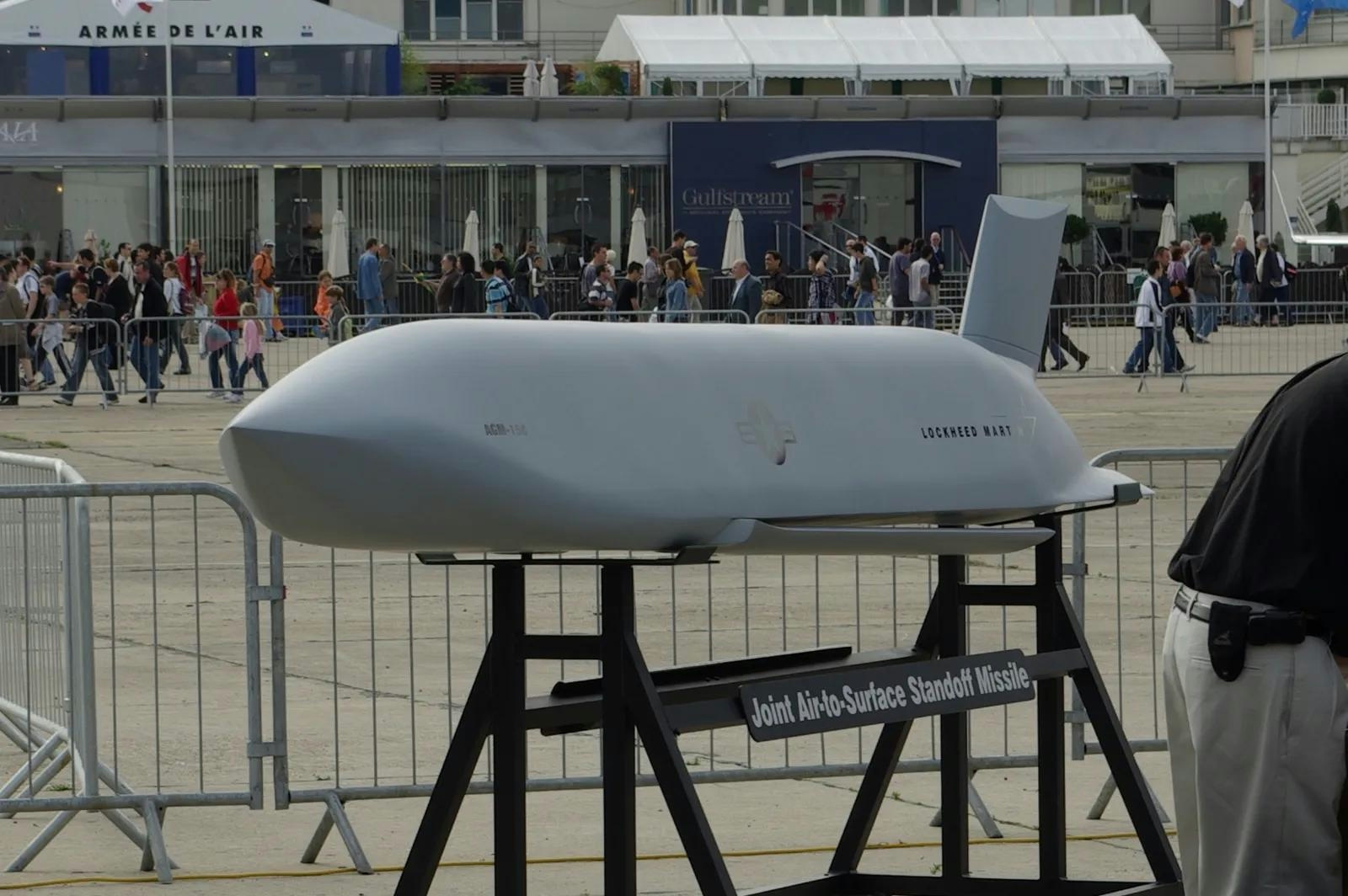
GE-Kratos F143 Selected as Second Engine for JASSM
The GEK800 turbofan, jointly developed by GE Aerospace and Kratos Defense & Security Solutions, has been officially designated by the US military as the F143-ZZ-100 and selected as a second-source propulsion system for the Joint Air-to-Surface Standoff Missile (JASSM). The US Air Force has awarded the companies a contract for engineering, manufacturing, and development (EMD), although specific details regarding the contract’s value, duration, and production schedule have not been disclosed.
Expanding Propulsion Options for JASSM
The selection of the F143-ZZ-100 represents a strategic effort to diversify the propulsion supply base for the JASSM program rather than replace existing engines. Currently, the AGM-158B JASSM-ER is powered by the Williams International F107-WR-105 turbofan, while the original AGM-158A utilizes a Teledyne CAE J402-CA-100 turbojet. The new F143 engine delivers 800 pounds of thrust and is designed specifically for long-range missiles and other uncrewed applications, reflecting evolving requirements in missile propulsion technology.
This development aligns with the US Air Force’s broader initiative to enhance its standoff-strike capabilities. In April 2026, the Air Force issued a request for information under the FAMM-BAR program, which aims to procure between 1,000 and 2,000 low-cost cruise missiles annually. These missiles are intended to complement higher-end weapons such as the JASSM-ER and the AGM-158 XR, underscoring the growing emphasis on scalable and cost-effective missile systems.
Development and Testing Milestones
The F143’s development commenced in 2023, with GE Aerospace and Kratos collaborating during the Technology Maturation and Risk Reduction (TMRR) phase. This effort has been supported by both internal investments and funding from the Air Force Research Laboratory (AFRL). Since the program’s inception, the joint team has completed over 50 engine starts during ground testing at facilities operated by both companies. Additionally, altitude testing was conducted in 2025 at Purdue University’s Maurice J. Zucrow Laboratories, further validating the engine’s performance under operational conditions.
Amy Gowder, president and CEO of GE Aerospace Defense & Systems, described the engine’s designation and contract award as the culmination of “years of disciplined engineering.” Eric DeMarco, president and CEO of Kratos, highlighted the broader objective of revitalizing US manufacturing capacity for low-cost jet engines tailored to drones and cruise missiles, a critical capability for future defense readiness.
Challenges and Market Impact
While the F143’s selection strengthens the JASSM program, it also presents significant challenges. Ensuring consistent reliability and performance, managing complex supply chains, and meeting rigorous military specifications will be essential as the engine advances toward production. Despite these hurdles, the announcement has been met with a positive market response, with both GE Aerospace and Kratos experiencing gains in their stock prices. Industry competitors are anticipated to respond by pursuing similar contracts or accelerating the development of alternative propulsion systems to maintain their competitive positions in the defense engine sector.
The GEK800 is the smallest of three engines currently under development by GE Aerospace for uncrewed and expendable platforms. Earlier in 2026, GE and Kratos secured a $12.4 million Air Force contract for the preliminary design of the 1,500-pound-thrust GEK1500. Additionally, in May 2026, GE Aerospace received a separate award to advance the medium-thrust GE426 engine through its preliminary design review, signaling a comprehensive approach to meeting diverse propulsion needs across multiple defense applications.

Etihad Airways Suspends Airbus A380 Flights on Key Route

Aditya Birla Group Seeks Approval for Aircraft Leasing in GIFT City

Qatar Airways Highlights Innovation and Connectivity at Arabian Travel Market 2026

Hong Kong's Five-Year Plan Includes Andrew Fan's Aircraft Parts Processing Hub Proposal

ACIA Aero Leasing Delivers ATR72-600 to Air Nostrum

RTX Appoints Jill Albertelli as Head of Pratt & Whitney

TAT Technologies Joins Beyond Aero Hydrogen Aircraft Program

AURAK Study Highlights Barriers to Air Taxi Adoption in Emerging Economies

Xiamen Air Selects Altitude for 787 Maintenance at Heathrow

Etihad and Swissport Extend Global Partnership
