
Orchestrer les insights d’IA pour les transformer en actions

Tendances
Categories
HAL and Safran Partner to Develop Aravalli Helicopter Engine
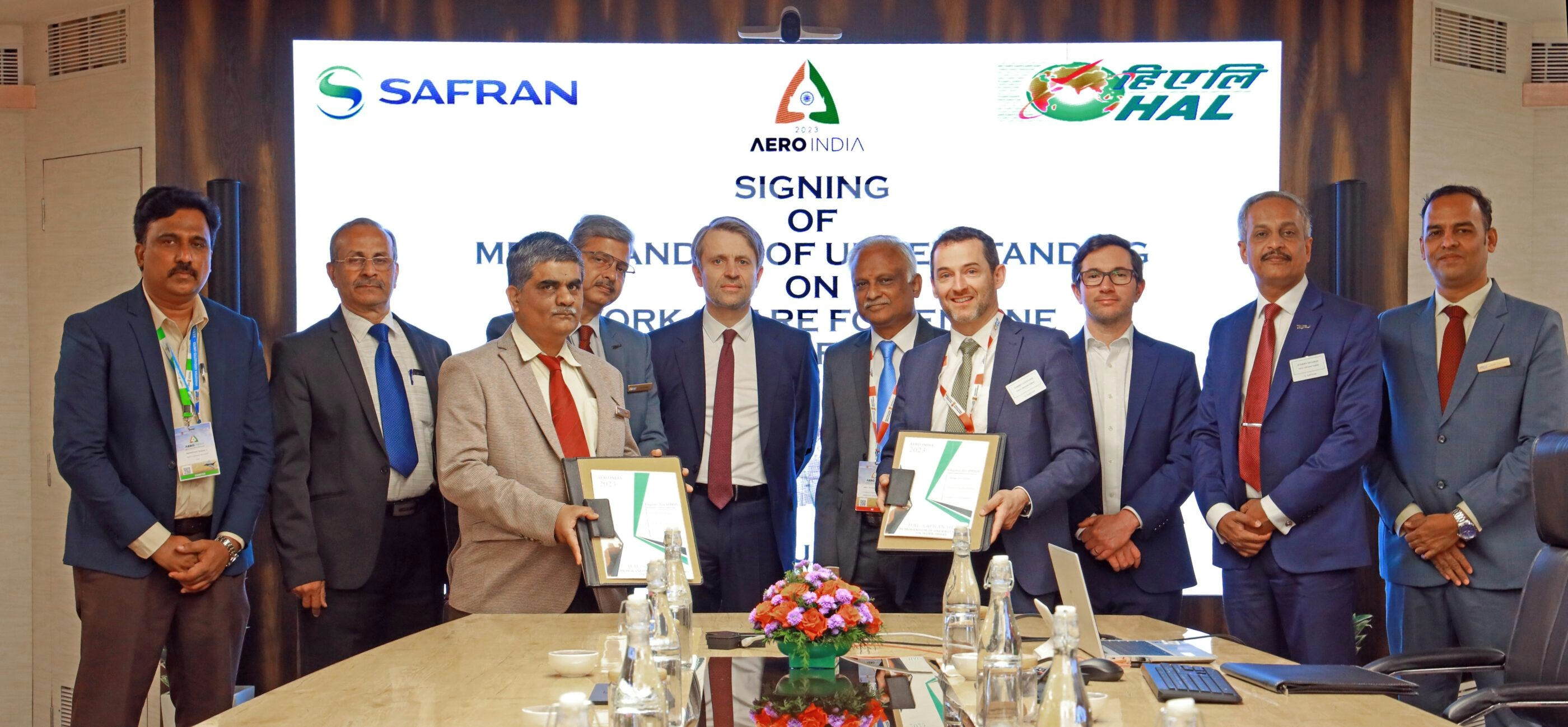
HAL and Safran Collaborate on Development of Aravalli Helicopter Engine
Hindustan Aeronautics Limited (HAL) and Safran Helicopter Engines have formalized a partnership through their joint venture, Safhal Helicopter Engines, to design, develop, manufacture, and provide lifecycle support for the new-generation Aravalli helicopter engine. This collaboration represents a pivotal advancement in India’s pursuit of self-reliance in critical aerospace propulsion technologies.
The Aravalli Engine and Its Strategic Role
The Aravalli engine, named after one of the world’s oldest mountain ranges, is engineered to deliver between 3,500 and 4,000 shaft horsepower (shp). It has been selected to power HAL’s forthcoming 13-tonne Indian Multi-Role Helicopter (IMRH) and its naval counterpart, the Deck-Based Multi-Role Helicopter (DBMRH). HAL emphasizes that the engine embodies the nation’s ambition to enhance indigenous capabilities for future rotorcraft programs, positioning the Aravalli as a cornerstone of next-generation helicopter propulsion.
Safhal Helicopter Engines will integrate the complementary strengths of HAL and Safran, combining advanced engine design, manufacturing, testing, and product support aligned with international aerospace standards. Ravi K, Chairman and Managing Director of HAL, highlighted the significance of the programme, stating that it lays a strong foundation for powering India’s next-generation helicopter platforms. He further noted that the Aravalli engine will not only meet the operational demands of the IMRH and DBMRH but also contribute substantially to the development of a robust domestic aerospace industrial ecosystem.
Cédric Goubet, CEO of Safran Helicopter Engines, expressed enthusiasm about deepening the longstanding partnership with HAL through this initiative. He underscored that this marks the first occasion Safran Helicopter Engines has engaged in co-development of an engine within this power class, reflecting a shared commitment to innovation, technology advancement, and industrial excellence.
Broader Implications and Challenges Ahead
Beyond its primary military applications, the Aravalli engine programme is anticipated to unlock opportunities in the civil aviation sector, including offshore transportation, utility missions, and passenger transport. The initiative is also expected to bolster indigenous maintenance, repair, and overhaul (MRO) capabilities within India, further strengthening the country’s aerospace infrastructure.
Nonetheless, the partnership faces considerable challenges. The integration of technologies from both HAL and Safran, alongside the inherent complexities of developing a new engine, will demand meticulous coordination. Additionally, navigating the regulatory and certification landscape for both military and potential civil uses introduces further complexity. Industry observers have voiced skepticism regarding the project’s timeline and cost projections, while competitors may respond by accelerating their own engine development efforts or intensifying lobbying for government contracts. Moreover, efforts to establish a resilient domestic aerospace industrial ecosystem may encounter resistance from entrenched market players.
The Aravalli programme builds upon a longstanding collaboration between HAL and Safran, which began with the Artouste engines powering the Cheetah and Chetak helicopters and continued with the Shakti engine family for HAL’s Advanced Light Helicopter (ALH), Light Combat Helicopter (LCH), and Light Utility Helicopter (LUH). As the Aravalli engine advances, its success will hinge on overcoming technical, regulatory, and market challenges while fostering innovation and self-reliance within India’s aerospace sector.

Etihad Airways Suspends Airbus A380 Flights on Key Route

Aditya Birla Group Seeks Approval for Aircraft Leasing in GIFT City

Qatar Airways Highlights Innovation and Connectivity at Arabian Travel Market 2026

Hong Kong's Five-Year Plan Includes Andrew Fan's Aircraft Parts Processing Hub Proposal

ACIA Aero Leasing Delivers ATR72-600 to Air Nostrum

RTX Appoints Jill Albertelli as Head of Pratt & Whitney

TAT Technologies Joins Beyond Aero Hydrogen Aircraft Program

AURAK Study Highlights Barriers to Air Taxi Adoption in Emerging Economies

Xiamen Air Selects Altitude for 787 Maintenance at Heathrow

Etihad and Swissport Extend Global Partnership
