
Orchestrer les insights d’IA pour les transformer en actions

Tendances
Categories
How AI Agents Are Disrupting Travel Economics
How AI Agents Are Disrupting Travel Economics
The Rise of AI in Travel Search
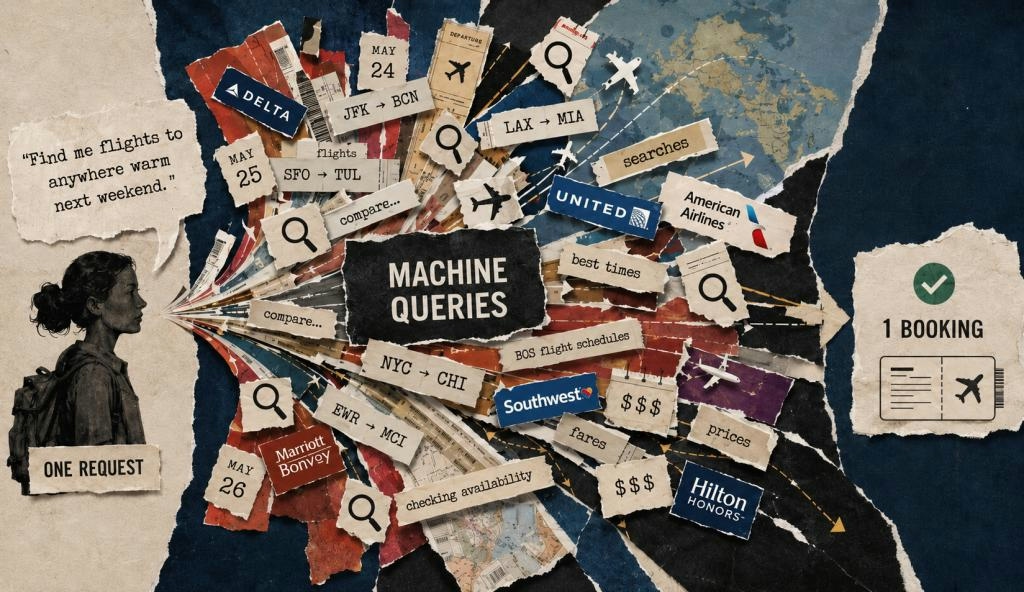
When insurtech founder Kiruba Shankar sought to book a single airline ticket, he employed Claude Code, an AI agent, to conduct an exhaustive search on the Etihad Airways website. The AI generated an astonishing 881,076 fare options, spanning every date within a month, all possible stopovers, and every combination across four routes. While this comprehensive search capability might appear advantageous for consumers, it highlights a significant and growing challenge for the travel industry.
Unlike static web pages, travel search engines must verify live rates, availability, fare rules, and bundled offers in real time. Each query imposes a cost on airlines and travel distributors. Traditionally, a booking process might involve 10 to 20 searches, a manageable expense if the customer ultimately converts. However, AI agents can now generate hundreds of thousands of queries within moments, causing the look-to-book (L2B) ratio—an industry metric measuring searches per booking—to escalate dramatically. When searches vastly outnumber bookings, the economic viability of travel distribution models is threatened.
Transforming Travel Distribution and Discovery
The surge in AI-driven queries is straining conventional booking frameworks and compelling the industry to reconsider its strategies. Beyond cost implications, AI agents are fundamentally reshaping the travel distribution landscape by blurring the boundaries between marketing and distribution. Rather than travelers manually browsing and comparing options, AI agents are making decisions earlier in the process, often filtering out the majority of available choices. Recent studies indicate that up to 94% of hotels may become invisible in AI-powered search results, profoundly altering how travel products are discovered and sold.
This transformation is also fostering the emergence of a new "trust economy" within luxury travel, where governance, security, and data quality have become critical competitive differentiators. Companies capable of ensuring the integrity and reliability of their data—and the AI agents that utilize it—are positioned to gain a strategic advantage as travelers and partners increasingly seek trustworthy sources in an automated environment.
Industry Responses and Future Challenges
Industry players are adopting varied approaches to this disruption. Some are upgrading their systems to accommodate AI-mediated interactions, investing in technologies designed to manage the surge in automated queries without incurring prohibitive costs. Others are emphasizing unique supply differentiation and cultivating deeper customer relationships, betting that personalized service and exclusive offerings will maintain their relevance as AI agents become the primary interface between travelers and suppliers.
As AI continues to disrupt travel economics, the industry stands at a critical juncture. The central challenge will be to balance the efficiency and convenience AI provides consumers with the sustainability of the business models that support global travel.

Etihad Airways Suspends Airbus A380 Flights on Key Route

Aditya Birla Group Seeks Approval for Aircraft Leasing in GIFT City

Qatar Airways Highlights Innovation and Connectivity at Arabian Travel Market 2026

Hong Kong's Five-Year Plan Includes Andrew Fan's Aircraft Parts Processing Hub Proposal

ACIA Aero Leasing Delivers ATR72-600 to Air Nostrum

RTX Appoints Jill Albertelli as Head of Pratt & Whitney

TAT Technologies Joins Beyond Aero Hydrogen Aircraft Program

AURAK Study Highlights Barriers to Air Taxi Adoption in Emerging Economies

Xiamen Air Selects Altitude for 787 Maintenance at Heathrow

Etihad and Swissport Extend Global Partnership
