
Orchestrer les insights d’IA pour les transformer en actions

Tendances
Categories
How Bengaluru Brain Power Is Helping Advance the Future of Flight
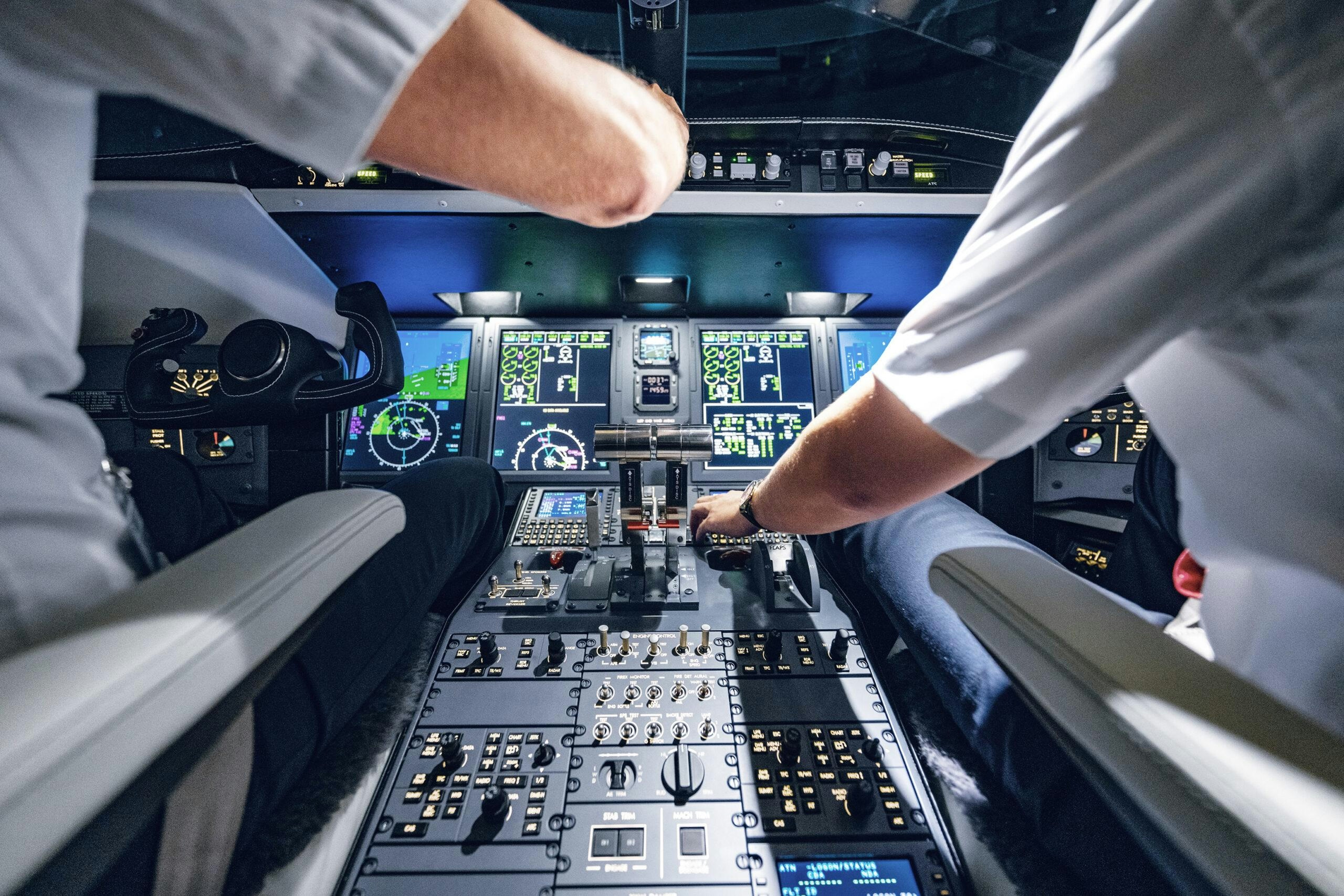
How Bengaluru Brain Power Is Helping Advance the Future of Flight
For more than twenty years, Bengaluru’s John F. Welch Technology Centre (JFWTC) has been a cornerstone of innovation in aviation, significantly influencing the trajectory of aerospace technology. As one of General Electric’s largest multidisciplinary research and development hubs outside the United States, JFWTC has contributed to breakthroughs that are redefining the future of flight. Today, as GE Aerospace gains international recognition for pioneering advancements in high-altitude hybrid electric propulsion—showcased at the recent Farnborough International Airshow—engineers in Bengaluru remain at the heart of this transformative progress.
Pioneering Next-Generation Propulsion Technologies
Nitesh Jain, Consulting Engineer at GE Aerospace, reflects on the centre’s legacy of innovation, noting its work on prominent engine lines such as the GE90, GEnx, GE9X, and CFM LEAP. Each of these engines delivered fuel efficiency improvements ranging from 10 to 15 percent. The current ambition, driven by the CFM RISE program, is to double that gain, targeting a 20 percent increase in fuel efficiency. This leap is to be achieved through next-generation propulsion technologies including the ductless Open Fan architecture, compact core engine designs, and hybrid electric systems—areas where Bengaluru’s expertise is indispensable.
The RISE program’s Open Fan design eliminates the traditional engine nacelle, enabling a larger fan diameter that produces greater thrust without incurring excessive weight or drag penalties. Internally, the compact core technology enhances the performance of high-pressure compressors and turbines, while adaptive cycle engine capabilities optimize efficiency across all flight phases. This integrated approach not only aims to improve fuel economy but also enhances engine durability and reduces dust ingestion, particularly in challenging operating environments.
Multidisciplinary Innovation and Global Collaboration
Achieving these advancements requires a sophisticated blend of disciplines, including aerodynamics, thermal systems, structural engineering, systems analysis, advanced materials, and additive manufacturing. Bengaluru’s teams are uniquely equipped to navigate these complex challenges, balancing the competing demands of weight reduction, operational efficiency, manufacturability, and reliability.
Aeroacoustics plays a critical role in the success of the Open Fan design. Without the noise-mitigating nacelle, engineers had to develop quieter fan blades by thoroughly understanding and addressing noise generation mechanisms. Ravish Karve, advanced lead engineer at JFWTC, led global collaborations to simulate airflow and acoustic phenomena using Frontier, one of the world’s most powerful supercomputers. This capability allowed for precise modeling of full-scale Open Fan configurations, significantly accelerating the pace of innovation.
Beyond engine development, Bengaluru’s influence extends to broader aviation technology. The city’s airport has been a pioneer in implementing parallel runway operations, reflecting a forward-looking approach to air traffic management. Looking ahead, the upcoming Drone Expo at Yashobhoomi (IICC) in September 2026 underscores India’s commitment to integrating drones and artificial intelligence-driven solutions into mainstream aviation.
Navigating Challenges in a Rapidly Evolving Industry
The rapid technological evolution in aviation also presents significant challenges. Industry leaders, including Bill Gates, have cautioned that the rise of artificial intelligence in aviation could disrupt traditional employment patterns, necessitating careful workforce management and reskilling initiatives. Concurrently, increased investment in AI-powered aviation technologies is prompting competitors worldwide to enhance their own capabilities in AI and drone systems to maintain competitiveness.
As the global aviation landscape continues to evolve, Bengaluru’s combination of technical expertise, collaborative innovation, and readiness to address emerging challenges positions the city as a vital hub in shaping the future of flight.

Etihad Airways Suspends Airbus A380 Flights on Key Route

Aditya Birla Group Seeks Approval for Aircraft Leasing in GIFT City

Qatar Airways Highlights Innovation and Connectivity at Arabian Travel Market 2026

Hong Kong's Five-Year Plan Includes Andrew Fan's Aircraft Parts Processing Hub Proposal

ACIA Aero Leasing Delivers ATR72-600 to Air Nostrum

RTX Appoints Jill Albertelli as Head of Pratt & Whitney

TAT Technologies Joins Beyond Aero Hydrogen Aircraft Program

AURAK Study Highlights Barriers to Air Taxi Adoption in Emerging Economies

Xiamen Air Selects Altitude for 787 Maintenance at Heathrow

Etihad and Swissport Extend Global Partnership
