
Orchestrer les insights d’IA pour les transformer en actions

Tendances
Categories
How the Boeing 777-300ER Became a Flagship for Leading Airlines
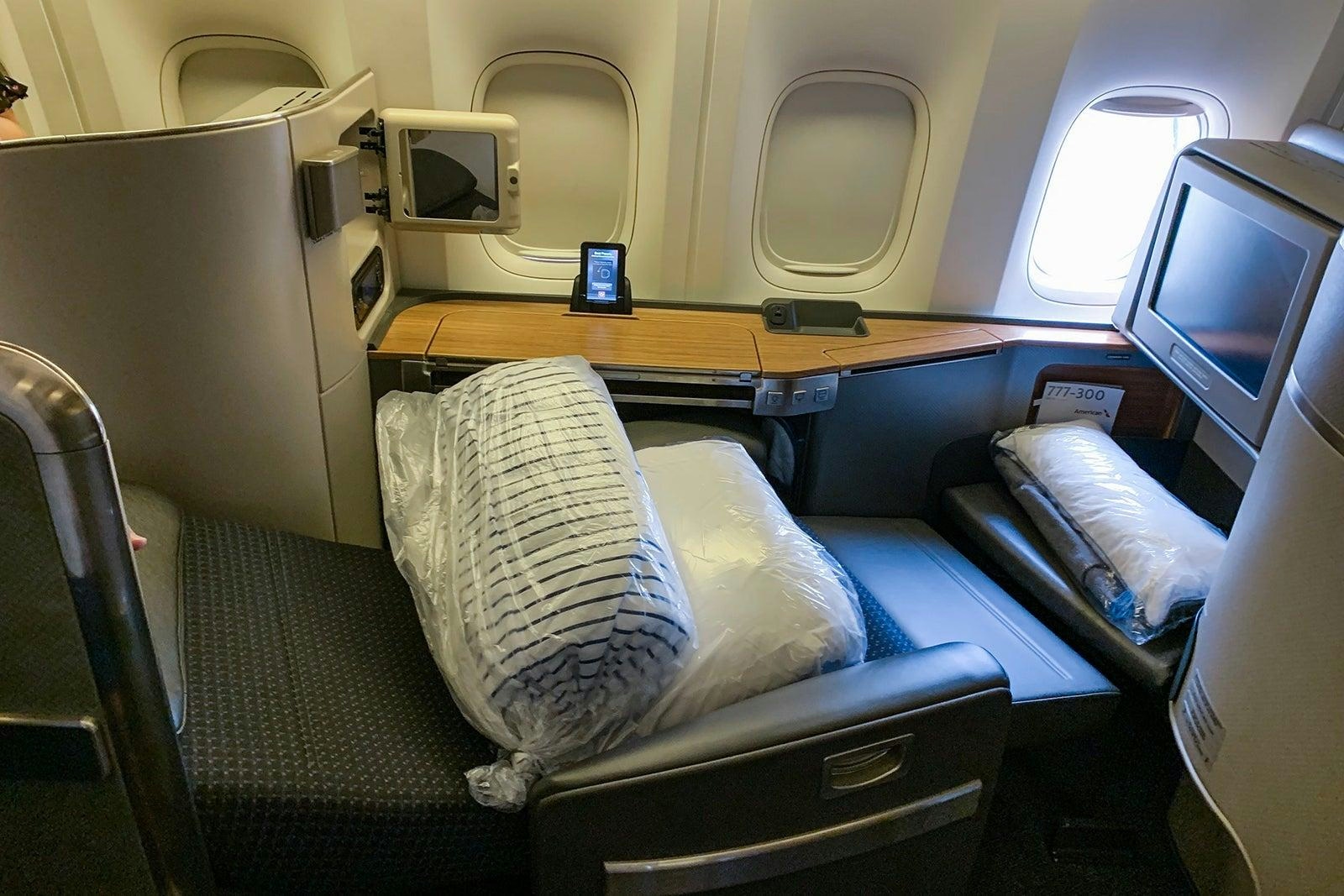
How the Boeing 777-300ER Became a Flagship for Leading Airlines
The Boeing 777-300ER has fundamentally transformed long-haul aviation, establishing itself as the flagship aircraft for many of the world’s premier airlines. Building on the legacy of Boeing’s earlier widebody twinjet, the 767, the 777 series showcased how a twin-engine design could deliver both economic efficiency and enhanced passenger experience. Its success played a pivotal role in diminishing the dominance of larger four-engine aircraft such as the Boeing 747, as airlines increasingly favored models that combined high capacity with exceptional fuel efficiency.
Engineering Excellence and Operational Impact
Central to the 777-300ER’s ascendancy was its ability to merge substantial passenger and cargo capacity with the dependable performance of its GE90 engines. Historically, twin-engine aircraft faced regulatory restrictions that limited their operation on long-haul transoceanic routes, requiring them to remain within close proximity to land. The 777-300ER disrupted this norm by achieving an ETOPS-180 certification, enabling it to operate on routes once exclusive to four-engine aircraft. The GE90 engines not only provided the thrust necessary to match or surpass the range and payload capabilities of larger jets but did so with significantly improved fuel consumption.
This technological advancement had far-reaching consequences for airline economics. While aircraft like the Airbus A380 and Boeing 747 offered greater seating capacity, their large size often made it challenging to maintain consistently high load factors, exposing airlines to financial vulnerabilities during periods of reduced demand. In contrast, the 777-300ER’s more moderate capacity allowed carriers to sustain profitability even with lower passenger loads. Its expansive cargo holds, which exceed those of the 747, frequently generate sufficient freight revenue to offset fuel expenses, rendering passenger ticket sales a primary source of profit.
Market Adaptation and Industry Influence
The emergence of point-to-point route networks further solidified the 777-300ER’s strategic importance. Unlike the traditional hub-and-spoke system that favored larger aircraft, point-to-point travel demands flexibility and operational efficiency. The 777-300ER’s ability to break even with fewer passengers made secondary city pairings economically viable, expanding airlines’ route options. Reflecting this success, Boeing has delivered over 800 units of the 777-300ER, a stark contrast to the mere 48 passenger versions of the 747-8 Intercontinental sold. Far from merely competing with the 747 and A380, the 777-300ER effectively rendered the era of quadjets obsolete.
Airlines rapidly adopted the 777-300ER for its optimal balance of payload, range, and efficiency. Introduced in 2002, the aircraft featured an extended fuselage capable of accommodating nearly 400 passengers, achieved with only a modest increase in fuel consumption. This “right-sized” widebody quickly became the backbone of global long-haul fleets, offering a modern and economical solution for international travel.
Challenges and Future Prospects
Despite its dominance, the 777-300ER faces challenges as airlines pursue fleet modernization. Integrating new aftermarket technologies and converting older aircraft for alternative roles has proven complex. Companies such as Ascent Aviation are employing advanced technological solutions to address these issues, while carriers like China Southern Airlines plan to introduce converted 777 freighters to meet rising cargo demand. Additionally, Air New Zealand has unveiled new cabin designs for its 777s, underscoring ongoing investments in enhancing passenger experience.
At the same time, delays in the production of Boeing’s next-generation 777X have caused frustration among key customers, including Emirates, raising concerns about the future competitive landscape. These manufacturing setbacks highlight the evolving dynamics of the widebody market, as airlines weigh the proven reliability and efficiency of the 777-300ER against the potential benefits—and uncertainties—of newer aircraft models.
The Boeing 777-300ER’s distinctive combination of efficiency, capacity, and adaptability has secured its status as a flagship aircraft for leading airlines worldwide, even as the industry confronts new technological and operational challenges.

Etihad Airways Suspends Airbus A380 Flights on Key Route

Aditya Birla Group Seeks Approval for Aircraft Leasing in GIFT City

Qatar Airways Highlights Innovation and Connectivity at Arabian Travel Market 2026

Hong Kong's Five-Year Plan Includes Andrew Fan's Aircraft Parts Processing Hub Proposal

ACIA Aero Leasing Delivers ATR72-600 to Air Nostrum

RTX Appoints Jill Albertelli as Head of Pratt & Whitney

TAT Technologies Joins Beyond Aero Hydrogen Aircraft Program

AURAK Study Highlights Barriers to Air Taxi Adoption in Emerging Economies

Xiamen Air Selects Altitude for 787 Maintenance at Heathrow

Etihad and Swissport Extend Global Partnership
