
Orchestrer les insights d’IA pour les transformer en actions

Tendances
Categories
IATA Projects Airline Profits of $41 Billion in 2026
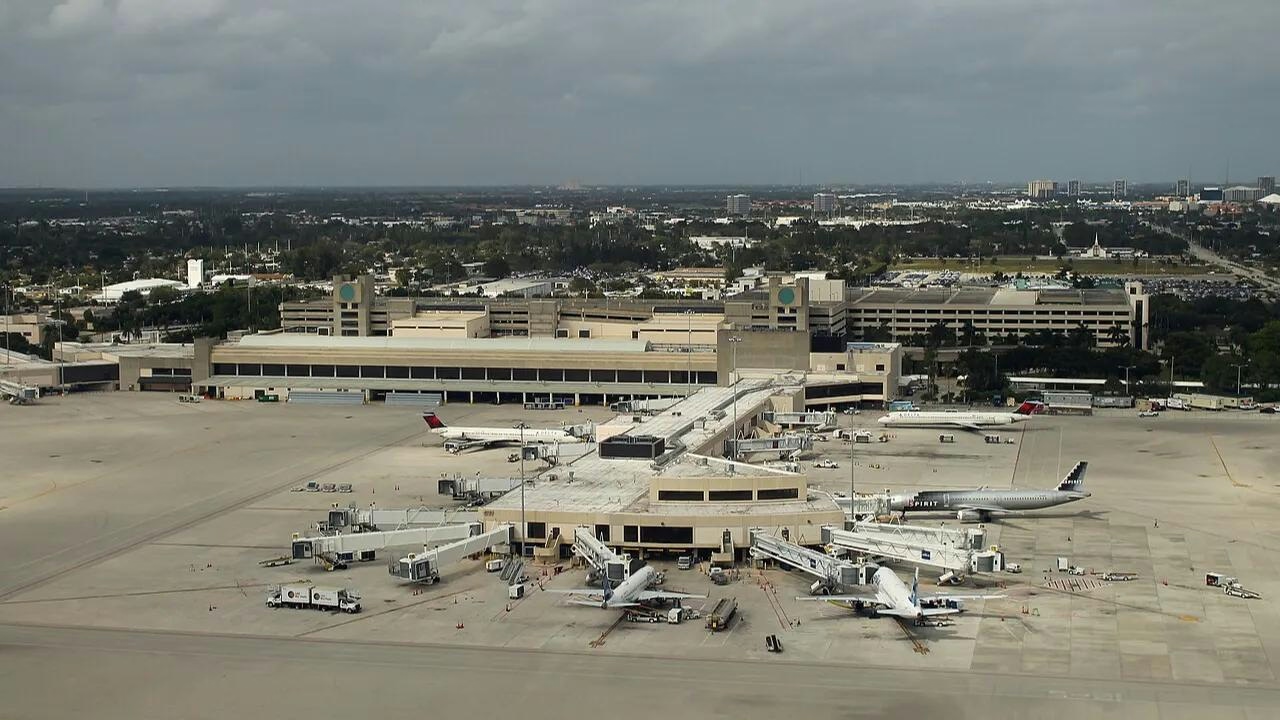
IATA Projects Record $41 Billion Airline Profit in 2026 Amid Ongoing Industry Challenges
The International Air Transport Association (IATA) has forecasted that global airlines will achieve a record net profit of $41 billion in 2026, an increase from $39.5 billion in 2025, while maintaining a net margin of 3.9%. This optimistic outlook is supported by strong air cargo performance and a weaker US dollar, which is expected to reduce costs for many carriers worldwide.
Revenue Growth and Regional Profitability
IATA anticipates total airline revenue to rise by 4.5% in 2026, reaching $1.053 trillion, outpacing the projected 4.2% increase in operating expenses. Passenger numbers are expected to climb to 5.2 billion, with an average load factor of 83.8%, while air cargo volumes are forecasted to reach 71.6 million tonnes. Passenger ticket revenue is projected at $751 billion, buoyed by a 4.9% increase in revenue passenger kilometers. Ancillary revenue is expected to total $145 billion, and cargo revenue $158 billion.
European airlines are predicted to lead in profitability, contributing $14 billion to the global total, surpassing North American carriers, who are expected to earn $11.3 billion. Despite these record profits, IATA Director General Willie Walsh emphasized that industry margins remain thin compared to other sectors. He noted that airlines support nearly 4% of the global economy and 87 million jobs but continue to face a significant profitability imbalance. “Apple will earn more selling an iPhone cover than the $7.90 airlines will make transporting the average passenger,” Walsh remarked, highlighting the ongoing challenges within the aviation value chain.
Industry Headwinds and Operational Constraints
Walsh described the profit forecast as “welcome news considering the headwinds that the industry faces,” including rising costs driven by aerospace supply-chain bottlenecks, geopolitical tensions, sluggish global trade, and increasing regulatory burdens. He credited airlines’ “shock-absorbing resilience” for sustaining stable profitability but warned that persistent supply-chain constraints and slower aircraft deliveries could hinder the industry’s capacity to meet growing demand. Aircraft backlogs are expected to increase as new orders outpace production, pushing the global fleet’s average age beyond 15 years and limiting efficiency gains to just 1%.
Fuel costs are projected to decline slightly to $252 billion in 2026, with Brent crude averaging $62 per barrel and jet fuel at $88 per barrel, accounting for 25.7% of total operating expenses. Non-fuel operating costs are expected to rise to $729 billion, with labor remaining the largest expense at 28%. Productivity challenges persist due to training bottlenecks and operational difficulties, while maintenance costs increase amid parts shortages and an aging fleet. Lease rates and airport charges also remain elevated.
IATA further noted that a weaker US dollar may enhance profitability for carriers with costs denominated in other currencies, as 55 to 60% of airline expenses are in US dollars. Regulatory costs continue to pose concerns, with proposed reforms to EU261 passenger compensation rules and rising infrastructure charges at major hubs. Operational challenges such as airspace restrictions, GNSS interference, and rerouting requirements also weigh heavily on airline efficiency.
Cargo Demand and Future Outlook
Despite these challenges, the industry is poised for record profits, driven largely by robust cargo demand, particularly from e-commerce and semiconductor shipments linked to artificial intelligence investments, as well as shifting trade flows influenced by the US tariff regime. However, IATA underscored that ongoing supply-chain disruptions and persistently thin margins necessitate continued resilience and adaptation across the aviation sector.

Etihad Airways Suspends Airbus A380 Flights on Key Route

Aditya Birla Group Seeks Approval for Aircraft Leasing in GIFT City

Qatar Airways Highlights Innovation and Connectivity at Arabian Travel Market 2026

Hong Kong's Five-Year Plan Includes Andrew Fan's Aircraft Parts Processing Hub Proposal

ACIA Aero Leasing Delivers ATR72-600 to Air Nostrum

RTX Appoints Jill Albertelli as Head of Pratt & Whitney

TAT Technologies Joins Beyond Aero Hydrogen Aircraft Program

AURAK Study Highlights Barriers to Air Taxi Adoption in Emerging Economies

Xiamen Air Selects Altitude for 787 Maintenance at Heathrow

Etihad and Swissport Extend Global Partnership
