
Orchestrer les insights d’IA pour les transformer en actions

Tendances
Categories
Inside the $46 Billion Backlog Facing Major Business Aircraft Manufacturers
Inside the $46 Billion Backlog Facing Major Business Aircraft Manufacturers
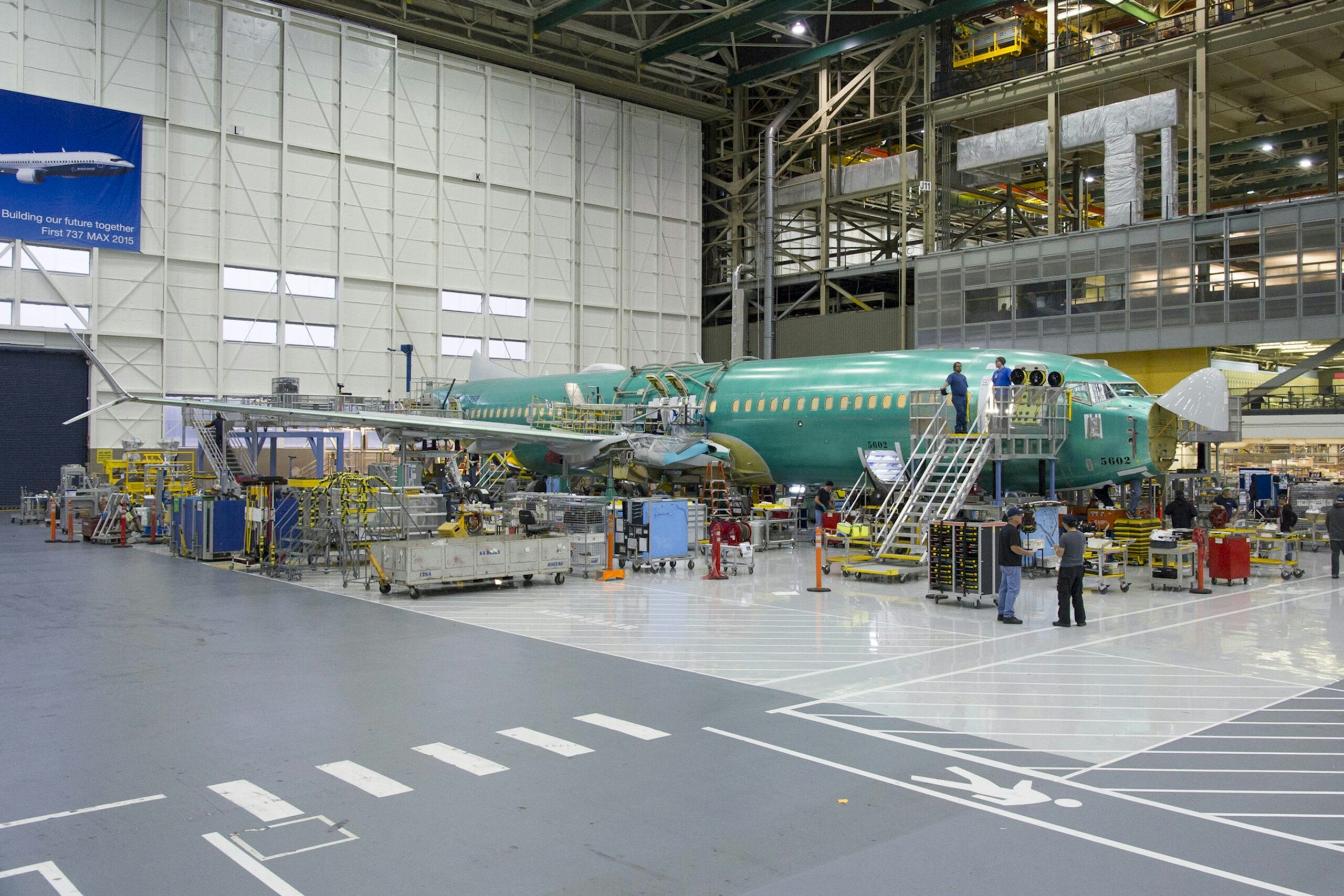
Major business aircraft manufacturers are currently contending with an unprecedented $46 billion backlog, highlighting both the strength of demand and the growing operational challenges within the sector. Recent financial disclosures from Bombardier and Gulfstream, the leading entities in the large and ultra-long-range jet markets, illustrate a landscape where incoming orders significantly outpace production capacity. This imbalance raises critical questions about the industry’s ability to fulfill commitments and sustain future expansion.
Backlog Growth and Market Dynamics
Bombardier’s backlog stood at $14.2 billion at the close of 2023, with a book-to-bill ratio of 1.0x, signaling a balance between new orders and deliveries. Early 2024 saw a modest increase to $14.4 billion, followed by a sharp rise to $17.5 billion by the end of 2025, as the book-to-bill ratio climbed to 1.4x. The momentum intensified in 2026; by the end of the first quarter, Bombardier’s backlog reached $20.3 billion, accompanied by a remarkable book-to-bill ratio of 3.6x. This ratio implies that for every 24 aircraft delivered, approximately 86 new orders were received. By the end of the second quarter, the backlog expanded further to $21.8 billion, representing a 25 percent increase within six months.
Gulfstream’s backlog trajectory has been somewhat steadier but similarly upward. Its Aerospace segment backlog was $19.5 billion at the end of 2022, with a book-to-bill ratio of 1.5x. This figure rose to $20.5 billion in 2023 before dipping slightly to $19.7 billion in 2024, as record deliveries absorbed new orders. By the end of 2025, the backlog rebounded to $21.8 billion. The first half of 2026 witnessed the strongest order intake in four years, with the backlog reaching $24.0 billion by the second quarter and a quarterly book-to-bill ratio of 1.5x.
The surge in orders is concentrated predominantly at the upper end of the market. Neither Bombardier nor Gulfstream competes in the light or midsize jet segments, which are largely dominated by Textron and Embraer. Instead, both manufacturers focus on super-midsize, large, super-large, and ultra-long-haul jets—market segments that have demonstrated particular resilience. Gulfstream’s growth is now almost exclusively driven by large-cabin aircraft, with 85 percent of its second-quarter deliveries falling into this category. Similarly, Bombardier’s recent gains have been propelled by its largest-cabin models.
Operational Challenges and Industry Implications
While the record backlog underscores robust demand, it also introduces significant risks. As manufacturers continue to sell aircraft faster than they can produce them, the primary challenge shifts from stimulating demand to effectively executing orders. Persistent supply chain disruptions, labor shortages, and limitations in industrial capacity threaten to prolong lead times and increase working capital requirements.
Market responses to these challenges have been varied. Companies such as Howmet Aerospace report strong build rates alongside record backlogs, suggesting operational resilience. Conversely, firms like TAT Technologies acknowledge the risks but maintain confidence in their outlook despite potential execution hurdles.
In response to these dynamics, Bombardier has emphasized operational milestones as it manages its expanding backlog, while Gulfstream’s leadership has described recent order intake as the strongest in several years. The industry’s capacity to navigate these operational headwinds will be critical in converting the substantial backlog into revenue and sustaining growth in the coming years.

Etihad Airways Suspends Airbus A380 Flights on Key Route

Aditya Birla Group Seeks Approval for Aircraft Leasing in GIFT City

Qatar Airways Highlights Innovation and Connectivity at Arabian Travel Market 2026

Hong Kong's Five-Year Plan Includes Andrew Fan's Aircraft Parts Processing Hub Proposal

ACIA Aero Leasing Delivers ATR72-600 to Air Nostrum

RTX Appoints Jill Albertelli as Head of Pratt & Whitney

TAT Technologies Joins Beyond Aero Hydrogen Aircraft Program

AURAK Study Highlights Barriers to Air Taxi Adoption in Emerging Economies

Xiamen Air Selects Altitude for 787 Maintenance at Heathrow

Etihad and Swissport Extend Global Partnership
