
Orchestrer les insights d’IA pour les transformer en actions

Tendances
Categories
Inside the Airbus A350F’s Cargo Door Designed to Accommodate Jet Engines
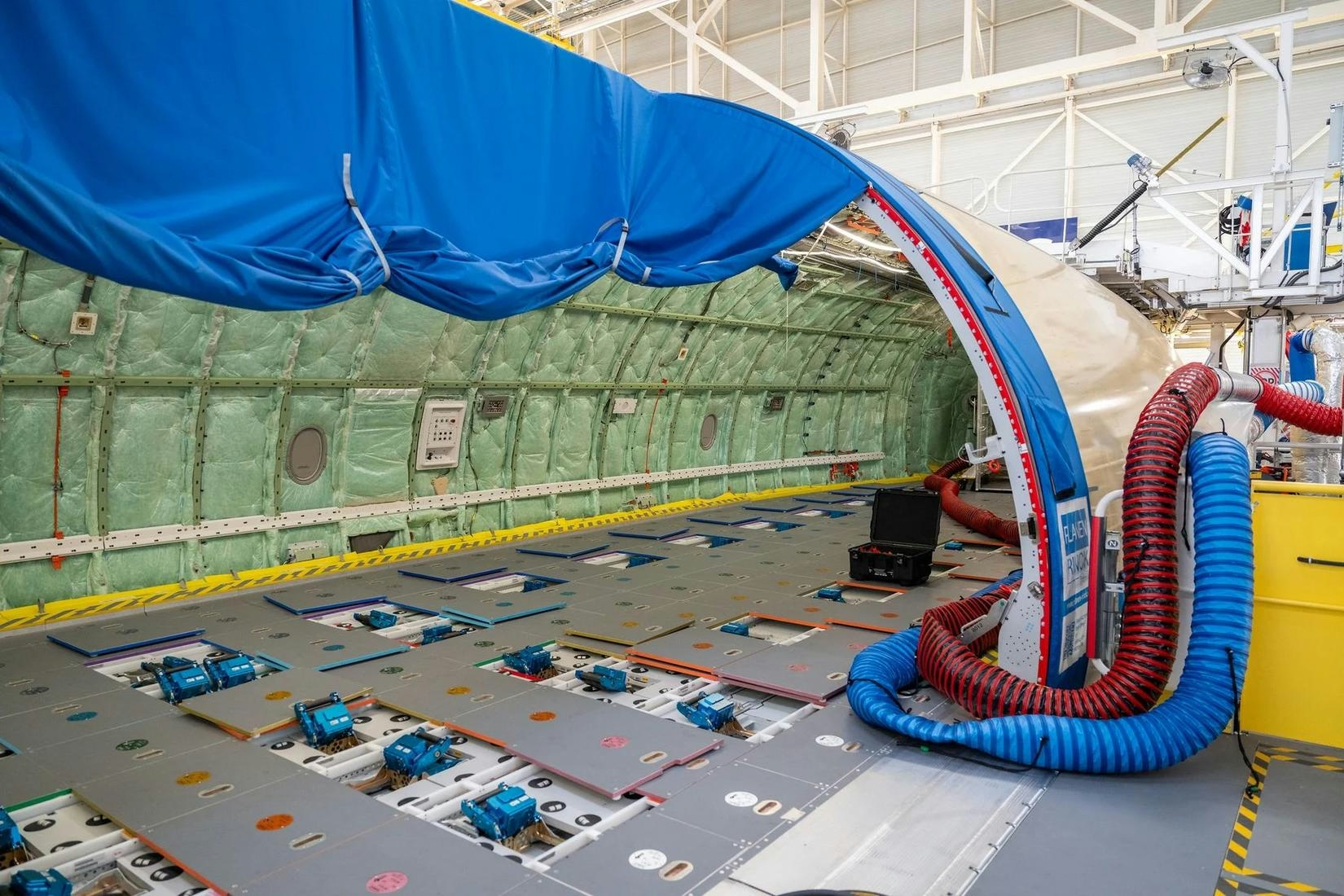
Inside the Airbus A350F’s Cargo Door Designed to Accommodate Jet Engines
When Airbus revealed the main deck cargo door for its new A350F freighter, the dimensions immediately captured attention: approximately 14.7 feet (4.5 meters) wide and 14.1 feet (4.3 meters) high, large enough to accommodate entire jet engines. However, the true engineering accomplishment extends beyond the door’s sheer size. The primary challenge lay in integrating such a substantial opening into a pressurized aircraft fuselage without compromising safety, structural integrity, or durability.
This engineering feat is central to Airbus’s strategy to compete with Boeing in the long-haul freighter market. The A350F is engineered to carry a payload of around 245,000 pounds (111,000 kilograms), promising enhanced efficiency and reduced emissions. These benefits, however, depend heavily on the aircraft’s capacity to reliably transport oversized cargo, a mission contingent on the flawless operation of its complex cargo door through thousands of flight cycles.
Engineering a Door in a Pressurized Fuselage
Aircraft fuselages operate as pressurized cylinders, maintaining cabin pressure significantly higher than the external atmosphere at cruising altitudes. This pressure differential generates outward forces distributed across the fuselage structure, enabling it to bear loads efficiently with minimal weight. The skin, frames, and stringers collectively resist circumferential and longitudinal stresses, forming a lightweight yet robust shell.
Introducing a garage-sized opening for the cargo door disrupts this structural equilibrium. Removing such a large section of load-bearing skin creates concentrated stresses at the door’s edges, which can lead to fatigue damage as the aircraft undergoes repeated pressurization and depressurization cycles. To mitigate these effects, Airbus engineers redesigned the load paths surrounding the door. Reinforced frames, longitudinal beams, and localized strengthening elements now redirect forces smoothly around the opening, while carefully contoured edges reduce stress concentrations.
Advanced materials are integral to this solution. The A350F, derived from the A350 passenger jet, extensively employs carbon-fiber-reinforced polymer instead of traditional aluminum. This composite construction allows engineers to tailor the structure precisely, aligning fibers to carry loads efficiently and reinforcing only where necessary. Composites also offer reduced weight, enhanced fatigue resistance, and superior corrosion protection—critical advantages for aircraft subjected to high-cycle freighter operations.
Challenges of Composite Structures
While composites provide significant benefits, they also introduce unique complexities. Unlike aluminum, which exhibits gradual deformation before failure, composite materials are less forgiving and can suffer damage such as delamination or fiber breakage with minimal visible warning. This characteristic makes the design and integration of large structural openings, such as the A350F’s cargo door, particularly demanding. The process requires meticulous engineering and manufacturing precision to ensure safety and longevity.
Market Response and Industry Implications
Despite these technical challenges, the market response to the A350F has been encouraging. Air China Cargo recently confirmed additional orders, reflecting strong confidence in the aircraft’s capabilities and the reliability of its innovative cargo door. Concurrently, the competitive landscape is evolving, with companies like ITP Aero expanding their roles in the geared turbofan (GTF) aftermarket to support new-generation aircraft such as the A350F. This development highlights the broader industry effort to enhance support and operational capabilities for advanced freighters entering service.
The success of the A350F—and its ability to safely and efficiently transport oversized cargo—ultimately depends on the seamless integration of cutting-edge materials, structural innovation, and precise engineering, all exemplified by its remarkable cargo door.

Etihad Airways Suspends Airbus A380 Flights on Key Route

Aditya Birla Group Seeks Approval for Aircraft Leasing in GIFT City

Qatar Airways Highlights Innovation and Connectivity at Arabian Travel Market 2026

Hong Kong's Five-Year Plan Includes Andrew Fan's Aircraft Parts Processing Hub Proposal

ACIA Aero Leasing Delivers ATR72-600 to Air Nostrum

RTX Appoints Jill Albertelli as Head of Pratt & Whitney

TAT Technologies Joins Beyond Aero Hydrogen Aircraft Program

AURAK Study Highlights Barriers to Air Taxi Adoption in Emerging Economies

Xiamen Air Selects Altitude for 787 Maintenance at Heathrow

Etihad and Swissport Extend Global Partnership
