
Orchestrer les insights d’IA pour les transformer en actions

Tendances
Categories
Market Analysis of Aircraft Weighing Scales
Market Analysis of Aircraft Weighing Scales
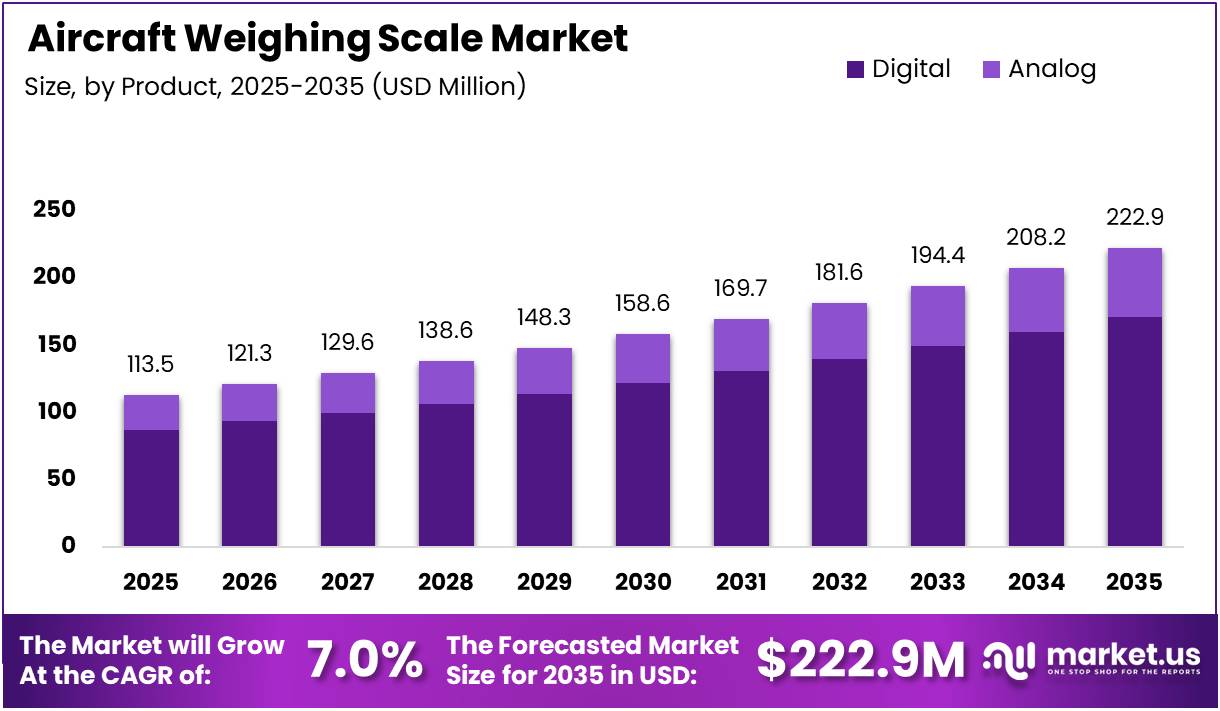
The global market for aircraft weighing scales is poised for significant growth, with projections estimating a rise from USD 113.5 million in 2025 to approximately USD 222.9 million by 2035. This expansion corresponds to a compound annual growth rate (CAGR) of 7.0% between 2026 and 2035. Aircraft weighing scales are critical precision instruments used to determine the weight and balance of aircraft, a fundamental aspect of aviation safety and regulatory compliance.
These weighing systems encompass a variety of types, including platform scales, floor-standing units, and load-cell jack systems. They are extensively utilized across commercial airports, military airbases, and Maintenance, Repair, and Overhaul (MRO) facilities. Their primary role is to ensure that aircraft conform to stringent safety and load compliance standards prior to every flight, thereby supporting airworthiness and the accurate maintenance of weight-and-balance records. Regulatory bodies worldwide mandate regular weight verification for all aircraft categories, sustaining a steady demand for certified, high-accuracy weighing equipment.
Market Dynamics and Emerging Trends
The aircraft weighing scale market is undergoing a technological transformation, with a marked shift toward advanced digital and smart weighing solutions. This evolution is driven by increasingly rigorous aviation safety standards and the growing necessity for comprehensive data logging capabilities. Government investments in aviation infrastructure, including the expansion of military fleets and the development of new commercial airports, are further stimulating market growth. Consequently, both public and private aviation sectors are intensifying their procurement of compliant, high-capacity weighing systems.
An additional factor influencing the market is the rise of C4ISR (Command, Control, Communications, Computers, Intelligence, Surveillance, and Reconnaissance) aircraft. These specialized platforms require enhanced situational awareness, which in turn demands more sophisticated and reliable weighing technologies. This trend is encouraging manufacturers to invest in technological upgrades and to develop customized solutions tailored to specific operational requirements.
Competitive Landscape and Market Segmentation
The competitive environment within the aircraft weighing scale market is increasingly polarized between commoditized products and bespoke solutions. While some companies focus on standardized, high-volume offerings, others differentiate themselves by providing tailored technologies. For instance, Minebea Intec has demonstrated its commitment to customization by showcasing specialized weighing systems at industry events such as interpack 2026. This strategic approach is expected to intensify as operators prioritize precision and reliability in their weighing equipment.
In terms of market segmentation, platform scales dominate, accounting for 63.8% of the market share in 2025. Their capacity to support aircraft weighing up to 80,000 pounds per unit makes them the preferred choice for servicing large commercial aircraft. Floor-standing scales, although representing a smaller segment, are gaining prominence in military and regional aviation sectors. Digital scales lead the product category with a 76.2% market share in 2025, reflecting the industry's shift toward enhanced accuracy and integrated data management. Commercial aviation remains the largest application segment, comprising 68.3% of the market in 2025. Regionally, North America holds a commanding lead with a 45.8% market share, valued at USD 51.9 million in 2025.
Technical Standards and Outlook
Professional aircraft weighing scales are subject to stringent calibration and accuracy requirements, maintaining precision within ±0.1% of the applied load—ten times more exacting than typical non-aviation scales. Platform scales can accommodate weights up to 80,000 pounds per unit, while top-of-jack load-cell systems are capable of weighing entire aircraft up to 450,000 pounds when configured with multiple load cells.
As aviation safety regulations become more stringent and operational demands grow increasingly complex, the need for advanced, reliable, and customized aircraft weighing solutions is expected to rise. Market participants are anticipated to continue investing in technological innovation and strategic differentiation to address the evolving requirements of the aviation industry.

Etihad Airways Suspends Airbus A380 Flights on Key Route

Aditya Birla Group Seeks Approval for Aircraft Leasing in GIFT City

Qatar Airways Highlights Innovation and Connectivity at Arabian Travel Market 2026

Hong Kong's Five-Year Plan Includes Andrew Fan's Aircraft Parts Processing Hub Proposal

ACIA Aero Leasing Delivers ATR72-600 to Air Nostrum

RTX Appoints Jill Albertelli as Head of Pratt & Whitney

TAT Technologies Joins Beyond Aero Hydrogen Aircraft Program

AURAK Study Highlights Barriers to Air Taxi Adoption in Emerging Economies

Xiamen Air Selects Altitude for 787 Maintenance at Heathrow

Etihad and Swissport Extend Global Partnership
