
Orchestrer les insights d’IA pour les transformer en actions

Tendances
Categories
MIT Project Evolves into $850 Million Ohio Factory for Eight-Motor Hybrid Aircraft
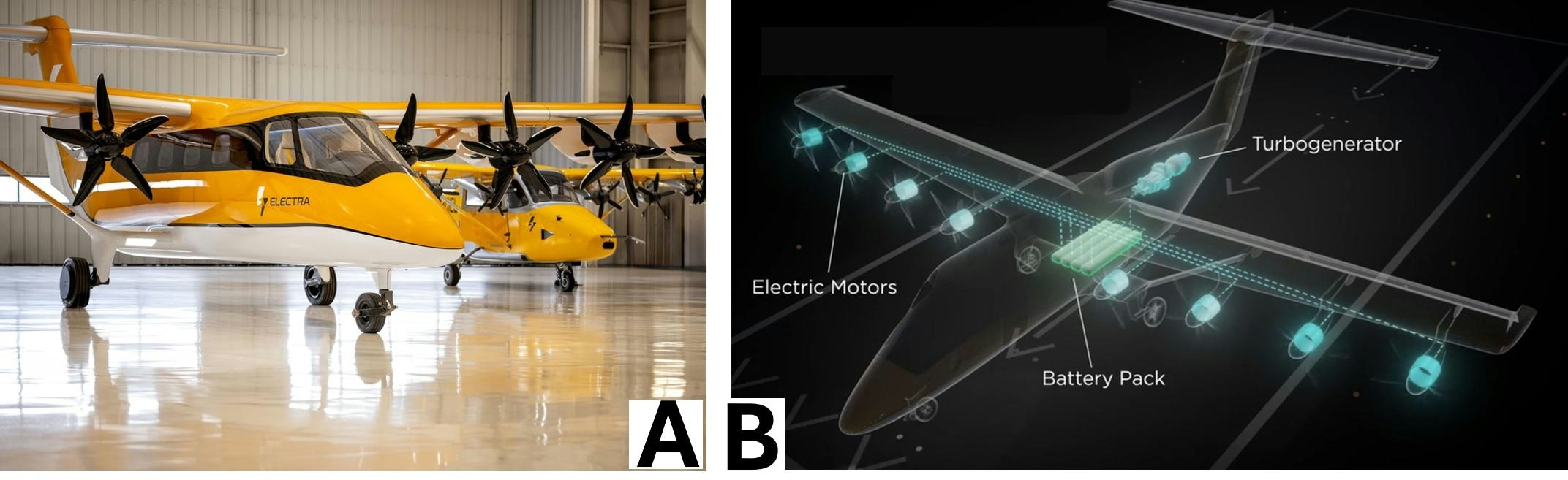
MIT Project Develops into $850 Million Ohio Factory for Innovative Eight-Motor Hybrid Aircraft
A pioneering initiative that began as a classroom project at the Massachusetts Institute of Technology (MIT) has evolved into an ambitious $850 million plan to establish a manufacturing facility in Ohio. The factory will produce a novel hybrid aircraft developed by Electra, a company founded by MIT alumni and faculty. This aircraft, distinguished by its eight electric motors, is engineered to take off and land within remarkably small spaces—comparable to the size of a soccer field—offering the potential to revolutionize regional air travel.
From Classroom Concept to Advanced Hybrid Design
The aircraft concept originated in 2017 during MIT’s course 16.886 Air Transportation Systems Architecting, where graduate students, including Chris Courtin (SM ’19, PhD ’24), investigated alternatives to the increasingly prevalent electric vertical takeoff and landing (eVTOL) aircraft. Their research combined lightweight electric motors and batteries with a fixed-wing design, culminating in what Electra now terms an ultra-short takeoff and landing (ultra-STOL) aircraft.
Electra’s design diverges from traditional aircraft by employing a gas-powered generator located in the nose to supply electricity to eight motors distributed along the wings. During takeoff and landing phases, both the generator and onboard batteries provide power to the motors. At cruising altitude, the generator alone supplies most of the energy while simultaneously recharging the batteries. This configuration allows the gas engine to operate efficiently during cruise, avoiding the high power demands typically required for takeoff.
A critical innovation lies in the aircraft’s “blown-lift” effect, whereby the eight motors direct airflow over the wings to generate sufficient lift for operations on significantly shorter runways than those required by conventional planes. This capability could overcome a major obstacle in regional air travel by enabling flights to operate from locations much closer to passengers’ points of origin and destination, reducing reliance on large airports.
Advancing Toward Production Amid Industry Challenges
The aircraft is designed to accommodate nine passengers, achieve a range of up to 1,200 miles, and cruise at approximately 200 miles per hour. The project has progressed from initial classroom experiments and wind tunnel testing to the development of real-world prototypes, supported by aerospace entrepreneur John Langford and MIT professors Mark Drela and John Hansman.
Despite these advances, transitioning from prototype to full-scale production presents significant challenges. Constructing an $850 million manufacturing facility in Ohio will necessitate securing a skilled workforce, managing substantial capital investment, and maintaining technological competitiveness in a rapidly evolving aerospace sector. Industry analysts suggest that established manufacturers may approach Electra’s market entry with skepticism, questioning the new facility’s ability to compete at scale. In response, incumbent competitors may intensify their own investments in manufacturing capabilities and innovation to protect their market positions.
As Electra advances its plans, the company aspires to make regional air travel quieter, faster, and more accessible. Should these efforts succeed, the project could herald a transformative shift in short-distance air transportation, bringing the vision that originated in an MIT classroom closer to practical realization.

Etihad Airways Suspends Airbus A380 Flights on Key Route

Aditya Birla Group Seeks Approval for Aircraft Leasing in GIFT City

Qatar Airways Highlights Innovation and Connectivity at Arabian Travel Market 2026

Hong Kong's Five-Year Plan Includes Andrew Fan's Aircraft Parts Processing Hub Proposal

ACIA Aero Leasing Delivers ATR72-600 to Air Nostrum

RTX Appoints Jill Albertelli as Head of Pratt & Whitney

TAT Technologies Joins Beyond Aero Hydrogen Aircraft Program

AURAK Study Highlights Barriers to Air Taxi Adoption in Emerging Economies

Xiamen Air Selects Altitude for 787 Maintenance at Heathrow

Etihad and Swissport Extend Global Partnership
