
Orchestrer les insights d’IA pour les transformer en actions

Tendances
Categories
M&M Pursues Global Aerospace Acquisitions Amid Supply Chain Challenges
M&M Pursues Global Aerospace Acquisitions Amid Supply Chain Challenges
Expanding Role in a Volatile Aerospace Sector
Mahindra & Mahindra (M&M) is actively pursuing acquisitions within the global aerospace supply chain as leading aircraft manufacturers increasingly seek its support to address persistent production bottlenecks. The aerospace industry is currently navigating a period of heightened supply chain volatility, driven by geopolitical disruptions, evolving trade dynamics, and structural shifts in transportation capacity. These factors have collectively intensified challenges in meeting delivery schedules for new aircraft.
Anish Shah, Group CEO and Managing Director of Mahindra, disclosed that global original equipment manufacturers (OEMs) have approached the company to assume a larger role in mitigating supply chain disruptions. Speaking during a recent earnings call, Shah emphasized that OEMs are not only placing orders but are also looking to Mahindra for scalable, high-quality supply solutions amid widespread supplier difficulties. “More than orders, we've got global OEMs looking at us saying, ‘You deliver very high quality, can you scale up and can we rely on you as our supplier?’ because they're facing challenges,” he stated.
Although Shah did not specify the OEMs involved, industry analysts highlight Airbus as a key partner that has significantly expanded its collaboration with Mahindra Aerostructures over the past year. Despite a backlog of confirmed aircraft orders extending over a decade, manufacturers continue to struggle with delivery delays caused by smaller suppliers who lack the capacity and resources to invest adequately in quality and production scale.
Challenges and Strategic Responses
The current supply chain environment is further complicated by factors such as supplier concentration, long lead times for critical components, limited testing infrastructure, and protracted qualification processes. In the United States, for instance, declining imports amid tariff pressures and global market volatility are reshaping supply chain configurations, adding layers of complexity for aerospace companies worldwide.
Shah revealed that OEMs are actively encouraging acquisition-led consolidation within the supply chain. “They're telling us, ‘Can you come in and acquire, we'll help you acquire?’” he explained, noting that Mahindra is maintaining stringent return expectations before committing to such deals. “If we do acquire, you need to guarantee our returns for five years. They said, ‘We will do that but we want you to come in.’”
These developments highlight the increasing strategic significance of Mahindra’s aerospace division, which has emerged as one of the group’s fastest-growing sectors. Over the past year, the aerospace unit secured nearly $1 billion in orders, a remarkable increase compared to approximately $150 million accumulated over the previous 12 to 15 years. Shah expressed confidence in the company’s trajectory, stating, “Our aspiration for our aerospace business is to be among the Top 5 aerostructures companies in the world. It's feasible that in the next three to five years we can actually get there as well.”
Strengthening Partnerships and Future Prospects
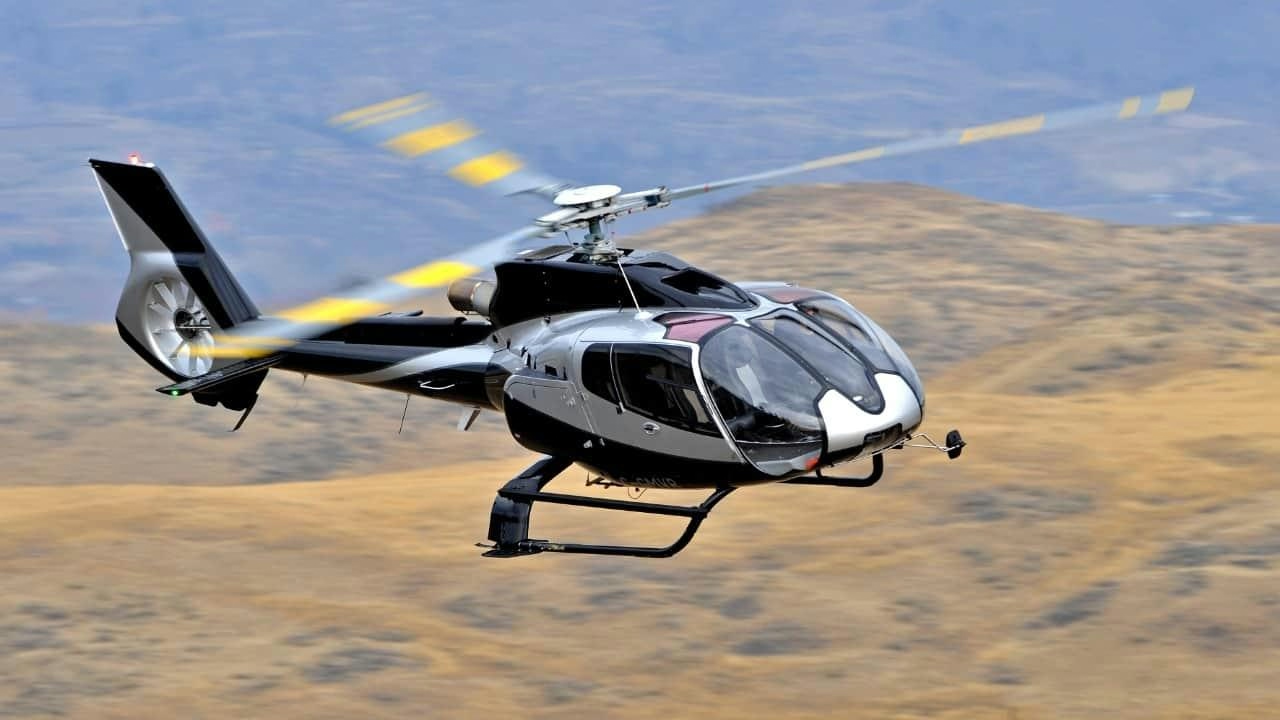
Mahindra’s ambitions have been reinforced by recent contract wins with Airbus. In April 2025, Airbus Helicopters awarded Mahindra Aerostructures a contract to manufacture the main fuselage assembly for the H130 helicopter, marking a significant advancement from component manufacturing to complex aerostructures. This partnership was further deepened in August 2025 when Mahindra was selected as an additional source for the main fuselage of the best-selling H125 helicopter.
As the aerospace sector continues to grapple with supply chain disruptions, competitors are investing heavily in automation, innovation, and digitalization to sustain their competitive advantage. For Mahindra, strategic acquisitions combined with deepening collaborations with global OEMs may prove critical in navigating ongoing turbulence and realizing its global growth ambitions.

Etihad Airways Suspends Airbus A380 Flights on Key Route

Aditya Birla Group Seeks Approval for Aircraft Leasing in GIFT City

Qatar Airways Highlights Innovation and Connectivity at Arabian Travel Market 2026

Hong Kong's Five-Year Plan Includes Andrew Fan's Aircraft Parts Processing Hub Proposal

ACIA Aero Leasing Delivers ATR72-600 to Air Nostrum

RTX Appoints Jill Albertelli as Head of Pratt & Whitney

TAT Technologies Joins Beyond Aero Hydrogen Aircraft Program

AURAK Study Highlights Barriers to Air Taxi Adoption in Emerging Economies

Xiamen Air Selects Altitude for 787 Maintenance at Heathrow

Etihad and Swissport Extend Global Partnership
