
Orchestrer les insights d’IA pour les transformer en actions

Tendances
Categories
Nakajima G10N Fugaku: Japan’s Long-Range Bomber Designed to Reach America
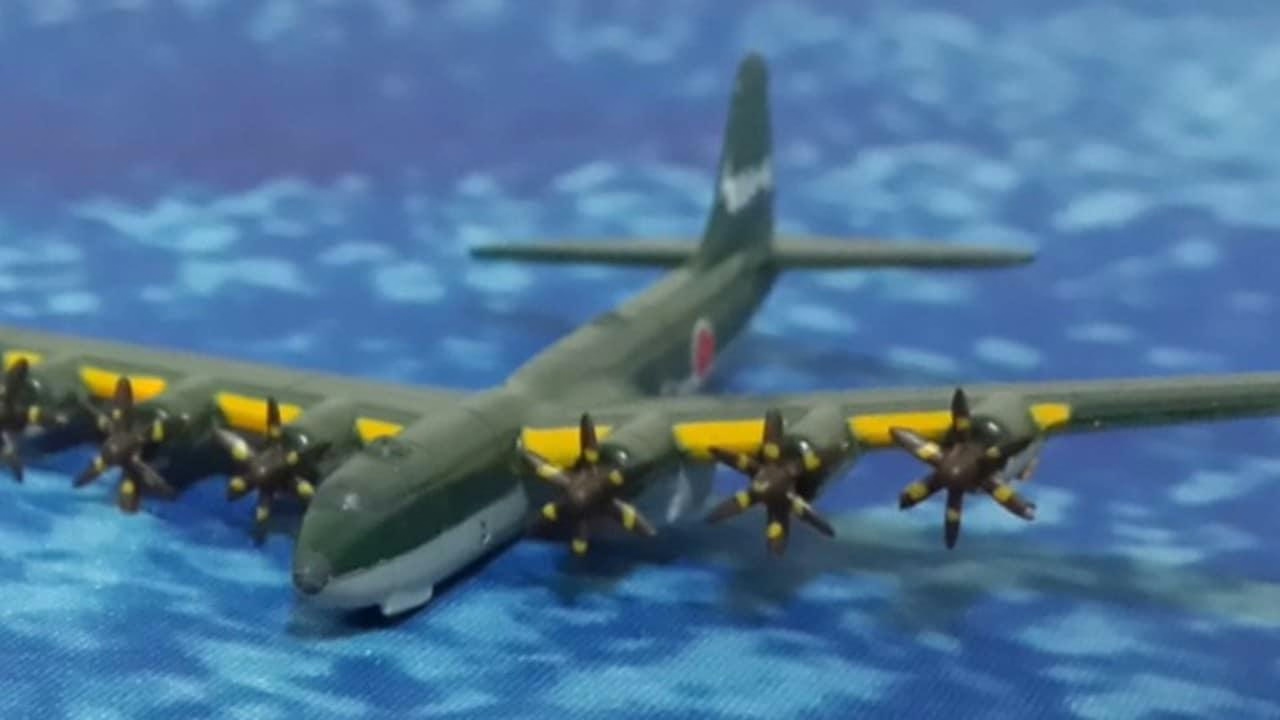
Nakajima G10N Fugaku: Japan’s Long-Range Bomber Designed to Reach America
An Ambitious Vision Amidst Wartime Adversity
In 1942, as the tide of the Pacific War increasingly turned against Japan, military strategists conceived an aircraft of extraordinary ambition: the Nakajima G10N Fugaku. Named after Japan’s iconic Mount Fuji, this ultra-long-range heavy bomber was designed to undertake a mission of unprecedented scale. The plan envisioned the Fugaku taking off from the Kuril Islands, crossing the vast expanse of the Pacific Ocean to bomb American industrial centers, and then continuing westward to land in Nazi-occupied France. This single, globe-spanning operation reflected the extreme lengths to which Japan’s military planners were willing to go in pursuit of strategic advantage. Although the Fugaku never progressed beyond the design phase, its conceptualization remains a striking example of wartime innovation and ambition.
Design and Technical Specifications
The Fugaku was the centerpiece of “Project Z,” an Imperial Japanese Army initiative aimed at developing a true intercontinental bomber. The aircraft’s proposed dimensions were staggering for the era, featuring a wingspan of approximately 207 feet (63 meters) and a length of around 131 feet (40 meters). Powered by six engines equipped with contra-rotating propellers, the bomber was projected to achieve a top speed of 485 miles per hour, operate at altitudes up to 49,000 feet, and carry a bomb load of up to 44,000 pounds. Its estimated range of 12,000 miles would have enabled it to traverse the Pacific and Atlantic Oceans in a single mission, a feat unmatched by contemporary aircraft.
Despite these impressive specifications, the Fugaku’s development was hindered by significant technical and industrial challenges. The complexity of the required engines and the strain on Japan’s wartime manufacturing capacity proved insurmountable. By 1943, when the project formally commenced, Japan’s resources were already heavily committed to ongoing military operations. Although plans for production facilities were drawn up, the program was ultimately cancelled in 1944 before any prototype could be constructed.
Strategic Context and Competitive Challenges
Had the Fugaku advanced to operational status, it would have entered a competitive field dominated by formidable long-range bombers such as the American B-52 Stratofortress and the Russian Tu-22M3. Matching or exceeding the capabilities of these aircraft would have presented considerable technological and strategic obstacles. Contemporary analysts, and indeed modern observers, have expressed skepticism regarding Japan’s capacity to produce a bomber on par with its American and Soviet counterparts, particularly given the industrial limitations and recent setbacks experienced by those nations’ bomber programs. It is likely that rival powers would have responded to the Fugaku’s emergence by emphasizing the technological sophistication and strategic advantages of their own fleets, thereby minimizing the perceived threat posed by Japan’s ambitious design.
Enduring Legacy
Although the Nakajima G10N Fugaku never materialized beyond blueprints and scale models, it endures as a symbol of wartime desperation and visionary engineering. The project encapsulates the extraordinary lengths to which nations will go in pursuit of strategic dominance, serving as a poignant reminder of the intersection between innovation and the harsh realities of war.

Etihad Airways Suspends Airbus A380 Flights on Key Route

Aditya Birla Group Seeks Approval for Aircraft Leasing in GIFT City

Qatar Airways Highlights Innovation and Connectivity at Arabian Travel Market 2026

Hong Kong's Five-Year Plan Includes Andrew Fan's Aircraft Parts Processing Hub Proposal

ACIA Aero Leasing Delivers ATR72-600 to Air Nostrum

RTX Appoints Jill Albertelli as Head of Pratt & Whitney

TAT Technologies Joins Beyond Aero Hydrogen Aircraft Program

AURAK Study Highlights Barriers to Air Taxi Adoption in Emerging Economies

Xiamen Air Selects Altitude for 787 Maintenance at Heathrow

Etihad and Swissport Extend Global Partnership
