
Orchestrer les insights d’IA pour les transformer en actions

Tendances
Categories
Northrop Grumman Tests Mid-Flight Autonomy Software Swap on Talon IQ
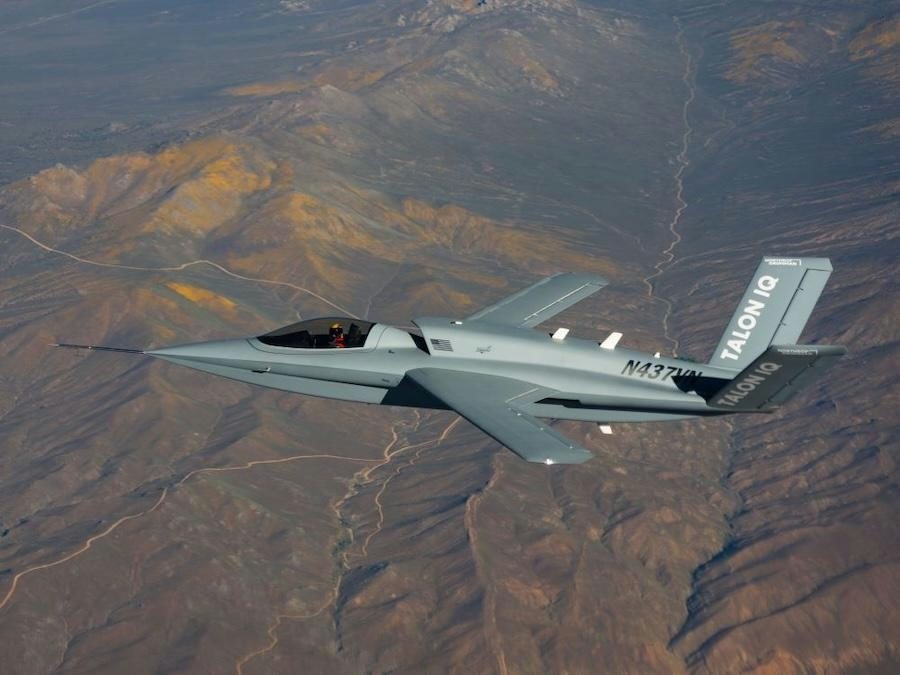
Northrop Grumman Advances Autonomous Flight with Mid-Flight Software Swap on Talon IQ
Northrop Grumman has marked a significant advancement in autonomous flight technology by successfully executing a mid-flight autonomy software swap on its Talon IQ testbed. Utilizing the company’s Prism Mission Autonomy software, the demonstration highlighted the capability to seamlessly transition between autonomy systems from multiple providers without interrupting flight operations.
Demonstration of Modular Autonomy Systems
The Talon IQ aircraft, derived from the Scaled Composites Model 437, initially operated under Northrop Grumman’s Prism software before dynamically switching mid-air to autonomy systems developed by Applied Intuition and Accelint. Beyond switching entire autonomy systems, the platform also demonstrated the ability to transition between individual autonomy “skills” without any degradation in operational performance. This capability underscores the open and modular architecture of the Talon IQ, designed to facilitate the integration of third-party autonomy solutions.
This modular framework aligns with the U.S. Air Force’s Autonomy Government Reference Architecture, which has recently been validated for use on competing Collaborative Combat Aircraft (CCA) platforms. The validation reflects a rapidly evolving and competitive market for autonomous systems, where interoperability and flexibility are increasingly critical.
Context Within the Autonomous Systems Market
Northrop Grumman’s demonstration arrives amid heightened scrutiny of the CCA market. Rival General Atomics recently faced setbacks following a drone wingman crash, resulting in a pause in flight tests and raising broader safety concerns within the industry. In contrast, Northrop Grumman continues to advance its autonomous and long-range strike capabilities, as evidenced by ongoing developments in the B-21 Raider program.
Craig Woolston, a senior executive at Northrop Grumman, emphasized the company’s commitment to accelerating software maturity and enhancing reliability. He noted that the Talon IQ ecosystem serves as a real-world, cost-effective testing platform, enabling companies to validate their autonomous technologies and drive the evolution of next-generation flight systems.
Strategic Importance of the Talon IQ Testbed
The Talon IQ testbed is a central element of Northrop Grumman’s Project Talon portfolio, which focuses on accelerating the development, integration, and testing of mission autonomy software. The system supports a broad spectrum of operations, including coordination between crewed and uncrewed platforms, as well as real-time routing and deconfliction with other aircraft in complex operational environments.
Beyond autonomous flight, Northrop Grumman’s broader strategy includes leveraging commercial launch providers such as SpaceX’s Falcon 9 for missions like the Cygnus cargo spacecraft launches to the International Space Station. This approach highlights the company’s engagement in an increasingly competitive landscape spanning both defense and space sectors.
Through the Talon IQ ecosystem, Northrop Grumman aims to enable rapid iteration and development of advanced autonomous capabilities, positioning itself at the forefront of future operational requirements in a dynamic and challenging market.

Etihad Airways Suspends Airbus A380 Flights on Key Route

Aditya Birla Group Seeks Approval for Aircraft Leasing in GIFT City

Qatar Airways Highlights Innovation and Connectivity at Arabian Travel Market 2026

Hong Kong's Five-Year Plan Includes Andrew Fan's Aircraft Parts Processing Hub Proposal

ACIA Aero Leasing Delivers ATR72-600 to Air Nostrum

RTX Appoints Jill Albertelli as Head of Pratt & Whitney

TAT Technologies Joins Beyond Aero Hydrogen Aircraft Program

AURAK Study Highlights Barriers to Air Taxi Adoption in Emerging Economies

Xiamen Air Selects Altitude for 787 Maintenance at Heathrow

Etihad and Swissport Extend Global Partnership
