
Orchestrer les insights d’IA pour les transformer en actions

Tendances
Categories
NTSB Finds Bird Remains in Engine After Ryanair Passenger Ejected Through Window
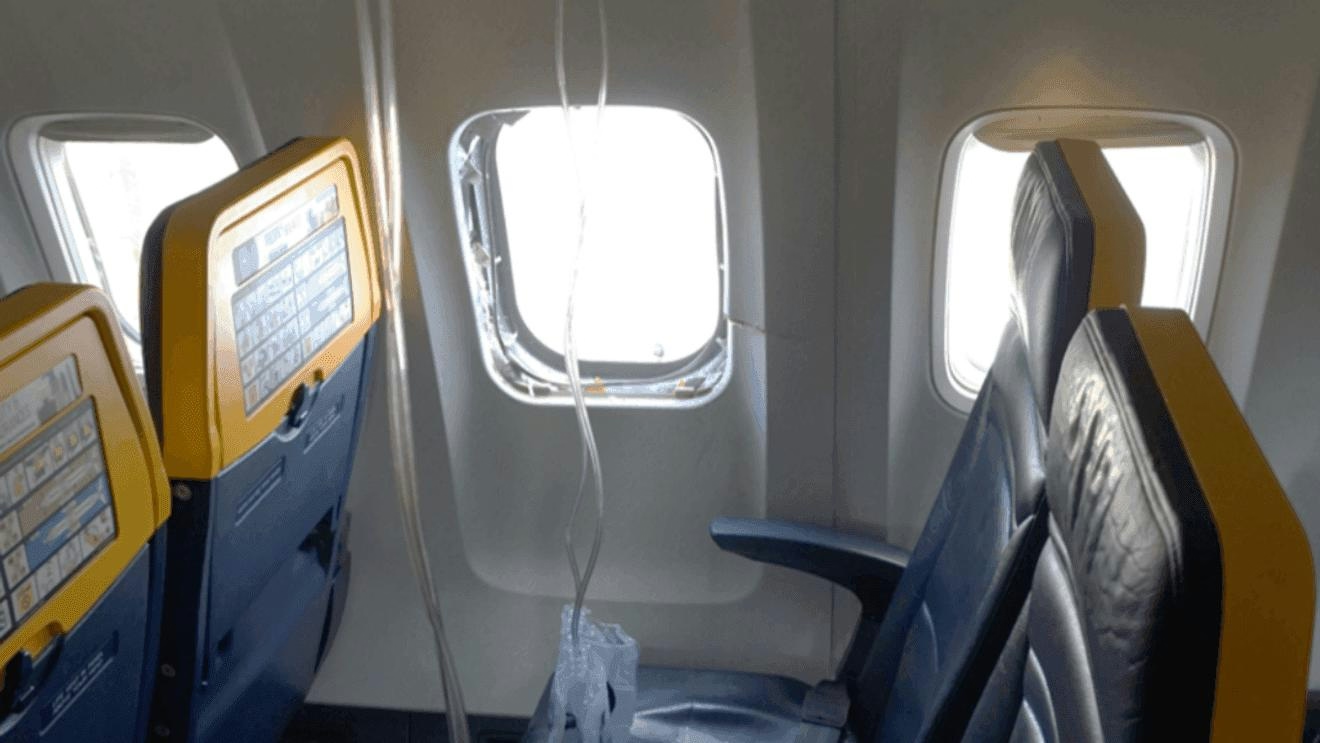
NTSB Identifies Bird Remains in Engine Following Ryanair Passenger’s Partial Ejection
Incident Overview
On July 10, a harrowing incident unfolded aboard Ryanair flight 1879, operated by Malta Air, shortly after its departure from Thessaloniki International Airport (SKG) in Greece. Serbian passenger Ljubisa Karović sustained severe injuries when his head and right shoulder were partially ejected through a shattered window. His wife reportedly held onto his legs, preventing a full ejection from the aircraft. The window was compromised by debris from the aircraft’s engine during its climb, prompting an emergency response and a subsequent four-hour delay. Passengers were eventually transferred to a replacement aircraft that completed the journey to Memmingen Airport (FMM).
Preliminary Findings and Investigation
The National Transportation Safety Board (NTSB) has released preliminary findings suggesting that a bird strike may have contributed to the incident. Investigators recovered bird remains, including feathers, from multiple locations within the affected Boeing 737-800 engine. These remains were found on the forward face of the IDG oil cooler, a thrust reverser blocker door drag link, and the lower section of the engine fan case. Both the bird remains and samples from the engine’s fan blades have been sent to the Smithsonian Institution Feather Identification Lab in Washington, DC, for detailed analysis.
The investigation further revealed that the engine had experienced four suspected bird strikes in the twelve months preceding the accident, with bird remains recovered after two of those events. Despite these prior incidents, ultrasonic inspections conducted in November 2025 and May 2026 reported no damage to the engine. However, during the July 10 flight, a fan blade detached, causing engine debris to strike and shatter the window adjacent to Karović, resulting in his partial ejection.
It remains uncertain whether the bird strike occurred during the accident flight or if earlier strikes contributed to the fan blade failure. The NTSB continues to examine the precise cause of the blade separation and its potential link to the engine’s history of bird strikes.
Responses from Ryanair and Regulatory Authorities
Ryanair CEO Michael O’Leary initially suggested that the incident was likely caused by “foreign object damage to the engine on takeoff at Thessaloniki,” though he did not clarify whether this referred to a bird or another object. NTSB Chair Jennifer Homendy responded by underscoring that no official determination had been made and criticized O’Leary for making public comments during an ongoing investigation. She cited violations of International Civil Aviation Organization (ICAO) protocols concerning the disclosure of information.
Ryanair’s chief executive, Eddie Wilson, adopted a more measured stance, acknowledging the severe damage to the engine and stating that the airline would await the conclusions of both the NTSB and Greek authorities before issuing further statements. Ryanair has declined to provide additional comments until the investigation is complete.
The NTSB’s inquiry remains active, focusing on all facets of the accident, including maintenance practices, the engine’s bird strike history, and the sequence of events leading to the catastrophic engine failure and subsequent passenger injury.

Etihad Airways Suspends Airbus A380 Flights on Key Route

Aditya Birla Group Seeks Approval for Aircraft Leasing in GIFT City

Qatar Airways Highlights Innovation and Connectivity at Arabian Travel Market 2026

Hong Kong's Five-Year Plan Includes Andrew Fan's Aircraft Parts Processing Hub Proposal

ACIA Aero Leasing Delivers ATR72-600 to Air Nostrum

RTX Appoints Jill Albertelli as Head of Pratt & Whitney

TAT Technologies Joins Beyond Aero Hydrogen Aircraft Program

AURAK Study Highlights Barriers to Air Taxi Adoption in Emerging Economies

Xiamen Air Selects Altitude for 787 Maintenance at Heathrow

Etihad and Swissport Extend Global Partnership
